Wednesday, 30 April 2014

WSJ: Likely Wall Street's reaction to the new policy statement

Yawn.
That is likely to be Wall Street’s collective reaction to the Federal Reserve’s latest policy meeting. The two-day confab, which ends with a policy statement but no press conference Wednesday afternoon, isn’t expected to contain any major changes. The Fed is expected to keep dialing back, or tapering, its bond-buying program by $10 billion. Economists also see the central bank maintaining a cautious stance on the economy.
Investors spent the better part of five years fixated on central-bank policy, thanks to the Fed pinning interest rates near zero and three rounds of quantitative easing. That has changed now.
At the beginning of the year the attention shifted to newly minted Fed chairman Janet Yellen. Investors wondered how she would handle the spotlight at these policy meetings, and whether she would continue the tapering trajectory that her predecessor, Ben Bernanke, had set.
Many of those questions have since been addressed.
“The excitement over Yellen’s first couple of meetings has worn off,” said Cameron Hinds, regional chief investment officer for Wells FargoWFC +0.36% Private Bank, which has $170 billion under management. “It’s clear they are tapering at a $10 billion pace barring some unforeseen development. The economy would really have to go off trend to stop the tapering process.”
That means this week’s meeting isn’t expected to be a market-moving event. There could be some immediate volatility once the Fed statement is released at 2:00 p.m. Eastern Time. Otherwise, the market’s recent grind is expected to continue.

WSJ: Highlights From the First-Quarter GDP Report

The Wall Street Journal reports, "consumer spending accounts for more than two-thirds of U.S. economic output, and it rose at a seasonally adjusted annual rate of 3.3% in the fourth quarter. It slowed in the first quarter, but not much, growing at a 3% pace. Spending on goods slowed to a 0.4% pace, but spending on services – like health care and energy – rose to a 4.4% pace. Personal consumption expenditures were the single biggest boost to economic output in the first three months of the year, and helped offset big drags on growth like trade.
Spending by businesses was another story. Fixed nonresidential investment fell at a 2.1% rate in the first quarter after surging 7.3% in 2012 and rising a more modest 2.7% in 2013. Spending on equipment fell at an annual pace of 5.5% in the first quarter of 2014, the worst drop since the second quarter of 2009, after rising at a 10.9% pace in the fourth quarter of 2013.
Net trade subtracted 0.83 percentage point from GDP growth in the first quarter as exports lagged and the trade gap widened. Exports fell at a 7.6% pace, the most since the recession ended in 2009. Trade had been a big boost to economic output in the second half of 2013, contributing 0.14 percentage point in the third quarter and 0.99 percentage point in the fourth quarter. Stay tuned, though: Trade data from March will be released by the Commerce Department next Tuesday, which could lead to significant revisions in GDP.
The U.S. housing recovery’s slowdown was a drag on GDP in the first quarter. Residential fixed investment — spending on home building and improvements — pulled down GDP growth to the tune of 0.18 percentage point in the first quarter after contributing 0.33 percentage point to GDP growth for all of last year.
A big buildup in private inventories helped boost economic output in the third quarter last year to a 4.1% annual rate. In the first quarter of 2014, by contrast, slowing inventories subtracted 0.57 percentage point from GDP growth. A measure of GDP that strips out inventory changes, final sales of domestic product, grew at a 0.7% pace in the first quarter, down from its 2.7% pace in the fourth quarter.

WSJ: Bill Gross: Expect Lower ‘Neutral’ Rates in the New Normal

     The Wall Street Journal reports"in the new normal, a world of excessive leverage and slower growth, a “neutral” interest-rate policy will by necessity produce lower rates than in previous business cycles, Pimco’s Bill Gross wrote in his monthly commentary, and understanding that is the key for investors of all asset classes".

“The old saying goes that when the U.S. economy sneezes, the world catches cold. That still seems to be true enough, although Chinese influenza is gaining in importance,” he wrote. The world saw what happened when the U.S. got a really, really bad cold in 2008. How to thread the needle today, keeping rates more or less neutral, but not too high to make debt servicing onerous, is a real trick. In a global economy with as much debt as the one we have today, “it’s important to realize that the price of money and the servicing cost of that leverage are critical for a healthy economy.”
"What this likely means, he concludes, is a lower “neutral” rate than we’ve seen in the past. At Pimco, we believe that this focus on the future “neutral” policy rate is the critical key to unlocking value in all asset markets,” he wrote. In a nutshell, he thinks a neutral fed funds rate may be closer to 2% than 4%. Understanding this would give a bond investor “the key to the kingdom,” he writes, but even holding that key comes at price, the price being lower returns across assets classes".
“So you say you need more? Join the club.” "Most pensions funds, he notes, assume total returns somewhere around 7-8%. “That won’t happen with a 2% neutral policy rate.” This will push investors into riskier assets".
“Bring a handkerchief in any case.”

Bureau of Economic Analysis U.S. Department of Commerce US GDP Increased 0.1% in Q1

GROSS DOMESTIC PRODUCT: FIRST QUARTER 2014 (ADVANCE ESTIMATE)

Real gross domestic product -- the output of goods and services produced by labor and property
located in the United States -- increased at an annual rate of 0.1 percent in the first quarter (that is, from
the fourth quarter of 2013 to the first quarter of 2014), according to the "advance" estimate released by
the Bureau of Economic Analysis. In the fourth quarter, real GDP increased 2.6 percent.
The increase in real GDP in the first quarter primarily reflected a positive contribution from 
personal consumption expenditures (PCE) that was partly offset by negative contributions from exports, 
private inventory investment, nonresidential fixed investment, residential fixed investment, and state and 
local government spending. Imports, which are a subtraction in the calculation of GDP, decreased. 
NOTE. Quarterly estimates are expressed at seasonally adjusted annual rates, unless otherwise 
specified. Quarter-to-quarter dollar changes are differences between these published estimates. Percent 
changes are calculated from unrounded data and are annualized. "Real" estimates are in chained (2009) 
dollars. Price indexes are chain-type measures. 
The deceleration in real GDP growth in the first quarter primarily reflected downturns in exports 
and in nonresidential fixed investment, a larger decrease in private inventory investment, a deceleration 
in PCE, and a downturn in state and local government spending that were partly offset by an upturn in 
federal government spending and a downturn in imports. 
 
The price index for gross domestic purchases, which measures prices paid by U.S. residents, 
increased 1.4 percent in the first quarter, compared with an increase of 1.5 percent in the fourth. 
Excluding food and energy prices, the price index for gross domestic purchases increased 1.4 percent in 
the first quarter, compared with an increase of 1.8 percent in the fourth. 
 
Real personal consumption expenditures increased 3.0 percent in the first quarter, compared with 
an increase of 3.3 percent in the fourth. Durable goods increased 0.8 percent, compared with an increase 
of 2.8 percent. Nondurable goods increased 0.1 percent, compared with an increase of 2.9 percent. 
Services increased 4.4 percent, compared with an increase of 3.5 percent. 
 
Real nonresidential fixed investment decreased 2.1 percent in the first quarter, in contrast to an 
increase of 5.7 percent in the fourth. Nonresidential structures increased 0.2 percent, in contrast to a 
decrease of 1.8 percent. Equipment decreased 5.5 percent, in contrast to an increase of 10.9 percent. 
Intellectual property products increased 1.5 percent, compared with an increase of 4.0 percent. Real 
residential fixed investment decreased 5.7 percent, compared with a decrease of 7.9 percent. 
 
Real exports of goods and services decreased 7.6 percent in the first quarter, in contrast to an 
increase of 9.5 percent in the fourth. Real imports of goods and services decreased 1.4 percent, in 
contrast to an increase of 1.5 percent. 
 
Real federal government consumption expenditures and gross investment increased 0.7 percent 
in the first quarter, in contrast to a decrease of 12.8 percent in the fourth. National defense decreased 2.4 
percent, compared with a decrease of 14.4 percent. Nondefense increased 5.9 percent, in contrast to a 
decrease of 10.0 percent. Real state and local government consumption expenditures and gross 
investment decreased 1.3 percent; it was unchanged in the fourth quarter. 
 
The change in real private inventories subtracted 0.57 percentage point from the first-quarter 
change in real GDP after subtracting 0.02 percentage point from the fourth-quarter change. Private 
businesses increased inventories $87.4 billion in the first quarter, following increases of $111.7 billion 
in the fourth quarter and $115.7 billion in the third. 
 
Real final sales of domestic product -- GDP less change in private inventories -- increased 0.7 
percent in the first quarter, compared with an increase of 2.7 percent in the fourth.
Gross domestic purchases 
 
Real gross domestic purchases -- purchases by U.S. residents of goods and services wherever 
produced -- increased 0.9 percent in the first quarter, compared with an increase of 1.6 percent in the 
fourth.
Disposition of personal income 
 
Current-dollar personal income increased $122.0 billion, or 3.5 percent, in the first quarter, 
compared with an increase of $78.5 billion, or 2.2 percent, in the fourth. The acceleration in personal 
income primarily reflected an acceleration in government social benefits to persons. 
 
Personal current taxes increased $18.9 billion in the first quarter, compared with an increase of 
$21.4 billion in the fourth. 
 
Disposable personal income increased $103.1 billion, or 3.3 percent, in the first quarter, 
compared with an increase of $57.1 billion, or 1.8 percent, in the fourth. Real disposable personal 
income increased 1.9 percent in the first quarter, compared with an increase of 0.8 percent in the fourth. 
 
Personal outlays increased $131.8 billion, or 4.4 percent, in the first quarter, compared with an 
increase of $127.0 billion, or 4.3 percent, in the fourth. 
 
Personal saving -- disposable personal income less personal outlays -- was $518.7 billion in the 
first quarter, compared with $547.4 billion in the fourth. 
 
The personal saving rate -- personal saving as a percentage of disposable personal income -- was 
4.1 percent in the first quarter, compared with 4.3 percent in the fourth. For a comparison of personal 
saving in BEA’s national income and product accounts with personal saving in the Federal Reserve 
Board’s financial accounts of the United States and data on changes in net worth, go to 

Euro zone inflation edges up, swift ECB action seen less likely

 Euro zone inflation rose in April, reducing chances the European Central Bank will act soon to ward off deflation, but the pace of price rises was below forecast and still within the ECB's "danger zone" of under 1 percent.

Annual consumer inflation in the 18 countries sharing the euro nudged higher to 0.7 percent in April from March's 0.5 percent, which was the lowest since late 2009, the European Union's statistics office Eurostat said on Wednesday.

The reading was lower than the 0.8 percent predicted in a Reuters poll despite higher spending over the Easter period, reflecting the poor state of the euro zone economy after a long recession and with unemployment at near-record levels.

The euro briefly fell to a two-month low versus sterling on the data but then recovered, with some traders saying they expect markets to gain because the immediate chances of radical steps by the ECB are now lower. [ID:nL6N0NM34E]

Faced with inflation rates running far below target, the ECB has opened the door to money printing with so-called

"quantitative easing" (QE) to boost the euro zone economy, which is growing at a slower rate than much of the rest of the world.

Some economists expect the ECB to follow other major central banks like the U.S. Federal Reserve and embark on some form of QE later this year, but others say it is a long way off because the euro zone is nowhere near the most serious kind of deflation such as that which took hold in Japan in the 1990s.

April's reading takes inflation back to where it was in February but it is below the 1.2 percent of April 2013.

Still, the lack of a clear up-tick in consumer prices will keep pressure on the ECB to act to stimulate the economy, possibly by lowering rates again, although it is not expected to do so at its next policy meeting on May 8.

Source: Reuters

Tuesday, 29 April 2014

WSJ: Alstom board accepts GE's offer of more than $12 bln for energy assets

       The WSJ reports,"Alstom SA  's board accepted a bid by General Electric Co. for the French conglomerate's power-generation and transmission business, people familiar with the matter said Tuesday, giving GE the lead in a politically charged takeover fight.
The preliminary deal, under which GE would pay more than $12 billion in cash for the assets, could be announced as soon as Wednesday, the people said.
Alstom's acceptance of the binding offer puts U.S.-based GE ahead of German rival Siemens AG  , which was pulled into the contest by French officials seeking a European buyer for Alstom".
Alstom had to be bailed out a decade ago and has fallen on tough times. But the company remains an industrial icon in France, where it makes the TGV bullet trains and power turbines for the country's fleet of nuclear plants. News that GE was in talks to buy the energy operations that account for 70% of the company's revenue leaked last week, triggering a political uproar.
Alstom's fate is a highly sensitive issue in France, where politicians, from the ruling Socialist administration of François Hollande to the opposition, expect a sense of subordination from the business class.
GE argued to French officials that it has been investing for years in the country, where it has 10,000 workers and plans to grow. After a deal closes, the company would base four global businesses, including hydropower and steam turbines, in France, GE ChiefJeff Immelt said in a letter to Mr. Hollande.

Shanghai-Hong Kong stocks draft rules issued

The Shanghai Stock Exchange on Tuesday issued draft rules on the Shanghai-Hong Kong stock connection to solicit public opinions.
There will be no changes on the practices of the two bourses, laws on stock trades or investor habits, according to the draft regulations, which specifies shares eligible for trade, volume controls and trading time.Trades will be settled in yuan.
Public opinions are welcome from April 29 to May 16.
On April 10, the China Securities Regulatory Commission and the Hong Kong Securities and Futures Commission announced approval for the pilot program, Shanghai-Hong Kong Stock Connect, for the establishment of mutual stock market access between Shanghai and Hong Kong.
The program promotes internationalization of the yuan and development of Hong Kong as an offshore yuan business center.
Source: Xinhua

China's CASS forecasts 7.4% economic growth in 2014

The Chinese Academy of Social Sciences (CASS) on Tuesday reported on China's economic outlook, saying that GDP will grow by about 7.4 percent by the end of 2014.
Slower growth this year will be caused by shrinking fixed asset investment and net exports of cargo and services, while the steady expansion of consumption will not provide enough stimulus to the economy, the report said. The next years will witness growths of about 7.5 percent each year amid "structural slowing down".
Central fiscal policy this year will improve fund use, ease burdens on small and micro business through tax reforms, guarantee financial stability as well as prevent liquidity risks and debt default incidents.Sustainable urbanization and infrastructure construction with more social capital, modern services and high-end manufacturing industry will fuel stable economic development.
The CASS also reported on real estate on Tuesday, indicating wider gaps in housing prices between different cities this year, through lack of a healthy expansion mechanism. Some megacities with large migrant populations will face pressure from housing price rises, while small cities with excess construction will see property bubbles.
The regulations on the property industry will further push forward property taxes in more pilot cities and continue restrictions in housing purchase and mortgages in megacities this year, the CASS said.
Source: Xinhua

China's largest Bank ICBC reports profits up 6.75% in Q1

The Industrial and Commercial Bank of China (ICBC), the country's largest bank, on Tuesday reported a 6.75-percent increase in net profits in the first quarter of 2014.
Net profits stood at 73.46 billion yuan (11.88 billion U.S. dollars) in the first three months, according to an ICBC statement filed with the Shanghai Stock Exchange.
The lender's total assets hit 19.73 trillion yuan (3.23 trillion U.S. dollars) at the end of March, up 4.32 percent from the end of last year. Its business revenues stood at 156.86 billion yuan at the end of March, up 8.37 percent year on year.
Net profits from interest was 115.83 billion yuan at the end of March, up 8.53 percent year on year. Net profits from fees and commissions was 37.68 billion yuan for the three-month period, up 10.32 percent year on year, according to the statement.
Its non-performing loans ratio was 0.97 and its provision coverage ratio was 245.39 percent at the end of March.
Source: Xinhua

China issues tax breaks to boost employment

Business startups and employers willing to hire the jobless will receive tax breaks as the Chinese central government looks to encourage employment amid the economic slowdown.
Businesses established by registered unemployed workers are allowed a maximum annual tax reduction of 9,600 yuan (1,559.56 U.S. dollars), according to a joint statement led by the Ministry of Finance on Tuesday.
Companies set up by new graduates, people who have been out of work for over six months and those living on government aid, as well as residents from zero-income families also qualify for the policy.
Firms that hire the jobless for over a year are able to enjoy an annual reduction of 5,200 yuan for every job opportunity provided, the statement said.
The move was a renewal of previous pro-employment measures that expired at the end of last year, with wider coverage, no restrictions on industries and simplified administrative procedures. The new policy will stay effective until Dec. 31, 2016.
Source: Xinhua

EBay turns in a loss due to tax charge

 EBay Inc. EBAY -4.33% on Tuesday reported a first-quarter loss of $2.3 billion, or $1.82 a share, on revenue of $4.3 billion, compared with earnings of $677 million, or 51 cents a share, on $3.75 billion in sales in the same period a year ago. EBay said its results were affected by "a discrete tax charge" of $3 billion. Excluding one-time items, eBay would have earned 70 cents a share. Analysts surveyed by FactSet had forecast the e-commerce leader to earn 67 cents a share on $4.22 billion in sales. EBay shares were off by 3.5% in after-hours trading. 

Source: Marketwatch

Twitter disappoints again on user growth and views; shares drop

Twitter Inc reported lackluster user and usage growth for the second consecutive quarter on Tuesday, deepening investor concerns about its struggle to gain a mass following.
Twitter's stock fell more than 10 percent after hours to $38.05, below its post-initial public offering low of $38.80 on November 25.
Perhaps most worrying, the San Francisco-based company said its 255 million monthly users, on average, appeared to check the service less frequently than a year ago.

The results revealed slowing momentum at a company that exuberant investors just six months ago had argued could one day match Facebook Inc's scale. At its peak in December, Twitter enjoyed a $46 billion market capitalization on just $665 million of revenue in 2013, making it one of the world's priciest stocks.
Source: Reuters

Xinhua: Best days ahead for China's Internet firms

 Some people have cried wolf following the decision by Chinese authorities to regulate the online broadcast industry and penalize Internet firms for allowing pornographic content.
Pessimism about China's Internet firms was obvious. The share price of Tencent fell 3 percent after four popular U.S. television shows were banned from being broadcast on online video streaming sites. Shares of Sina plummeted after being revoked some online publication licenses.
Speculation has been building, out of ulterior motives or ignorance, that the cases spell trouble for China's flourishing Internet stars and might precede a "wider crackdown" on Internet companies, the Internet economy or even the use of the Internet itself.
The fact is that they are just standalone cases by which the Chinese authorities try to fill the "regulation vacuum" concerning content for online broadcast, and, in the case of Sina, enforce its anti-porn laws.
Online video content regulation and anti-porn laws should be familiar to Internet users in most countries, especially in the West, where the most sophisticated and sound laws are in place to guard against misuse of the Internet and harms to public interests, especially minors.
Both cases should not have come as surprise. For the TV show case, the state broadcast regulator issued a notice in March to enhance online video content regulation. For the Sina case, it is common sense that any law-breakers must be penalized.
It is as simple as this. Nothing more. All the other conspiracy theories are misleading, either to ordinary people or investors coveting China's Internet economy which holds great business potentials.
Just as the real economy, the Internet economy also needs rules and orders, maybe even more, as the intangible Internet is far more tricky to trace and manage.
Be it against online rumors, against pornographic content or measures to guard Internet security, they are all part and parcel of China's efforts to create a healthier environment for people and businesses to jump on the Internet economy bandwagon.
In this sense, the two cases should have come as a boon to Internet companies, as they would herald a cleaner, healthier, more certain and rule-based Internet business environment.
The Internet economy is booming, and, given the huge user base in China, is set to thrive for many years to come.
In 2013, China's Internet was a platform for about 9.9 trillion yuan of commerce, and about 1.2 trillion yuan was paid on mobile phones, the users of which reached a whopping 838 million by January this year.
It is business as usual in China's Internet economy and Internet firms, calm and cool, are pursuing their business plans. Coincidentally, online video business, which was claimed to be under threat, was a target in a 1.22-billion-U.S.-dollar takeover deal between Alibaba and Youku Tudou on Monday.
Source: Xinhua

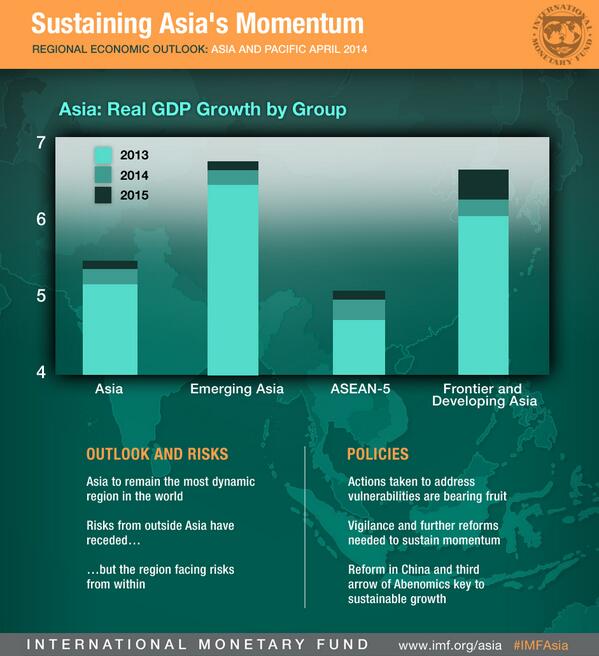
IMF: Sustaining Asia's Momentum

Enlace permanente de imagen incrustada

Reuters: LATAM Airlines expects to regain Investment-Grade debt rating by 1st half 2016


WSJ: TWO CHINESE ONLINE-GAMES FIRMS SEEKING IPO


WSJ: Deutsche Bank to Boost Capital After First-Quarter Profits Fall

       The WSJ reports, "Deutsche Bank  on Tuesday pledged to take all possible measures to bolster its capital as first-quarter profit tumbled 34%.
"We would take all measures to reach our capital targets but keep focused on organic capital creation," Co-Chief Executive Anshu Jain told analysts Tuesday after reporting that the bank's key capital ratio actually worsened in the first quarter with analysts predicting it will come under further regulatory pressure later this year.
Chief Financial Officer Stefan Krause said additional regulatory charges will weigh on the bank's core tier one capital ratio, a key measure of balance sheet strength that compares equity to assets weighed by riskiness. This meant that further measures including "bonus reduction, dividend reduction and authorized capital" could no longer be excluded, Mr. Krause said.
Germany's largest lender reported a net profit of €1.08 billion ($1.5 billion) for the three month ending March 31, down from €1.65 billion a year earlier but above analysts' estimates of €927 million. The bank's revenue for the quarter fell to €8.39 billion from €9.4 billion a year earlier.
The combination of results that were actually better than some analysts had expected and the pledge to solve the bank's capital problem buoyed investors. Deutsche Bank's shares were up 2.7% in early afternoon trading, outperforming the Stoxx European banks index which rose 1.5%.
Low interest rates and sluggish client activity in key investment banking products are denting Deutsche Bank's efforts to boost capital by retaining earnings and shedding unwanted assets. The core tier one ratio fell to 9.5% at the end of March, slightly down from the end of last year and below the 10% minimum target it has set for the end of the first-quarter 2015".

China's Big Airlines Get a Boost From Overseas Travel


Deutsche Bank is running just to stand still.

Deutsche Bank is running just to stand still. Germany’s biggest lender increased its equity base by 1.3 billion euros in the first quarter, chiefly by retaining earnings. That self-help is impressive in difficult markets. But it probably will not avert the need for Deutsche to boost capital by tapping shareholders.

For starters, organic progress on capital was offset by other hits. A rise in risk-weighted assets (RWAs) knocked Deutsche’s common equity Tier 1 ratio (the industry measure of capital strength) down 20 basis points to 9.5 percent. The bank’s relatively late adoption of Basel III capital modelling accounted for just under half the 6.5 percent rise in RWAs. The rest of the uplift was the result of Deutsche expanding its trading book as it sought to take market share in what is usually the busiest period of the year.

That competitive aggression did have some effect. Debt trading revenue was down 16 percent year-on-year, although this includes the now non-core commodities business. That sharp decline is still towards the more respectable end of the range seen on Wall Street. Meanwhile, Deutsche’s retail and commercial arm and transactional banking business are on the mend.

But Co-Chief Executives Anshu Jain and Juergen Fitschen still have cause to fret. Costs have been higher than expected when the pair launched their strategy in September 2012. Investigations for Libor, foreign exchange and other markets have required additional personnel. Europe’s banking sector asset quality review and stress tests are also sapping resources. Deutsche’s cost-to-income ratio rose over the quarter to 77 percent – way off the bank’s long-term target of 65 percent.

What’s more, a new European Central Bank requirement to measure assets more conservatively will knock between 1.5 billion euros and 2 billion euros off Deutsche’s capital base, it estimates. At the higher end of that range, Deutsche will still need as much as 5 billion euros by this time next year to hit its capital target.

If Deutsche can sustain its level of organic capital generation and keep litigation charges down, concerns about its capital would diminish. Those are big ifs. At least the operational progress will make an equity increase much easier to sell to shareholders.


Source: Reuters

U.S. home prices unchanged in February

U.S. home prices were nearly unchanged in February, after slumping 0.1% in each month since November, according to S&P/Case-Shiller's 20-city composite index released Tuesday. After seasonal adjustments, home prices in February rose 0.8%. Meanwhile, longer-term trends show that price growth is slowing down. On a year-over-year basis, home prices rose 12.9% in February, down from 13.2% in January and a recent peak of 13.7% in November. "The annual rates cooled the most we've seen in some time," David Blitzer, chairman of the index committee at S&P Dow Jones Indices, said in a statement. Including February, prices remained about 20% below a 2006 peak. 

Source: Marketwatch

Moody's changes outlook on Greece's banking system to stable from negative

"The outlook for the Greek banking system has been changed to stable from negative, reflecting expectations of a return to growth of the domestic economy in 2014-15 after six years of contraction. The gradual economic recovery, coupled with Greek banks' recapitalisations and regained access to inter-bank and international capital markets, will further ease funding pressures and lead to a gradual recovery of pre-provision profitability in 2015. In addition, the outlook also takes into account the expected deterioration in asset quality and capital metrics in 2014, although at a much reduced pace than before, says Moody's Investors Service in a new report published today.
The rating agency considers that -- despite continued weak domestic demand in the wake of wage cuts and a still elevated unemployment rate -- the operating environment for Greek banks will gradually improve, signalling the re-emergence of more normalised financial metrics over the 12-18 month outlook horizon.
The new report: "Banking System Outlook: Greece", is now available on www.moodys.com. Moody's subscribers can access this report via the link provided at the end of this press release.
Moody's forecasts gradual economic recovery -- with real GDP growth of 0.3% in 2014 and 1.2% in 2015 -- led by tourism and exports, as structural reforms are progressively transforming Greece into a more competitive export oriented economy from a consumer-led growth model. Despite still weak labour markets and demand, the rating agency considers that the current GDP growth path will create more sustainable business opportunities for banks, while the economies of scale resulting from the significant sector consolidation in 2012-13 will better position banks to benefit from efficiencies.
The rating agency also expects funding pressures on Greek banks to stabilise further, as dependence on central bank funding will continue to ease against the background economic recovery. Greek banks have been able to access both the interbank repo market, as well as the international capital markets, as evidenced by the recent senior debt issuance by two Greek banks. Moody's also notes that banks' recapitalisation in June 2013 and the resulting access to the interbank repo market has reduced funding requirements from the European Central Bank and Emergency Liquidity Assistance from the Bank of Greece to 19% of total assets at end-December 2013 from 34.6% in December 2012. However, customer deposits will remain fragile and will take time to replenish the sizeable loss of deposits in the system since 2010"
Source: Moody's Investor Service.

WSJ: Chinese Pork Producer WH Group. Scrapped IPO. As Investors Turned Off by WH Group's Overly High Pricing; Underwriters Struggled to Sell Offering

     The Wall Street Journal reports,"a Chinese pork producer scrapped what could have been the world's biggest IPO in a year when investors balked at the high price.
The failed IPO was a blow to WH Group, which just eight months ago bought Smithfield Foods in the biggest Chinese acquisition of a U.S. company so far".
At that time, the landmark deal, and the Chinese company's private equity shareholders, were widely lauded for capturing China's growing appetite for high-quality meat with the purchase of the world's largest hog producer. On Tuesday, however, that marriage of Smithfield and Shuanghui became the latest Asian IPO to face investor distaste, and pulled an IPO that had already been reduced to US$1.9 billion from as much as US$5.3 billion.
At US$5.3 billion, WH's IPO could have been the world's biggest offering since Brazil-based insurer BB Seguridade Participacoes SA 's IPO that raised US$5.7 billion in April 2013, according to Dealogic

U.S. Consumer Confidence eases to 82.3 in April

Consumer Confidence
Released On 4/29/2014 10:00:00 AM For Apr, 2014
PriorPrior RevisedConsensusConsensus RangeActual
Consumer Confidence - Level82.3 83.9 83.0 80.8  to 87.8 82.3 
Highlights
Consumer confidence eased in April but still remains over the key 80 level, at 82.3 in April vs March's upwardly revised 83.9. These readings are the highest of the recovery and follow five straight prior readings under 80.

But there is bad news in the April report and that is the present situation component which fell under 80, to 78.3 and sizably below March's 82.5. This comparison points to weakness for month-to-month consumer sector readings for April including for job readings as the jobs-hard-to-get subcomponent rose a sharp 1.1 percentage points to 32.5 percent. And the jobs plentiful reading is down, to 12.9 percent vs 13.8 percent in March.

The good news in the report is the expectations component which is steady and solid at 84.9 vs 84.8 in March. Those seeing more jobs opening up in the months ahead are up, to 15.0 percent vs March's 14.1 percent, as are those seeing their income going up, to 17.1 percent from 15.3 percent. Nevertheless, those seeing their own income falling rose to 12.9 percent from 11.5 percent.

Gas and food prices have been on the climb but have yet to affect inflation expectations which, like they were in last week's consumer sentiment report, are unchanged, at 5.5 percent for this report.

This report is showing less strength this month in consumer spirits than other readings though the results are still respectable. Yet the decline in the current conditions component is a concern. The Dow is moving off opening highs following today's report. 
Market Consensus before announcement
The Conference Board's consumer confidence index rose to 82.3 in March versus a revised 78.3 in February. The gain was led by strong showings in two subcomponents, expectations for future business conditions and, importantly, expectations for future employment. But the assessment of current conditions actually was down a bit including the very closely watched jobs-hard-to-get subcomponent which rose 6 tenths to 33.0 percent.
Source: Bloomberg

WSJ: Q&A: Youku Tudou CEO On Alibaba Investment

In an interview with The Wall Street Journal, Youku Tudou Founder and Chief Executive Victor Koo said the company held talks with a few companies in parallel, eventually deciding on Alibaba after a series of meetings in Shanghai, Beijing and Hong Kong in recent months. Mr. Koo spoke about how his company will make use of the funds, the rash of recent deals in China’s Internet sector, and the government’s recent crackdown on four American TV shows. The following is an edited excerpt of the interview.
WSJD: What was the motivation for taking the investment from Alibaba?
Koo: When we first really considered a strategic investment, we talked to all potential partners and indicated Youku Tudou is an independently operated company so we were looking for strategic investments to take us to the next step. The strategic investment itself will help us accelerate our progress as well as the whole development of our Internet entertainment media platform.
We’ve been around now for 7 or 8 years and we’re looking at this as an important strategic step to progress us to the next level with financial resources, strategic resources…because we see these opportunities happening around us, we want to leverage the market opportunity that is in front of us.
WSJD: What is Alibaba’s motivation for making more investments into media and entertainment in China?
Koo: From their perspective clearly the whole area of video as well as entertainment media is a growth sector as China moves to a consumer-led economy. This is an area where traditionally they have not focused, and they really felt, that by investing in Youku Tudou they [can leverage that]. I think we have a lot of common vision and common goals in terms of what [the video and entertainment industry] can be in China.
For example, the U.S. and Europe have a very developed media entertainment business, but in Asia you look at Korea for example, it’s a relatively small country but its culture and entertainment industry has widespread influence in Asia as well as the rest of the world. China has a huge population and a very sizable Internet space…that kind of reach can create a lot of interesting opportunities. With our base, I think whether it’s in terms of content and how it ties with Alibaba’s businesses in terms of commerce, big data, cloud as well as payment, there are a lot of interesting areas we will explore together.
WSJD: What is your view on the recent crackdown by the government on several popular U.S. television shows including “The Good Wife,” which you feature on your site?
Koo: Besides our strength in web-based original content, syndication is also an area where we started global syndication earlier than any of our competitors and have the broadest library here. Overall, what we see is that the regulatory authorities are highly supportive of this and of course there may be isolated incidents or content [that have problems] – that is something that as an industry we need to cooperate and work with under the overall framework here in China. And so we don’t see that as a widespread phenomenon. I think it’s new enough that we’re also having communication [with the government].
WSJD: Whats going on in Chinas Internet sector now with all these big deals?
Koo: I’ve recently talked about the 20 years of the Chinese Internet, in my view there are a couple of inflection points in these 20 years and 2013 and 2014 is definitely one of those inflection points. I think in five to ten years when people look back [they will see] this is the beginning of the multiscreen age, and mobile Internet and smart TVs, all these things are coming together.
So you’ve seen an acceleration of industry growth as well as an acceleration of strategic cooperation of different forms, investments, partnerships, acquisitions, and mergers and so forth. These kinds of strategic tie ups [happen] when you see a market opportunity and a market inflection that has encouraged the key players in the industry to be more open-minded or more proactive in terms of thinking outside the box and being more strategic.
WSJD: How will this affect Youku Tudou’s cooperation with other companies?
Koo:   Youku Tudou has an open cooperation strategy and that will continue to be the case, so we work with a wide variety of screen manufacturers, whether it’s smart TVs or set-top boxes because we have the leading content software service and user base in terms of video.

The Guardian: Who are the Russians on US sanctions list?

"White House implements visa ban, asset freezes and export licence denials on panoply of Russian officials close to Vladimir Putin

Igor Sechin


The most notable name on the list is Igor Sechin, the head of Russia's largest oil company and an ally of Putin's since the early 1990s, when both worked in the St Petersburg mayoral administration. Sechin previously worked as Putin's deputy chief of staff and deputy prime minister and is considered to be a leader of the conservative bloc within the Kremlin.
Since taking over Rosneft, he has cultivated contacts with western investors, and the news of his sanction could raise questions about a joint venture between Exxon Mobil and Rosneft to develop Arctic oil fields. BP holds a 19.75% stake in Rosneft. A spokesman said the company was "committed to our investment in Rosneft".

Vyacheslav Volodin

Widely believed to be in charge of the regime's internal political strategy, Volodin, a career bureaucrat, was an MP and high-ranking member of the ruling United Russia party. According to the US Treasury Department statement accompanying the sanctions, "Putin's decision to move into Crimea is believed to have been based on consultations with his closest advisors, including Volodin".

Sergei Chemezov

CEO ROSTEC

Chemezov and Putin first became friends when they lived in the same apartment complex in East Germany in the 1980s. Chemezov previously worked in the presidential administration and now heads of the tech industry state corporation Rostec, which was was created in 2007 to consolidate the management of Russian industry and now controls or has stakes in hundreds of companies.

Dmitry Kozak

Deputy prime minister
A Kremlin loyalist who has worked with Putin since the beginning of the Russian leader's political ascent, Kozak is a lawyer by training who, like Putin, worked in Soviet intelligence and then the St Petersburg mayoral administration. He is known as a specialist in handling sensitive Kremlin projects: the deputy prime minister served as Putin's point man on the Sochi Olympics and was put in charge of Crimea's development after Russia annexed the peninsula last month.

Oleg Belavencev

Putin's envoy to Crimea
A former vice admiral in the Russian navy who was deported from the UK in 1985 on suspicion of spying, Belavantsev was recently named presidential envoy to Crimea and appointed to Russia's security council.

Eveniy Murov

Director of Russia's Federal Protective Service
An army general and veteran of state intelligence agencies since 1971. As head of the federal protection service, he oversees the security of the country's leadership.

Aleksei Pushkov

United Russia MP
Chair of the international affairs committee in the Russian Duma, or lower house of parliament, representing the pro-Kremlin United Russia party and a leading voice on Russia's foreign policy".

Popular Posts