Thursday, 19 June 2014

Opinion: The Collapsing Obama Doctrine By DICK CHENEY And LIZ CHENEY

      The WSJ reports, "Rarely has a U.S. president been so wrong about so much at the expense of so many. Too many times to count, Mr. Obama has told us he is "ending" the wars in Iraq and Afghanistan—as though wishing made it so. His rhetoric has now come crashing into reality. Watching the black-clad ISIS jihadists take territory once secured by American blood is final proof, if any were needed, that America's enemies are not "decimated." They are emboldened and on the march.
The fall of the Iraqi cities of Fallujah, Tikrit, Mosul and Tel Afar, and the establishment of terrorist safe havens across a large swath of the Arab world, present a strategic threat to the security of the United States. Mr. Obama's actions—before and after ISIS's recent advances in Iraq—have the effect of increasing that threat".
On a trip to the Middle East this spring, we heard a constant refrain in capitals from the Persian Gulf to Israel, "Can you please explain what your president is doing?" "Why is he walking away?" "Why is he so blithely sacrificing the hard fought gains you secured in Iraq?" "Why is he abandoning your friends?" "Why is he doing deals with your enemies?"
In one Arab capital, a senior official pulled out a map of Syria and Iraq. Drawing an arc with his finger from Raqqa province in northern Syria to Anbar province in western Iraq, he said, "They will control this territory. Al Qaeda is building safe havens and training camps here. Don't the Americans care?"
Our president doesn't seem to. Iraq is at risk of falling to a radical Islamic terror group and Mr. Obama is talking climate change. Terrorists take control of more territory and resources than ever before in history, and he goes golfing. He seems blithely unaware, or indifferent to the fact, that a resurgent al Qaeda presents a clear and present danger to the United States of America.
When Mr. Obama and his team came into office in 2009, al Qaeda in Iraq had been largely defeated, thanks primarily to the heroic efforts of U.S. armed forces during the surge. Mr. Obama had only to negotiate an agreement to leave behind some residual American forces, training and intelligence capabilities to help secure the peace. Instead, he abandoned Iraq and we are watching American defeat snatched from the jaws of victory.
The tragedy unfolding in Iraq today is only part of the story. Al Qaeda and its affiliates are resurgent across the globe. According to a recent Rand study, between 2010 and 2013, there was a 58% increase in the number of Salafi-jihadist terror groups around the world. During that same period, the number of terrorists doubled.
In the face of this threat, Mr. Obama is busy ushering America's adversaries into positions of power in the Middle East. First it was the Russians in Syria. Now, in a move that defies credulity, he toys with the idea of ushering Iran into Iraq. Only a fool would believe American policy in Iraq should be ceded to Iran, the world's largest state sponsor of terror.
This president is willfully blind to the impact of his policies. Despite the threat to America unfolding across the Middle East, aided by his abandonment of Iraq, he has announced he intends to follow the same policy in Afghanistan.
Despite clear evidence of the dire need for American leadership around the world, the desperation of our allies and the glee of our enemies, President Obama seems determined to leave office ensuring he has taken America down a notch. Indeed, the speed of the terrorists' takeover of territory in Iraq has been matched only by the speed of American decline on his watch.
The president explained his view in his Sept. 23, 2009, speech before the United Nations General Assembly. "Any world order," he said, "that elevates one nation above others cannot long survive." Tragically, he is quickly proving the opposite—through one dangerous policy after another—that without American pre-eminence, there can be no world order.
It is time the president and his allies faced some hard truths: America remains at war, and withdrawing troops from the field of battle while our enemies stay in the fight does not "end" wars. Weakness and retreat are provocative. U.S. withdrawal from the world is disastrous and puts our own security at risk.
Al Qaeda and its affiliates are resurgent and they present a security threat not seen since the Cold War. Defeating them will require a strategy—not a fantasy. It will require sustained difficult military, intelligence and diplomatic efforts—not empty misleading rhetoric. It will require rebuilding America's military capacity—reversing the Obama policies that have weakened our armed forces and reduced our ability to influence events around the world.
American freedom will not be secured by empty threats, meaningless red lines, leading from behind, appeasing our enemies, abandoning our allies, or apologizing for our great nation—all hallmarks to date of the Obama doctrine. Our security, and the security of our friends around the world, can only be guaranteed with a fundamental reversal of the policies of the past six years.
President Obama is on track to securing his legacy as the man who betrayed our past and squandered our freedom.
Mr. Cheney was U.S. vice president from 2001-09. Ms. Cheney was the deputy assistant secretary of state for near eastern affairs from 2002-04 and 2005-06.

With eye on Iran, Saudi insists Iraq solution is internal

- Saudi Arabia kept up a drumbeat of opposition to any foreign intervention in Iraq on Thursday in an apparent message to regional rival Iran, which has hinted at possible cooperation with the United States in quelling insurgents menacing Baghdad.
Washington is considering an Iraqi request to launch air strikes on the positions of Islamic State of Iraq and the Levant (ISIL) rebels, and the Iranian president has said his countrymen will not hesitate to defend Shi'ite shrines there if need be. Either scenario would probably dismay Sunni Muslim Gulf Arab governments wary about what they see as meddling by Shi'ite Muslim power Iran in the region and opposed to any armed action that could harm Sunni communities in Iraq.
In a statement, the Saudi embassy in Britain reiterated that Riyadh opposed "all foreign intervention and interference in the internal affairs of Iraq. Instead, we urge all the people of Iraq, whatever their religious denominations, to unite to overcome the current threats and challenges facing the country."
And a Saudi source in the Gulf told Reuters that Riyadh's opposition to foreign intervention was shared by the United States, France and Britain. "No outside interference will be of any benefit," the source told Reuters.
The comments suggested Iraq risks becoming a pawn in a fierce regional power struggle between Iran and Sunni heavyweight Saudi Arabia, which was aghast when the U.S. occupation after Saddam's Hussein's fall in 2003 brought about elections that empowered Iraq's Shi'ite majority.

In a sign of a new chill in already frosty ties between the Sunni Muslim kingdom and Iraq's Shi'ite-led government, Saudi Foreign Minister Prince Saud al-Faisal dismissed as "ludicrous" Iraqi charges that the kingdom supported Sunni militants there.
(Our) advice to the Iraqi official to combat terrorism in his country is to follow the policy which the Kingdom is following and not to accuse it of being with terrorism... praise be to God we have cleaned our country of this epidemic."
Retired Qatari diplomat Nasser Al-Khalifa, in comments that appear to reflect a wide strand of thinking among Gulf Arab policymakers, said in a Twitter message that it would be "wise" for the West to stay clear of Iraq, unless it were for the purpose of removing Maliki from power.
"Any intervention in Iraq by the west to prop up criminal Maliki in Iraq will be seen by the whole Sunni Arabs and Muslims as war against them," said Khalifa, a former ambassador to Washington.
"For the West or Iran or the two working together to fight beside Maliki against Sunni Arabs will be seen as another conspiracy against Sunnis," he said.
The United Arab Emirates announced on Wednesday it was recalling its ambassador to Baghdad for consultations, saying it was worried that the Iraqi government's "sectarian" policies could heighten political tensions and worsen security there.
Islamist scholars led by influential Qatar-based cleric Youssef al-Qaradawi urged Arab and Islamic states on Thursday to protect Sunnis in Iraq, who they said had suffered a great injustice at the hands of the Iraqi government.
Source: Reuters

US bond yields fall to two-week low on dovish Fed

U.S. Treasuries yields fell to two-week lows on Thursday, a day after the Federal Reserve struck a more dovish tone than expected at its June meeting, reassuring investors that the U.S. central bank will remain accommodative for some time.
The Federal Reserve on Wednesday expressed confidence the U.S. economic recovery was on track and hinted at a slightly more aggressive pace of interest rate increases starting next year, but added that a recent uptick in inflation was not a concern.
Stronger-than-expected consumer price data on Tuesday had led some investors to expect the Fed would hint towards interest rate hikes sooner than had been previously expected.
"There was some hope that they would be more hawkish, but they are ignoring the uptick in inflation," said Charles Comiskey, head of Treasuries trading at Bank of Nova Scotia in New York. Now "people are adjusting their positions."
The inflation increase may, however, help the Treasury sell $7 billion in new 30-year Treasury Inflation-Protected Securities (TIPS) later on Thursday.
Benchmark 10-year notes <US10YT=RR> rose 1/32 in price to yield 2.59 percent, down from 2.62 percent late on Wednesday. Five-year notes <US5YT=RR> gained 1/32 in price to yield 1.67 percent, down from 1.72 percent.
The longer-dated yield curve also continued to steepen as investors unwound bets on further flattening and added positions for more steepening. The curve between 5-year notes and 30-year bonds <US5US30=TWEB> steepened to 175 basis points, up from five-year lows of 165 basis points on Monday.
Two-year note yields <US2YT=RR> fell to 0.44 percent, from 0.48 percent on Wednesday.
"When Janet Yellen restated that short-term rates will stay lower well after tapering ends it was somewhat reassuring," said Jim Kochan, chief fixed income strategist at Wells Fargo Funds Management in Menomonee Falls, Wisconsin.
Many investors have anticipated rates will rise as the economy gains momentum but the selloff hasn't yet happened, with 10-year yields stuck in a relatively small range between around 2.40 percent and 2.80 percent since late January.
"Yields are sustainable only if investors are convinced that short-term rates aren’t going up anytime soon," said Kochan.
The Fed bought $2.51 billion in notes due from 2022 to 2024 on Thursday.
The Treasury said it will sell $94 billion in new two-year, five-year and seven-year notes next week.

Source: Reuters

Gold 3 Months Futures Hits US$ 1,300


Source: LiveCharts

WSJ: Risky Business in China’s Financial System

         The WSJ reports,"though official figures suggest that just 1% of loans are non-performing, bank balance sheets likely aren’t as healthy as they seem.
Evidence from a range of countries suggests that credit booms – as China experienced from 2009-‘13 – result in substantially higher levels of non-performing loans (NPLs). A more realistic assumption that 10%-20% of total loans might go bad implies total NPLs of RMB6-12 trillion (US$1-1.9 trillion). The higher end of the range would suggest a bad-asset problem comparable in scale to the one that followed the U.S. subprime loan crisis".
That’s risky enough — even before taking into account the rapidly expanding shadow banking sector. Shadow banking, which is more lightly regulated than conventional banking, now accounts for around 15% of total financing to China’s economy, up from less than 5% in 2005.
The existence of such a large shadow-banking sector is a warning sign about the true extent of financial-market risk. The shadow banking sector largely developed to help banks circumvent government restrictions, so asset quality there is likely lower than in the formal banking sector. Indeed, non-bank lending institutions have been key factors in other regional financial crises, notably in Thailand in 1996-97 and Korea in 2003.
What might trigger a crisis in China? The drift downward in property prices could accelerate as the economy cools, leaving substantial oversupply. Property and land are often used in China as collateral for loans, so a sharp fall in house prices would damage bank balance sheets; liquidity would dry up; and institutions with high rollover needs might struggle to find funding.
Higher interest rates also would increase debt-service payments, and banks could see their deposit bases erode as corporate deposits shrink. The growing importance of the shadow-banking system would likely exacerbate these effects.
Such a crisis would have major economic implications not only for China but — through financial and trade linkages – for the whole world. The Oxford Economics Global Economic Model estimates that, in such a scenario, Chinese gross domestic product would grow less than 2% in 2015, and world growth would drop as low as 1%.
Of course, that’s a worst-case scenario, and odds of it happening are only about 10%. With China’s overall government debt relatively low and foreign exchange reserves at an all-time high, authorities have the means to intervene on a large scale if necessary.
Still, as long as interest on deposits is capped by the government, Chinese savings will continue to be invested in riskier and higher-yielding products, adding to distortions in the financial system.

Iron ore bounces off 21-month low but glut still a drag

Iron ore regained more ground after falling to its lowest since September 2012 earlier in the week as some buyers snapped cargoes after this year's sharp fall in prices although ample supplies may limit a further recovery.

Iron ore has stayed below $100 a tonne for about a month now, much longer than it did during the 2012 slump, as a market glut combined with tighter credit conditions in top importer China.

Ore with 62 percent iron content , the industry benchmark, rose 1.1 percent to $90.30 a tonne on Wednesday, gaining more ground after falling to a 21-month low of $89 on Monday, based on data from compiler Steel Index. The price has dropped almost 33 percent this year.

Iron ore futures were mixed on Thursday, with the August contract on the Singapore Exchange up 0.6 percent at $89.77 a tonne, while iron ore for September delivery on the Dalian Commodity Exchange eased 0.6 percent to close at 663 yuan ($110) per tonne.

Buying interest for spot cargoes picked up after a recent rapid fall in prices with miners selling via tenders, private deals and the globalORE platform, traders said.

Top iron ore supplier Vale is offering two cargoes of its Brazilian iron ore fines, with total volume of nearly 300,000 tonnes, in tenders closing on Thursday, traders said.

Second-ranked Rio Tinto is offering a 170,000-tonne cargo of its 61 percent grade Australian iron ore fines in a separate tender, traders said.

China's demand for iron ore remains fairly strong given brisk steel output. The country's large steelmakers produced a record high 1.833 million tonnes of crude steel on average a day in the first 10 days of June, based on data from the China Iron and Steel Association.

But traders say the available iron ore supply still trounces China's needs.

"I'm not sure the market has reached a bottom. There's too much stocks at the ports and the price at the ports is much cheaper than fresh seaborne cargoes," said a Shanghai-based trader.

Inventory of imported iron ore at Chinese ports stood at 113 million tonnes last week , still near a record-high of 113.6 million tonnes reached at the end of May, according to Steelhome, which tracks the data.

"Concerns over end-user steel demand is holding back gains in (iron ore) with China's real estate market showing signs of a cyclical slowdown," Australia and New Zealand Bank said in a note.

The most-traded rebar contract for October delivery on the Shanghai Futures Exchange slipped 0.2 percent to close at 3,009 yuan a tonne. The contract touched an all-time low of 2,994 yuan on Tuesday.

Data on Wednesday showed China's average home prices fell for the first time in two years in May and price weakness spread to more major cities, adding to signs of cooling in the property market which are posing a growing risk to the broader economy.


Source: Reuters

Zinc hits 16-month high, nickel slips

Zinc touched the highest levels in 16 months on Thursday after recent data showed the market deficit had deepened, and investors expected it to deepen further as major mines shut down.

In other metals, copper and aluminium ticked higher, lifted by the dollar's fall to a three-week low, while nickel prices came under pressure from a build-up in stockpiles.

Three-month zinc on the London Metal Exchange LME) hit a high of $2,155 a tonne in heavy volume, the strongest since Feb. 20, 2013, before paring gains to $2,151.50 by 1355 GMT, a rise of 0.77 percent.

"We are unambiguously positive in our outlook for zinc prices," said Nic Brown, head of commodities research at Natixis. "We continue to think that the zinc market will experience a substantial deficit in 2014."

Data on Monday showed that the global zinc market was in a 107,000 tonne deficit in January to April, versus a deficit of 17,000 tonnes in January-March.

Brown's forecast of a zinc deficit this year of 476,000 tonnes is at the high end of analysts' estimates, but a decline in zinc inventories so far this year of 235,000 tonnes shows that it is close to the mark, he said.


WEAK DOLLAR

Copper edged up 0.1 percent to $6,714 a tonne, and aluminium 
Helping gains was a drop in the dollar against a basket of currencies to its weakest level in three weeks after a cautious message from the U.S. Federal Reserve on Wednesday and after a fall in jobless claims on Thursday. [FRX/] [ID:nLNSJHEAHX]

A weak dollar makes commodities priced in the U.S. unit cheaper for holders of other currencies.

"The weaker dollar has helped lift prices this morning after the FOMC (Federal Open Market Committee) stayed pretty dovish," Societe Generale analyst Robin Bhar said.

The metal used in power and construction is down 8.5 percent lower from levels at the beginning of the year as doubts remain about the outlook for demand from top consumer China and on worries about tight financing for metals.

"Copper prices are not really showing much direction, particularly given concerns about China's economy ... Prices are likely to meander around these levels as we are going into the quiet summer period."

LME nickel fell 1.5 percent to $18,467 a tonne, extending losses after dropping 2 percent on Wednesday.

Nickel stocks in LME-registered warehouses surged by 19,242 tonnes across diverse locations in Asia to a record high on Wednesday, before dipping by just 618 tonnes on Thursday.

Traders said the deliveries reflected metal sold by producers when prices climbed above $20,000 last month.

The rise in stocks reminded investors that a ban on unprocessed ore by Indonesia, which spurred 35 percent gains this year, has not yet hit the refined market.


Source: Reuters

Gold edges up as dollar drops after Fed; platinum rises

Gold gained on Thursday on a lower dollar after the Federal Reserve said it remained committed to accommodative measures and low interest rates, while platinum rose as new hurdles emerged in settling South Africa's mining strike.
The U.S. central bank hinted at a slightly faster pace of interest rate increases starting next year, but lowered projections for the long-term target interest rate, sending the dollar to its lowest level in nearly two weeks.
The Fed cut its U.S. growth forecast for 2014 from 2.9 percent to a range of between 2.1 percent and 2.3 percent, but it also expressed confidence that the U.S. economic recovery was on track.

Spot gold edged up 0.3 percent to $1,28.140 an ounce by 1109 GMT, while U.S. gold futures for August delivery rose 0.7 percent to $1,281.60.
 "In the short term, gold is still very much headline-driven, with what's happening in Iraq, as far as safe-haven buying is concerned," Mitsubishi Corp analyst Jonathan Butler said.
But for the medium-term, the Fed comments were not a major event for gold, which will still suffer from the central bank concluding its quantitative easing programme at the end of the year and raising interest rates some time in 2015", Butler added.
Gold rose at the same time as equities, as both assets benefited from a less hawkish view than expected from the Federal Reserve.
The metal tends to have an inverse relationship with equity markets, with investors seeking refuge from riskier assets in times of political or financial troubles. However, gold and equities have both been underpinned by accommodative monetary policies over the past few years.
Tensions over Iraq and Ukraine were still seen attracting some safe-haven bids for gold, having lifted crude oil prices to nine-month highs.
Gold is usually seen as an hedge against oil-led inflationary pressures.
Physical demand in top buyers China and India has been weak, with premiums in both countries dropping in recent days. Indian premiums are at a four-month low, while Chinese prices are trading between discounts and on par with global prices.
SPDR Gold Trust, the world's largest gold-backed exchange-traded fund, saw two straight sessions of outflows earlier in the week before a pause on Wednesday.
Holdings of the fund are near a five-year low, reflecting bearish investor sentiment towards the metal.
Platinum rose 0.5 percent to $1,451.50 an ounce and palladium was up at $823.70 an ounce, with both trading near one-week highs as a mining strike in major producer South Africa looked set to drag on.
South African platinum union AMCU has made "unaffordable" new demands beyond a deal struck with producers last week, miners said on Wednesday, dashing hopes of an end to the country's longest and costliest mining strike.
Silver was up 0.3 percent to $19.91 an ounce.
Source: Reuters

U.S. jobless claims point to firming labor market

 The number of Americans filing new claims for unemployment benefits dipped more than expected last week, pointing to strengthening labor market conditions.

Initial claims for state unemployment benefits slipped 6,000 to a seasonally adjusted 312,000 for the week ended June 14, the Labor Department said on Thursday. Economists had forecast first-time applications for jobless aid falling to 314,000.

The Federal Reserve said on Wednesday the job market would continue to improve gradually and hinted at a slightly faster pace of interest rate increases starting in 2015.

The U.S. central bank, which has kept overnight lending rates near zero since December 2008, also announced further cuts to its monthly bond buying program. 

U.S. stocks were set to open slightly higher. Prices for U.S. Treasury debt rose marginally, while the dollar held losses against the euro and the yen.

A Labor Department analyst said there were no special factors influencing the state level data.

The four-week moving average for new claims, considered a better measure of underlying labor market conditions as it irons out week-to-week volatility, fell 3,750 to 311,750 last week.

The data covered the survey week for June's nonfarm payrolls. The four-week average for claims declined 11,000 between the May and June survey periods, suggesting payroll growth will probably increase from last month's gain of 217,000 jobs.

The economy, which has recovered all the 8.7 million jobs lost during the recession, has enjoyed four straight months of job gains above 200,000, a stretch last seen in early 2000.

Other measures such as job openings and hiring intentions by small businesses have also pointed to a normalization of the labor market.

The claims report showed the number of people still receiving benefits after an initial week of aid dropped 54,000 to 2.56 million in the week ended June 7, the lowest level since October 2007.

The so-called continuing claims have been trending lower, an indication that some long-term unemployed were finding work.

The unemployment rate for people collecting unemployment benefits fell to 1.9 percent during the week ended June 7, the lowest since October 2007, from 2.0 percent the prior week.

Source: Reuters

Battle for Iraq refinery as U.S. hesitates to strike

Iraqi government forces battled Sunni rebels for control of the country's biggest refinery on Thursday as Prime Minister Nuri al-Maliki waited for a U.S. response to an appeal for air strikes to beat back the threat to Baghdad.

Secretary of State John Kerry said President Barack Obama still had "all options" open to him but U.S. regional allies Turkey and Saudi Arabia echoed concern in Washington about the risk of U.S. action serving only to inflame the sectarian war.

The sprawling Baiji refinery, 200 km (130 miles) north of the capital near Tikrit, was a battlefield as troops loyal to the Shi'ite-led government held off insurgents from the Islamic State of Iraq and the Levant and its allies who had stormed the perimeter a day earlier, threatening national energy supplies.

A government spokesman said around noon (0900 GMT) that its forces were in "complete control" but a witness in Baiji said fighting was continuing and ISIL militants were still present.

A day after the government publicly appealed for U.S. air power, there were indications Washington is sceptical of whether that would be effective, given the risk of civilian deaths that could further enrage Iraq's once dominant Sunni minority.

Turkish Prime Minister Tayyip Erdogan, a NATO ally, said the United States "does not view such attacks positively", given the risk to civilians. A Saudi source said that Western powers agreed with Riyadh, the main Sunni state in the region, that what was needed was political change, not outside intervention, to heal sectarian division that has widened under Maliki.

Video aired by Al-Arabiya television showed smoke billowing from the plant and the black flag used by ISIL flying from a building. Workers who had been inside the complex, which spreads for miles close to the Tigris river, said Sunni militants seemed to hold most of the compound in early morning and that security forces were concentrated around the refinery's control room.

The 250-300 remaining staff were evacuated early on Thursday, one of those workers said by telephone. Military helicopters had attacked militant positions overnight, he added.


CAPTURED TERRITORY

Baiji, 40 km (25 miles) north of Saddam Hussein's home city of Tikrit, lies squarely in territory captured in the past week by an array of armed Sunni groups, spearheaded by ISIL, which is seeking a new Islamic caliphate in Iraq and Syria. On Tuesday, staff shut down the plant, which makes much of the fuel Iraqis in the north need for both transport and generating electricity.

ISIL, which considers Iraq's Shi'ite Muslim majority as heretics in league with neighbouring, Shi'ite Iran, has led a Sunni charge across northern Iraq after capturing the major city of Mosul last week as Maliki's U.S.-armed forces collapsed.

The group's advance has only been slowed by a regrouped military, Shi'ite militias and other volunteers. But on Tuesday, Sunni fighters took the small town of Mutasim, south of Samarra, giving them the prospect of encircling the city which houses a major Shi'ite shrine. A local police source said security forces withdrew without a fight when dozens of vehicles carrying insurgents converged on Mutasim from three directions.

ISIL, whose leader broke with al Qaeda after accusing the global jihadist movement of being too cautious, has now secured cities and territory in Iraq and Syria, in effect putting it well on the path to establishing its own well-armed enclave that Western countries fear could become a centre for terrorism.

The Iraqi government made public on Wednesday its request for U.S. air strikes, two and half years after U.S. forces ended the nine-year occupation that began by toppling Saddam in 2003.

Asked whether Washington would accede to that appeal, Kerry told NBC only that "nothing is off the table".


U.S. RESPONSE

Some politicians have urged Obama to insist that Maliki goes as a condition for further U.S. help. Asked about U.S. aid for the prime minister, Kerry said: "What the United States is doing is about Iraq, it's not about Maliki. Nothing the president decides to do is going to be focused specifically on Prime Minister Maliki. It is focused on the people of Iraq."

He played down the extent of possible U.S. cooperation with Iran, the main Shi'ite power, which backs Maliki, saying Washington wanted communication on Iraq with its long-time enemy to avoid "mistakes" but would not work closely with Tehran.

U.S. officials, speaking on condition of anonymity, say Iraq has asked for drone strikes and increased surveillance by U.S. drones, which have been flying over Iraq. However, officials note, targets for air strikes could be hard to distinguish from civilians among whom ISIL's men were operating.

Turkish premier Erdogan said: "America, with its current stance and the statements it has made, does not view such attacks positively ... Such an operation could result in a serious number of deaths among civilians."

The Saudi source told Reuters: "No outside interference will be of any benefit," adding that Washington, France and Britain all agreed with Riyadh that "dialogue and a political solution is the way forward in Iraq".

Competing with Iran for regional influence - a rivalry that echoes 13 centuries of Sunni-Shi'ite strife - Saudi Arabia hit back angrily at an accusation this week by Maliki's government that Riyadh was promoting sectarian "genocide" by supporting ISIL. Foreign Minister Saud al-Faisal called that "ludicrous" and said Saudis were fighting ISIL, an al Qaeda splinter group.

From Iran, which has pledged to intervene if necessary in Iraq to protect Shi'ite holy places, a tweet from an account linked to Supreme Leader Ayatollah Ali Khamenei noted that Western powers support the mostly Sunni revolt against Syria's Iranian-backed leader. It called for Sunnis and Shi'ites to resist efforts by the militants and the West to divide Muslims.


OIL INDUSTRY

If the Baiji refinery falls, ISIL and its allies will have access to a large supply of fuel to add to the weaponry and economic resources seized in Mosul and across the north.

An oil ministry official said the loss of Baiji would cause shortages in the north, including the autonomous Kurdish area, but that the impact on Baghdad would be limited - at around 20 percent of supplies - since it was served by other refineries.

Some oil companies have pulled out foreign workers.

Washington and other Western capitals are trying to save Iraq as a united country by leaning hard on Maliki to reach out to Sunnis, many of whom feel excluded by the Shi'ite parties that have dominated elections since the Sunni Saddam was ousted.

In a televised address on Wednesday, Maliki appealed to tribes, a significant force in Sunni areas, to renounce "those who are killers and criminals who represent foreign agendas".

But so far Maliki's government has relied almost entirely on his fellow Shi'ites for support, with officials denouncing Sunni political leaders as traitors. Shi'ite militia - some of which have funding and backing from Iran - have mobilised to halt the Sunni advance, as Baghdad's million-strong army, built by the United States at a cost of $25 billion, crumbles.

Source:  Reuters

Wednesday, 18 June 2014

WTI Gains on U.S. Supplies as Iraq Fighting Rages; Brent Steady

West Texas Intermediate rose for the first time in four days after a government report showed U.S. crude inventories shrank and as Iraqi forces battled insurgents north of Baghdad. Brent was steady in London.
Futures advanced as much as 0.4 percent in New York. Crude stockpiles fell by 579,000 barrels last week, the Energy Information Administration said yesterday. Islamist militants battled Iraq’s military for control of the Baiji oil refinery, the country’s biggest, as President Barack Obama told top U.S. lawmakers that he won’t need additional congressional approval for the options he’s considering in response to the crisis.
“The crude market is telling us the importance of Iraq,” said Jonathan Barratt, the chief investment officer at Ayers Alliance Securities in Sydney who predicts investors may sell West Texas contracts if prices climb to $107.50 a barrel. “The concerns are smoldering and that keeps oil up. The EIA numbers are in line with what you’d expect this time of year.”
WTI for July delivery, which expires tomorrow, gained as much as 46 cents to $106.43 a barrel in electronic trading on the New York Mercantile Exchange and was at $106.42 at 11:17 a.m. Singapore time. It dropped 39 cents to $105.97 yesterday, the lowest close since June 11. The more-active August contract was up 45 cents at $106.04. The volume of all futures traded was about 16 percent below the 100-day average. Prices have increased 8.1 percent this year.
Brent for August settlement was 22 cents higher at $114.48 a barrel on the London-based ICE Futures Europe exchange. The European benchmark crude traded at a premium of $8.46 to WTI for the same month. The spread widened for a third day yesterday to close at $8.67.
Source: Bloomberg

Asian Stocks Climb Amid U.S., China Growth Optimism

Asian stocks rose toward a six-year high after the Federal Reserve said interest rates will remain low for some time as U.S. growth rebounds, and Premier Li Keqiang pledged to sustainChina’s economic expansion forecast.
BHP Billiton Ltd. (BHP), the world’s largest miner, climbed 3.1 percent in Sydney as materials companies led gains. Seiko Epson Corp. surged 8.4 percent after Citigroup Inc. said earnings at the Japanese printer maker are above market estimates. China Overseas Land & Investment Ltd lost 1.9 percent in Hong Kong as UBS AG said it expects more extensive price cuts for property.
The MSCI Asia Pacific Index advanced 1.1 percent to 145.28 as of 11:22 a.m. in Hong Kong, heading for its biggest gain in a month as all 10 industry groups rose. A close at this level would be the highest since June 2008. Fed Chair Janet Yellen said accommodative monetary policy, rising home and equity prices plus an improving global economy should produce an above-trend U.S. expansion.
The Topix jumped 1.5 percent today, climbing for a third day and poised for it highest close in almost five months. Australia’s S&P/ASX 200 Index advanced 1.5 percent and Hong Kong’s Hang Seng Index rose 0.2 percent. New Zealand’s NZX 50 Index and Singapore’s Straits Times Index added 0.1 percent, while Taiwan’s Taiex index gained 0.2 percent. The Shanghai Composite Index declined 0.4 percent and South Korea’s Kospi index (KOSPI) slid 0.1 percent.
China will have “medium to high-level” growth in the long run, Premier Lisaid during a speech in London yesterday, adding that he could promise “honestly and solemnly there won’t be a hard landing.”
“The Chinese government is adjusting its economic operations to ensure the minimum growth rate is 7.5 percent, the level to ensure job creation,” Li said in the speech.
Source: Bloomberg

Iraq crisis may change China's oil suppliers

The security crisis in Iraq will affect oil prices in China and change the mix of the country's overseas oil supply sources in the long run, energy industry experts say.
Iraq is China's fifth-largest crude oil supplier.
Lin Boqiang, director of the China Center for Energy Economic Research at Xiamen University, said on Monday it is almost certain that the situation in Iraq will drive up oil prices in China.
Iraq is the second-largest producer in the Organization of the Petroleum Exporting Countries, after Saudi Arabia.
China depends on the world market for nearly 60 percent of its annual petroleum use.
Lin said the changing picture of Iraqi politics will also affect Chinese oil companies' investment strategies in the Middle East.
Li Li, research and strategy director at ICIS C1 Energy, an energy information consultancy in Shanghai, said China may increase imports from other oil producers such as Russia, Iran and Oman if the Iraqi crisis lingers.
However, Li said the security crisis is unlikely to drastically affect China's supply.
China National Petroleum Corp, the country's largest oil producer, is operating four projects in Iraq, making the company the largest foreign investor there.
In 2013, CNPC produced 40.72 million tons of crude, or 299 million barrels, from Iraq, almost one-third of the company's overseas output.
Li said Chinese investors are concentrated in southern Iraq and their operations may not be affected that soon, because the turmoil is taking place in northern areas of the country.
Han Xiaoping, chief information officer at China Energy Net Consulting Co, said he believes the Iraqi situation will stabilize soon, most probably within the next six months.
Han said the most crucial factor is to protect investment by Chinese oil companies in Iraq.
Lin predicts the price of oil will rise to more than $120 a barrel if the Iraqi crisis spreads to the south of the country.
Jin Ting, senior analyst at JYD Online Corp, a bulk commodity consultancy in Beijing, said June and July are the traditional peak season for global crude oil demand, and the Iraqi situation will lead to soaring prices.
She predicts that the next round of China's oil repricing, scheduled for June 23, will result in a slight rise of 70 yuan ($11.27) a ton for refined oil.
In the first four months of the year, China's crude imports from Iraq increased by 31 percent year-on-year to about 600,000 barrels a day, while imports from Iran rose by 55 percent to the same number of barrels a day.
Imports from Russia increased by 28 percent, also to about 600,000 barrels a day.
Source: ChinaDaily USA

Growth concerns rise for Alibaba

Lower first-quarter earnings cast shadow on prospects for IPO
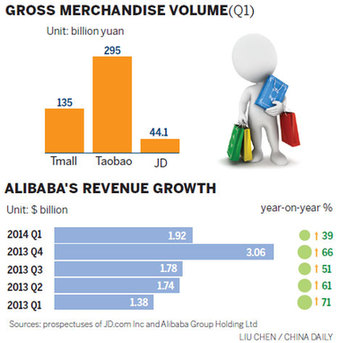
Alibaba Group Holding Ltd, China's e-commerce conglomerate, disclosed in an updated filing on Monday that quarterly revenue growth slipped to its slowest pace in six years, amid concerns that the development may cast a shadow on its highly anticipated initial public offering in the United States.
Growth concerns rise for AlibabaThe Hangzhou-based e-commerce giant reported lower revenue growth of 39 percent year-on-year between January and March in its revised filing to the US Securities and Exchange Commission on Monday. The company's growth rate was 71 percent in the same quarter last year. Operating margins narrowed to 45 percent from 51 percent in the previous year. The group's revenue during the first quarter was 12 billion yuan ($1.92 billion).
A growth rate of 39 percent would be considered robust for most companies, but for Alibaba Group, which owns China's largest customer-to-customer platform, Taobao, and the country's largest business-to-customer platform, Tmall, the slowing momentum has triggered concerns ahead of its much-anticipated initial public offering in the United States.
The reported first-quarter growth of 39 percent also marked the first time that Alibaba Group has posted a quarterly revenue increase of below 40 percent since Yahoo Inc, one of its major shareholders, began disclosing results in 2008.
Zhuo Saijun, an e-commerce analyst with the Beijing-based consulting firm Analysys International, said Alibaba's revenue decline in the first quarter was not surprising.
"Alibaba's Nov 11 shopping festival pushed many merchants to increase their online marketing spends during the fourth quarter of 2013. This has led to overdrawn marketing budgets in the first quarter," he said. Zhuo added that Alibaba still dominates China's e-commerce market, but research has shown that its market share is shrinking. "The shrinking is not that significant, but it shows the general trends of competition," he said.
Source:ChinaDaily USA

Chinese premier's Greece visit to set new milestone in bilateral relations

Chinese Premier Li Keqiang's upcoming official visit to Greece will be a diplomatic feat that will translate traditional friendship into practical cooperation, says China's ambassador to this southern European country.
The two sides will sign more than 20 cooperation agreements and business contracts during Li's visit, covering investment, trade and finance, among others, Zou Xiaoli said in a recent interview, adding that they will also hold their first-ever maritime cooperation forum.
Noting that Li travels to Greece one year after Greek Prime Minister Antonis Samaras' visit to China, Zou said China not only stood by Greece in the throes of the debt crisis, but is willing to work with it for Greece's economic recovery and development.
History has proved that Greece is one of China's most trustworthy friends, he said, recalling that even before the establishment of diplomatic ties, Greek ship-owners broke through blockade and helped China transport goods.
From the Beijing Olympics to the evacuation of Chinese nationals from Libya, Greece always stood ready to extend a helping hand, said the ambassador.
Enjoying a unique geographical advantage, Greece can be a bridge for the export of Chinese commodities and capital, said Zou. "Though limited in scale at the moment, trade and investment between China and Greece have a promising future."
Taking the Piraeus port as an example, he said, "if China-Greece economic and trade cooperation is a giant dragon, then Piraeus is the dragon's head. Once the dragon raises its head high, it will soon fly."
Meanwhile, Zou said that during the visit the two countries will sign an agreement to establish cultural centers in each other so as to provide a concrete vehicle for bilateral cultural exchanges and cooperation.
As a traditional maritime country, Greece has one of the largest merchant fleets in the world, said Zou, adding that China needs to learn from Greece's knowledge, development, management and protection of the oceans along with its experience in cultivating a network in the shipping industry.
China has 3 million square km of blue territory, and the oceans will be an important field for China's development and its contribution to the world in the future, said the ambassador.
"Therefore, strengthening maritime cooperation between China and Greece is a blessing to both countries and peoples as well as the whole world at large," said Zou.
As a return visit to Samaras' China trip last year, Li's visit shows that both sides attach high importance to their relations and hope the bilateral relationship can serve as a model for China's relations with other European countries, the ambassador concluded.
The Chinese premier flies to Athens on Thursday after wrapping up his official visit to Britain.
Source: Xinhua

Chinese economy should stabilize in the next six months

In June 16 2014, the People's Bank of China (PBOC) formally lowered the reserve requirement ratio for qualified commercial banks by 0.5 percent. On April 25 2014, the PBOC had lowered the reserve requirement ratio of county-level rural commercial banks and county-level rural cooperative banks. This was therefore the second time that the PBOC had used this monetary measure.
In the past two months, China's decision-makers have sent positive signals to the market by moving forward with "microstimulation" policies, which have not only addressed the liquidity problem in the short term, but also laid a foundation for stabilizing the economy in a long term.
According to a rough estimation from Shenyin Wanguo Securities, lowering the reserve requirement ratio released about 60 to 70 billion yuan on this occasion. Combined with 60 to 100 billion yuan released on the previous occasion, this means a total of 120 to 170 billion yuan were released.
In the last few weeks, through lowering the reserve requirement ratio, refinancing and other measures, the PBOC has provided sufficient liquidity to the interbank market. Currently, the interbank market interest rate has fallen to its lowest level since May 2013.
The discount rate and the transfer discount rate, both indicators of company level liquidity, are also lower, which suggests that liquidity in the real economy has improved.
According to some analysts, the PBOC is favoring a moderate sufficiency of liquidity overall through lowering the reserve requirement ratio, which means that the basic orientation of the monetary policy has not changed. The key point of the next step will be lowering the financing cost. Along with the implementation of the "microstimulation" policies, the economy will be given a boost. Domestic demand will stop declining and stabilize. With stable aggregate demand, there is every likelihood that the Chinese economy will stabilize in the coming half year.
Source: Xinhua

China: Home prices in more cities start to fall

China's property sector continued to cool in May, as new home prices in half of a sample of 70 major cities showed month-on-month drops, the National Bureau of Statistics (NBS) said in an online statement on Wednesday.
 
Thirty-five cities saw month-on-month drops in new home prices last month, contrasted with eight in April. Only 15 cities saw month-on-month increases, substantially down from 44 in April.
The average home price in the 70 cities slipped 0.15 percent from the previous month, marking the first drop in more than a year, according to the NBS.
The average new home price in April increased 0.06 percent month on month.
Of all the 70 cities, prices in Hangzhou of East China's Zhejiang province dropped the most, down by 1.4 percent, followed by 0.7 percent for Shijiazhuang, Wuxi and Xuzhou.
The highest month-on-month price increase was 0.3 percent in central China's Zhengzhou, while the price in Beijing increased 0.2 percent, faster than the growth pace in April, the NBS data showed.
For existing homes, prices declined in 35 cities month on month in May, up from 22 cities in April.
Liu Jianwei, senior statistician for the NBS, said home buyers have started to take a wait-and-see attitude amid uncertain market prospects, prompting developers to cut prices to alleviate pressures from piling inventories.
On a year-on-year basis, however, new home prices in 69 cities of the statistical pool continued to increase, with the highest growth at 11.3 percent.
Source: ChinaDaily USA

Popular Posts