Sunday, 29 December 2013

Scientists grow liquid crystal "flowers" to use as lenses

A liquid crystal 'flower' under magnification (Photo: University of Pennsylvania)
Scientists at the University of Pennsylvania have grown liquid crystal flowers, making it possible to create lenses as complex as the compound eye of a dragonfly. When perfected, the technology could allow the growth of lenses on curved surfaces, and structures to be assembled out of liquid crystals to build new materials, smart surfaces, microlens arrays and advanced sensors.
To create the lenses from the liquid crystals, the researchers planted tiny silica beads in a pool of transparent liquid crystal, to obtain a pattern of defects. Petal-like shapes formed in the liquid crystal around the defects in a tiered manner, resulting in a flower-like structure that resembles an insect's compound eye.
"It's a lot like how you make rock candy as a kid," Randall Kamien, Professor in Physics and Astronomy, Penn Arts & Sciences, tells Gizmag. "The sugar naturally makes crystals, but you need to put in a seed (usually a stick or a piece of string) to get it to grow where you want. We have just done this on a smaller scale, making smaller bits of ordered material cued by smaller elements, like our silica beads."
The research represents a significant step forward in "directed assembly" nanotechnology, where scientists try to build minute structures by specifying starting conditions and letting physical and chemical processes do the assembly work, instead of doing it themselves.
"We exploit a material's tendency to form ordered structures by adding cues to the system", explains Kamien. "It is how cultured pearls are made – a seed is deliberately planted in the oyster to get it to naturally produce nacre around the seed."
Each flower petal formed out of transparent liquid crystal can act as a lens since light can interact with its curved surface. Since individual lenses can be manipulated so that they are a few microns to tens of microns in diameter, it's possible to create a flower of collective lenses which are tens of microns to millimeters in size. The technique makes it possible to grow a liquid crystal eye that's as complex as a dragonfly's eye, for example, which has millions of spherical lenses that enable it to stack lots of images into a 3D image.
"Researchers try to fabricate such compound eyes, for example, for cameras or detectors," Shu Yang, Materials Science and Engineering Professor at Penn Engineering tells us. "But it’s typically by a top-down process. So it isn't possible to fabricate millions of eyes in one-step, nor will it be cheap. Self-assembly of flower pattern of lenses will make it possible to create compound eyes in one-step. And we can control the curvature of the template, i.e., how we plant the seeds in the first place to determine how the lenses will be put together, how many of them and in what shape."
Being able to grow lenses this way opens up many exciting possibilities. Lenses could change sizes from the center to the edge, in a single eye; a feature that's very useful for certain types of applications. Biosensors could collect information from many lenses at the same time. Since the lenses form spontaneously in liquid crystal, a medium that's easily reconfigured, it may be possible to create self healing re-configurable optical devices. And all that's just for starters.
"We could make inexpensive lenses that could cover entire surfaces," says Kathleen Stebe, Chemical and Biomolecular Engineering Professor at Penn Engineering. "They could transmit images from many focal points and be reconstructed by algorithms to give improved resolution. We could have a camera on flexible substrate or curved substrates with lens that form and re-form after being bent."
Creating new synthetic metamaterials, where the arrangement and shapes of individual components determines its physical properties, also becomes a possibility.
"We are also interested in dynamically changing the physical properties of the metamaterials, which can be achieved by tuning the shape and arrangement of the seeds," Yang reveals. "Such materials will be of interest for creating superlenses that can produce flawless images much smaller than the wavelength of light, drug delivery, shape conforming mechanical metamaterials and acoustically invisible cloaks."
The team anticipates these lenses working their ways into liquid crystal displays within the next 10 years.
Source: TECHINASIA

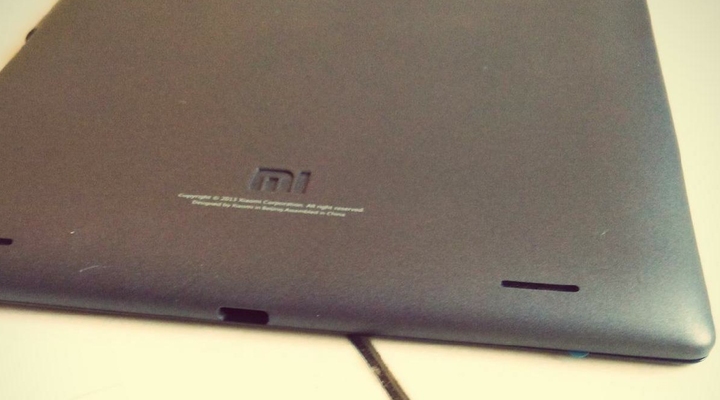
Leaked photo of a 7-inch Xiaomi tablet surfaces on Sina Weibo

When we interviewed Xiaomi founder Lei Jun  in October 2012, he stated clearly that the startup phone-maker was not working on an Android tablet. But that was 14 months ago. A leaked image this week claims to show a 7-inch Xiaomi tablet (pictured), suggesting that Xiaomi might have been swayed by the success of budget tablets like the original Nexus 7.
The leaker, a Sina Weibo user named @PunkPanda with a fairly strong track record of sniffing out new hardware, adds that the Xiaomi Tablet – we guess it’ll be called the MiPad – has a 720p HD screen (1,280x720px resolution) and is powered by a MediaTek quad-core processor allied to a mere 1GB of RAM. That sounds a lot like the fairly basic specs of Xiaomi's budget Hongmi smartphone.
The supposed price of the Xiaomi Tablet? Nearly RMB 1,100 (about $180), which is close to the price of the Hongmi model.
This is speculation for now. It remains to be seen if Lei Jun has been convinced that Android tablets are ready to challenge the dominance of Apple’s iPad.


Leaked photo of Xiaomi tablet

Rumah.com claims it’s the leading Indonesian property portal in 2013.With strong mobile presence

With the end of 2013 in front of our eyes, Rumah.com, an Indonesian online property portal, reveals its stats for the outgoing year.
Rumah, which was acquired by PropertyGuru in 2011 , rolled out its BlackBerry app last year, and followed that up with an Android and iPhones apps this year. The new Android and iPhone apps have seen 300,000 downloads, the company tells Tech in Asia , and now mobile search contributes more than 4.2 million page-views per month. That’s more than 20 percent of all visits to the website.
Jessica Effendi, the head of operations of Rumah, says that Rumah’s mobile app is proving most popular in Indonesia in terms of downloads, compared to Thailand, Malaysia, and Singapore.
On a side note, the portal has seen the number of paying real estate agents grow from 4,207 to 6,400, and active property listings have nearly doubled from 123,000 to 220,000. The team is positive that the number will keep on growing rapidly next year.
According to the latest ComScore findings in November (as quoted by the Rumah team), Rumah.com is the top property portal in the region in terms of the number of unique visitors, stronger than competitors such asRumahku ,Rumah123 ,RumahDijual , and PropertyKita . Rumah counted up two miillion visits per month on the website in September and October.
Rumah is confident in mobile uptake in Indonesia and will continue to invest in its mobile infrastructure in the country. Effendi added:
 
Indonesians want to be able to search for their desired properties on the go and in their own time. That is why we’ve incorporated their online behaviour into our development strategy to provide an inituitive and user-friendly property search experience through mobile apps, similar to what the Rumah.com website currently provides.
Mita Agustina, head of public relations at Rumah.com, reveals that the company will announce a “new, very seasoned industry heavyweight” as the new country manager for Indonesia in February.

Why did Alibaba and Jingdong apply for mobile telecom licenses?

Yesterday news broke that China’s Ministry of Industry and Information Technology (MIIT), the regulator of the country’s three state-owned telcos, announced that 11 Chinese companies had received licenses allowing them to operate as “virtual telecom service providers.” This enables these private firms to lease services from China Telecom, China Mobile, or China Unicom and repackage them for consumers, much like how Sprint licenses airwaves to Virgin Mobile, or how Walmart offers service plans using T-Mobile’s network.
It’s a watershed moment in the country’s telecom industry, marking a rare instance in which Chinese state-run firms have had to cede some power to private enterprises. However, it’s not yet clear what subsequent competition might look like.
Of the eleven firms that received licenses, two of them are major e-commerce players in China: Alibaba’s web services branch Net.cn nabbed approval (the company offers domain listings and cloud services), along with major e-store competitor Jingdong, best known for its speedy delivery service and quality control.
It’s also worth noting that two other major chinese retailers reportedly made bids for licenses Suning and Gome, both of which are companies best known for selling electronic appliances and gadgets – big bulky things like refrigerators and microwaves, in addition to sexy touchscreen phones – in their brick-and-mortar stores. But both are pushing into e-commerce as well.

Why are e-commerce firms applying for telecom licenses?

For one thing, Alibaba and Jingdong, as the country’s two largest e-commerce firms, both sell a lot of phones. In their view, selling products and services that typically accompany phones – mobile data and call minutes, mainly – could be an easy avenue through which a few extra dollars can be earned. Customers might purchase a brand-new Samsung Galaxy S4 on Taobao and subsequently select a service package from Net.cn just before the final checkout page.
Jingdong and Alibaba can also utilize their internal data to create new types of packages for consumers. In an exclusive statement given to Chinese-language media outlet Techweb, Jingdong vice president Wang Xiaosong stated that the company intends to release a phone that comes packaged completely for free along with a monthly plan – something he claims traditional carriers in China aren’t wont to doing, but that Jingdong can implement in good faith due to its existing records of customer credit ratings.
There’s also opportunity to use the increased presence on consumers’ phones to promote other company products and services. Much like traditional telcos will ink deals with hardware and software companies to pre-install apps, Alibaba and Jingdong could do the same with their own services.
That’s why Alibaba’s license is of particular interest. Over the past year, the company has launched a mobile-social land grab that saw the company expand into messaging, cloud storage, and smart televisions. It’s not clear what Alibaba’s specific end goal is, but it appears to be aiming to build an integrated online and offline ecosystem through which users can purchase physical and virtual goods. By obtaining a larger degree of control over what comes pre-installed on users’ phones, as well as fostering long-term relationships with customers via contracts, the company can continue to push its other, newer product offerings. You can be sure, for example, that an Alibaba-sanctioned phone won’t come with WeChat pre-installed, and if it does come with a messaging app built in on the home screen, it will probably be Laiwang.
There are many unknown factors that could affect the execution of Alibaba’s and Jingdong’s newly obtained licenses. For one thing, it’s not clear what terms and stipulations the state-owned telecoms might include as they provide these 11 firms access to their resources. If the terms are unfavorable and the private companies have no choice but to offer expensive contracts to customers, the new venture into the telco sector might take time before strong revenues surface.
Source: TECHINASIA

Malaysia's price hike: Subsidy cuts, new taxes worry people

Investors are more confident about Malaysia's long-overdue steps to rein in deficit. But to most Malaysians, a string of subsidy cuts and price hikes coupled with the prospect of a new tax, are a worry and many say it's too much to hit the people with at one time.
People say they've already seen prices for essentials rise since the government slashed petrol subsidies in September. And Malaysians are bracing for a lot more of the same.
In the recent months, the government has announced it will introduce a Goods and Services tax starting in 2015. Then more recently it announced increases to electricity tariffs, public transportation fares and highway tolls.
"The next one, two years will be more difficult for the general public. When things are going up, your living standards will drop, that's for sure. And it looks like we are going in that trend," Malaysian resident Puvanathan Sabaratnam says.
Malaysia's government has been running fiscal deficits since the financial crisis of 1998.
"It's important that the government rationalize the subsidies because it now makes up more than half the fiscal deficit and that in itself is not sustainable," Yeah Kim Leng, chief economist of Rating Agency Malaysia, says.
Economists also say that the country's tax base is currently too narrow, with oil and gas revenues providing up to 40 per cent of the government's income.
"This so-called over reliance on the national oil company is actually not prudent. So that's the basis for actually implementing the long-awaited GST," Leng says.
The political opposition, though, say that before squeezing the public for more revenue, the government of Najib Razak has to curb its excesses as exposed year after year in its own auditor general's reports.
"No matter how many new taxes you implement, no matter how new stream of income you bring to the government, unless there is a discipline to get rid of wastages, corruption, to re-look at the procurement practices of the country, it's like pouring money into a black hole," Rafizi Ramly of People's Justice Party says.
Najib doesn't have to call an election for at least another four years, giving plenty of time for any public dissatisfaction to ease and for the government to convince people that all these fiscal measures were in the country's best interests. Rian Maelzer, CCTV, Kuala Lumpur.
Source: CCTV

WSJ: Don't Bank on Oil Firing Up Aluminum

According to a report from the Wall Street Journal,''it can be all too easy to dismiss conflict in a place like South Sudan as "a quarrel in a faraway country between people of whom we know nothing," as then-U.K. Prime Minister Neville Chamberlain said of Czechoslovakia in 1938".
Anyone dabbling in commodities should know that nowhere is that far away, and all sorts of unexpected linkages exist. When it comes to the impact of South Sudan's crisis, consider oil and aluminum.
Next year is shaping up to be bearish for oil prices as supply growth outpaces that of demand. But recent years have reminded the world that much oil gets produced in volatile places. Civil conflict in South Sudan puts at risk its output of about 250,000 barrels a day.
Which is not an important amount as % of total world production, but if  it coincided with, say, worse violence in Iraq or a breakdown in talks with Iran, it could help support oil prices.
Higher oil, and so energy, costs could help aluminum producers and their investors with a chronic problem: oversupply. Morgan Stanley  estimates that since 2007, the market has accumulated 11.59 million metric tons of surplus metal. That is equivalent to roughly three months of global demand, a huge overhang.
Despite healthy demand growth, the world's smelting capacity has increased too rapidly to lift prices. Promised closures rarely seem to materialize. As of mid-November, some 1.2 million metric tons of production cuts had been announced, according to Citigroup. Yet the world produced an extra 1.8 million metric tons through the first 11 months of 2013 compared with a year earlier.
Morgan Stanley estimates the highest-cost aluminum producers make the metal for north of $1 a pound. The market price today is less than 80 cents. A big reason many smelters keep running despite this: Half the world's aluminum comes from China, where economic concerns aren't always the primary driver of keeping a facility open. Rising energy prices would squeeze high-cost producers further.
   Taking in account all these facts, at the end of the day fundamentals will prevail, and because of the high stocks of aluminum, expect oversupply in this metal and  weak prices also.


Friday, 27 December 2013

2013 was a year of booming social e-commerce in Thailand

2013 was a year of booming e-commerce in Thailand. Thanks to more3G coverage , the 131 percent mobile penetration rate, and about 52 million internet users in the country, more people than ever shopped online. In fact, the Thai E-Commerce Association expects that e-shopping and online businesses will have grown by 30 percent this year, up from THB 119.64 billion ($3.65 billion) spent in 2012.
In Thailand, this boom was boosted by newer kinds of e-commerce, things that have evolved from more established channels such as general e-stores and consumer-to-consumer selling via forums. Here are four emerging social e-commerce trends we’ve seen in Thailand in 2013.

F-commerce

Now that Thailand has 24 million Facebook users , it’s only natural that people are taking advantage of the crowded social network for things other than sharing. This trend is ‘Facebook commerce’, or f-commerce for short. In Thailand, f-commerce sellers often focus on women’s products, ranging from accessories to clothes, skincare products to make-up. However, merely creating a page to sell something is so 2012; in 2013, merchants actually started using promoted posts and other types of Facebook advertising. This made the business a lot more social.
This new trend – across Asia as a whole, not just Thailand – was also a chance for startups to offer services to these sellers. And so we saw things like Page365, Instapps, and Bentoweb emerge as services dedicated to building solutions for Facebook vendors in this region. Those all offers an analytics dashboard for sellers to monitor their customers’ behavior, product requests, purchases, and view how items are being shared socially within Facebook.
In some cases, these Facebook stores in Thailand are making over $100,000 per month in revenue.
Source: TECHINASIA

Millions of Tons of Metals Stashed in Shadow Warehouses

According to a report published today on the Wall Street Journal, "the world's metal is slipping into the shadows.
Banks, hedge funds, commodity merchants and others are stashing tens of millions of tons of aluminum, copper, nickel and zinc in a hidden system of warehouses that span the globe.
These facilities are known to some in the industry as "shadow warehouses" because they are unregulated and don't disclose their holdings.
They operate outside the London Metal Exchange system of warehouses, the traditional home for these metals".
As of October, a record seven million to 10 million tons of aluminum were being housed in these facilities, in countries as far apart as Malaysia and the Netherlands, according to estimates from several analysts.
The amount dwarfs the 5.5 million tons of aluminum in the LME-licensed warehouses, based on LME figures as of Tuesday. Just 12 months ago, the figures were about equal.
A similar shift is taking place with other industrial metals, analysts say.
As a result, producers and consumers are bracing for potentially wild swings in metals prices as market participants have difficulty accurately gauging supplies of these metals. With no clear insight into how much metal is in the shadow system, setting prices will become increasingly difficult, they say.
Turbulent raw-materials prices can make it more expensive to produce everyday goods when prices spike or limit output from mines and smelters when prices drop below their cost of production.
The lack of transparency is making this shadow system increasingly attractive to institutions seeking to profit from information that other buyers and sellers don't have. Some companies also are seeking a cheaper alternative to the LME warehouses, which can be 10 times as expensive as the unregulated storage, analysts and traders say.
However, metal owners can face higher interest rates from banks if they wish to use metal stored in shadow warehouses as collateral for loans, because banks see the LME system as less risky, analysts say.
Five companies operate 75% of the LME's 778 licensed warehouses. All own shadow facilities as well, people familiar with the companies said.
In some instances, a single firm runs licensed and unlicensed warehouses in the same building, with the metal counted by the LME separated from hidden stockpiles by a chain-link fence, said David Wilson, a commodities analyst with Citigroup.

After five Years from the Great Recession,UK recovery is still slow.

Five years after the collapse of Lehman Brothers almost tipped the global economy into the abyss, recovery has been slow and halting. Meanwhile the UK's 'Alice in Wongaland' economy has been coasting on easy money, its growth propelled by shopping sprees and property prices. It was a phrase which struck a chord in a year when many things were not quite what they seemed.
The UK was braced for a triple-dip recession in spring,but by summer even the double-dip
recession of 2011/12 has been pushed from headlines by statitistical updates. Growth accelerated,unemployment dropped.But many economists saw little to celebrate in a recovery driven by consumer spending and an overheating housing market. While the chancellor boasted of upward revisions to growth forecasts,the economy remains 2.5% smaller than its pre-recession peak.

Source: theguardian

Brasil : Operação para segurar dólar custa R$ 8 bilhões ao governo em novembro

O governo teve um gasto extra de R$ 8 bilhões em novembro  -o equivalente a quatro meses de Bolsa Família- na tentativa de conter a alta das cotações do dólar.
A perda foi contabilizada em operações nas quais  o Banco Central ofereceu uma espécie de seguro ao mercado contra a valorização da moeda norte-americana. Como ela subiu, o BC ficou com o prejuízo.
Chamadas de swap cambial, essas operações haviam gerado um ganho de R$ 4,7 bilhões em outubro ao BC. O objetivo, porém, não é ganhar ou perder dinheiro: é tranquilizar empresários e investidores que temem a desvalorização do real.
O dólar está em tendência de aumento em razão das perspectivas de recuperação da economia dos Estados Unidos, o que pode gerar perdas para quem tem dívida externa e elevação dos preços dos produtos importados.
Sem o seguro oferecido pelo BC, o mercado buscaria proteção comprando dólares à vista, o que elevaria ainda mais as cotações.
As perdas do mês passado foram incorporadas às despesas financeiras do governo federal, que, somadas às dos Estados e municípios, chegaram a R$ 29,9 bilhões.
Com isso, as contas públicas fecharam o mês com despesas acima das receitas, mesmo com a poupança recorde de R$ 29,7 bilhões  puxada pelo governo federal.

Fonte : Fohla de São Paulo

Foreign Warplanes Active in China’s Defense Zone

According to a report from the Wall Street Journal,"after China announced an air defense zone in November, the U.S.demonstrated its displeasure by deliberately entering the air space with an unannounced incursion by a pair of B-52 bombers. As with that dramatic gesture, new Chinese figures suggest the air zone did not deter activity by foreign militaries".
"China’s Defense Ministry said this week it monitored nearly 800 foreign warplanes within the East China Sea Air Defense Identification Zone during its first month. At a press conference Thursday, Defense Ministry spokesman Geng Yansheng also said China sent  87 of its own aircraft into the area on 51 missions during the period, both for routine patrols and “emergency identification missions.”
“We have had effective monitoring and management of the East China ADIZ and will take corresponding measures in accordance with different air threats to safeguard national air security,” Mr. Geng said.
Countries set up air defense zones as early-warning buffer areas; planes flying through them may be required to identify themselves to distinguish potentially hostile incursions. China says its zone is needed because of evolving military risks in the region  , stressing that it doesn’t reflect any new territorial claims by Beijing.
But the U.S. and China’s Asian neighbors charged China with raising risks in an already tense region, in part because its zone overlaps with ones previously declared by Japan and South Korea.
Washington regularly warns that stepped up military activity in and above the East China Sea raises the possibility of accidents and miscalculations.
In the press conference, "the Chinese defense ministry spokesman made no suggestion any dangerous incidents arose from the foreign military flights into the zone. He didn’t characterize any communication with intruding aircraft, or say which sections of the zone were entered".
Source: WSJ

China: Foshan’s Four Surprises and How China can move from middle income to high income status

"Few people outside of China know Foshan, a city of seven million located at the heart of the Pearl River Delta in southern China. But this vibrant and economically progressive city – which Foreign Policy and the McKinsey Global Institute ranked last year as the  world's 13th most dynamic city , based on its projected GDP increase from 2010 to 2025 – embodies China’s quest for a high-value-added, high-income economy.
  With this in mind, about 18 months ago, a team of researchers (including us) launched a case study on Foshan . The city stood out, because its experience exemplifies China’s progress over the last 35 years – as well as the structural challenges that the country now faces. One of the first Chinese cities to implement experimental economic reforms, Foshan first built itself up as a low-cost manufacturing center, and is now working to become a knowledge-based, innovation-driven economic powerhouse.

This micro-institutional study of macro outcomes produced four surprises.
 The first was Foshan’s economic performance. The city’s per capita GDP reached $14,828 in 2012 – higher than Shanghai or Beijing, and well within the World Bank’s “high income” category. Real-estate value per capita reached almost $50,000 in 2010 – more than four times per capita GDP that year – owing largely to soaring property prices. And Foshan’s urbanization rate, supported by high-quality infrastructure and an advanced industrial sector, reached 94%.
Of course, Foshan is not the only such success story in China. Of 287 Chinese cities, 17 have populations of more than three million, with per capita GDP exceeding $12,000. Together, these cities account for 11% of China’s total population and 30% of its GDP. While all of them hold important lessons for China as it attempts to avoid the middle-income trap, Foshan’s experience offers particularly useful insights.
  Thisis because of the second surprise: beyond slightly easier access to international markets – a result of its proximity to Hong Kong and history of municipal-level reform – Foshan’s success does not depend on some unique advantage. Thus, the main components of Foshan’s escape from poverty can be replicated in other Chinese cities. These include:
         Private-sector-led growth. The private sector contributed 62.5% of Foshan’s GDP in 2012, with one private enterprise for every 20 residents.
       Production for domestic markets. Foshan’s net exports declined from 30% of GDP in 2006 to 18% in 2012, reflecting a much earlier shift to domestic markets than occurred in other Chinese manufacturing cities like Wenzhou (25% of GDP), Dongguan (32%), and Shenzhen (37%).
·         Globally connected, specialized markets. Foshan has more than 30 specialized market towns with sophisticated industrial clusters and local supply chains linked to international markets.
       High-quality migrant labor. More than half of Foshan’s population and two-thirds of its workforce are migrants, who have access to the same social services as locals, owing to reforms in vocational training, health care, housing, and social security.
        Greater local autonomy. By delegating significant fiscal and management responsibility to county, township, and village officials, Foshan’s government was able to stop acting as a substitute for the market, and begin facilitating and supporting market growth.
        Decentralization of social services. The delegation of social services to more than 1,000 industry associations and non-government entities improved delivery and reduced the burden on public finances.
The third surprise was why only Foshan took these six steps, even though other cities could have done so easily. The city’s mayor, Liu Yuelun, explained that Foshan “had to rely on the market to get the people, capital, resources, infrastructure, technology, and sales for its growth.” After all, Foshan is not a special economic zone; it is not under the direct control of the central or a provincial government; and it is not rich in natural resources. In other words, the market – not the state – played a key role in resource allocation.
 The final surprise was that the key economic challenges facing Foshan today – such as local-government debt, credit access for small and medium-size enterprises (SMEs), and pollution – are identical to those facing China as a whole.
These four surprises highlight the need for China to move beyond mainstream economics, which emphasizes top-down macro policies, at the expense of the micro, institutional, and municipal-level reforms. But it is precisely such reforms that will determine whether China reaches the next stage of development".


Source: by Andrew Sheng and Geng Xiao, Project-Syndicate

Banks to accept smartphone photos of cheques

British banks are set to accept photos of cheques sent by smartphone, cutting the processing time from six to two days, the Treasury said on Thursday – but it insisted that this was not the next step in phasing out them out entirely.
The chancellor, George Osborne, is to consult next year on legislation to speed up cheque payments and make it easier for businesses and consumers to use smartphone technology. Consumers would also be allowed to send photos of cheques or go to banks with photographs of cheques in a move that mimic the way that plane tickets can now be printouts of emails.
In America, JP Morgan Chase introduced the cheque service in 2010, followed by Citibank and Bank of America. But in the UK, the law states the bank has a legal right to demand to physically see the cheque, especially if it is from a different bank, before it decides to honour it.
Welcoming the move, Steven Roberts, Barclays' managing director, said: "When you can download a book or a film in seconds, we believe you should be able to deposit a cheque in the same way. This is just the beginning of how we want to transform the 'cheque clearing cycle' for our customers, driving down the six days it currently takes a cheque to clear."
The Treasury said it accepts that despite debit cards, cheques remain crucial, with nearly £840bn-worth processed last year. This accounts for 10% of all payments made by individuals. A total of 23m cheques were sent as gifts since surveys show they are still the most trusted method of sending money through the post. But with cheques in overall decline, the Treasury said the new photo cheque would boost their status.
Source:  theguardian

Japan's CPI 1% in November. Analysts skeptical of 2% target of BOJ

Japanese consumer inflation topped 1 percent in November for the first time in five years, making steady headway under the central bank's efforts to achieve a 2 percent inflation target via aggressive monetary stimulus.

Factory output rose for a third straight month, retail sales jumped and job availability hit a six-year high, other data showed on Friday, adding to growing signs the recovery in the world's third-largest economy is gathering momentum.
Still, analysts remain doubtful of whether inflation will accelerate quickly enough to meet the BOJ's ambitious target, set in April, of 2 percent inflation in roughly two years.
"Consumer prices show signs of being pushed up by the weak yen, so we're still looking at cost-push inflation. It remains to be seen how strongly wages will rise," said Yasuo Yamamoto, senior economist at Mizuno Research Institute in Tokyo.
The core consumer price index, which includes oil products but excludes volatile costs of fresh food, rose 1.2 percent in November from a year earlier, government data showed on Friday, roughly in line with a median market forecast for a 1.1 percent increase.
That was the fastest pace of growth since a 1.9 percent increase in October 2008, when a spike in global commodity prices pushed up import costs.

Source: NewsOnJapan

China will further open its markets, accelerate negotiation on free trade zones and promote investment partnerships.

China will further open its markets to the outside world by setting up free trade zones and launching investment agreement negotiations with its trade partners, according to a statement issued after the annual Central Economic Work Conference.
The closed-door meeting, which was held from December 10 to 13 in the capital, brought together the country's top policymakers to review the previous year's economic conditions and set out a roadmap for the following year's development.
In some ways, the meeting can be seen as picking up where the third full meeting of the Communist Party's 18th Central Committee left off, trying to flesh out broad plans with finer details.
At the conference this year, policymakers indicated that opening up the economy would continue. Also, for the first time leaders said they wanted to take measures to help exports.
Exports have experienced a significant slowdown since the onset of the Global Financial Crisis in 2008. In the past, exports grew at 30 percent per year, but recently that has slowed to 10 percent. Although the country's exports continue expanding as a portion of the global total, they are facing challenges due to rising labor and material costs and stronger competition from Southeast Asia and Latin America.
The conference this year pledged to "accelerate negotiations on free trade zones" and for the first time mentioned "steadily pushing forward with negotiations on investment agreements." These statements indicated the country wants better engagement in bilateral and regional trade and business cooperation.
China has signed 12 free trade agreements and another six are in talks, including ones with South Korea, Australia and Norway. Negotiations with Australia are expected to be completed next year.
The talks between China and South Korea have entered the stage of price bargaining, while trade talks between China, Japan and South Korea are in their third round where the focus is on the model of tax reductions and scope.
In May, negotiations on the Regional Comprehensive Economic Partnership (RCEP) between China, Association of Southeast Asian Nation members and several other countries were launched. The talks are scheduled to be completed by the end of 2015.
China is also trying to promote stronger investment partnerships with the United States and Europe. With the launch of the Shanghai Free Trade Zone, some experiments in foreign investment management are expected to be adopted in future partnerships.
In both the economic work conference report and a document issued after the party meeting in November, policymakers said they wanted to "promote a new maritime Silk Road." This is an indication the government intends to enhance links between the Pacific Ocean and the Baltic Sea, the body of water between northern and central Europe.

Source: Xinhua

China : Grain Security Top Priority in 2014

Grain security and agricultural modernization are the two expected focal points at this week's Central Rural Work Conference. Officials say China’s high self sufficiency ensures a stable grain supply, while more efforts are needed to make it more secure.
Despite the record high grain output this year, officials are admitting that the grain supply remains a challenge for China, as the country’s urbanization continues to unfold. Therefore, ensuring grain security will be a top priority next year.
China’s grain self-sufficiency is more than 95 percent. It is absolutely secure, and the actual figure is higher than the level, up to 98 percent.
Agricultural modernization is also a major issue at the meeting. Experts say the Chinese government is piloting rural reform areas and looking to set up a new rural operation system, as part of its modernization drive. That will give a huge boost to the sector’s overall efficiency.
Source: Xinhua

London Metal Exchage Prices


London Metal Exchange
Aluminium Alloy Cash Official Confirmed $/m tonneFri 13:301810.00
+15.00
+0.8
Aluminium Alloy 3mo Official Confirmed $/m tonneFri 13:301845.00
+35.00
+1.9
Primary Aluminium Cash Official Confirmed $/m tonneFri 13:301753.25
+43.75
+2.6
Primary Aluminium 3mo Official Confirmed $/m tonneFri 13:301796.75
+41.50
+2.4
Copper Cash Official Confirmed $/m tonneFri 13:307365.25
+93.75
+1.3
Copper 3mo Official Confirmed $/m tonneWed 13:307226.75
0.00
0.0
Lead Cash Official Confirmed $/m tonneFri 13:302278.75
+32.75
+1.5
Lead 3mo Official Confirmed $/m tonneFri 07:452245.50
0.00
0.0
N. American Special Alum Alloy Cash Official Confmd $/m tonneFri 13:301814.50
+42.00
+2.4
N. American Special Alum Alloy 3mo Official Confmd $/m tonneFri 13:301847.50
+35.00
+1.9
Nickel Cash Official Confirmed $/m tonneFri 13:3014222.50
+115.00
+0.8
Nickel 3mo Official Confirmed $/m tonneWed 13:3014102.50
0.00
0.0
Tin Cash Official Confirmed $/m tonneFri 13:3022975.00
+35.00
+0.2
Tin 3mo Official Confirmed $/m tonneFri 13:3022975.00
+57.50
+0.3
Zinc Cash Official Confirmed $/m tonneFri 13:302102.25
+30.50
+1.5
Zinc 3mo Official Confirmed $/m tonneFri 07:452075.00
0.00
0.

Popular Posts