Friday, 13 June 2014

Reuters: U.S. may have to "drink cup of poison" on Iran By John Kemp

In 1988, Supreme Leader Ayatollah Ruhollah Khomeini “drank the cup of poison” and agreed to a U.N.-mediated ceasefire with Saddam Hussein to end the devastating Iran-Iraq war.

For Iran’s leader, whose country suffered nearly a million deaths at the hands of the enemy, with countless more wounded, the bitterness can only be imagined, but it must have seemed better than continuing to fight.

Now President Barack Obama and the United States may have to drink their own cup of poison, and decide whether to settle with Iran on the nuclear issue and sanctions because it is better than watching the Middle East continuing to descend into chaos.


SERIOUSLY OVERSTRETCHED

Put bluntly, the United States is battling on too many fronts and not winning on any of them at the moment.

Syria has been lost to Islamist radicals and the government of Bashar Assad. Libya is well on the way to becoming a failed state. Large parts of Iraq have been overrun by insurgents. American policy across the Middle East is a shambles.

Elsewhere, the security situation in Nigeria and other parts of West Africa is deteriorating. Afghanistan, Pakistan, Yemen and East Africa remain violent and unstable, and continue to harbour large numbers of anti-American fighters.

The United States is locked in a confrontation with Russia over Ukraine and with China over the East and South China seas.

Washington is not without allies in Europe and Asia but its foreign policy and policymakers appear dangerously overstretched by trying to confront so many adversaries at the same time.

In this context, the Obama administration needs to improve relations with at least some of its adversaries to concentrate on winning the conflicts that really matter.

The current round of nuclear negotiations provides an opportunity to ease tensions with Iran and concentrate on re-establishing security across Iraq and Syria - as well as trying to tackle the threat of insurgency across Afghanistan, Yemen, East and North Africa.

Source: Reuters


WHO LOST THE MIDDLE EAST?

Concluding any deal with Iran will be exceptionally bitter for any U.S. president. Enmity between the two countries reaches back far beyond the nuclear issue to the hostage crisis in 1979 and the overthrow of Prime Minister Mohammad Mossadegh in 1953.

Israel wants a tough line against a country it sees as an existential threat and can be expected to push for the toughest deal possible even at the risk of derailing the negotiations. Other U.S. allies in the region are also wary.

No president can afford to appear weak for his audience at home or abroad.

The Iranian hostage crisis helped destroy the presidency of Jimmy Carter. The overthrow of Chiang Kai-shek’s U.S.-backed Kuomintang government in China in 1949 sparked a bitter debate about “Who lost China?” that undermined President Harry Truman and led eventually to McCarthyism.

Presidents must be seen to deal from a position of strength, something Richard Nixon managed in starting to normalise relations with China in the 1970s.

The same could not be said for any pact between the Obama administration and Iran. Any deal the administration tries to reach is likely to draw intense criticism from Congress and sections of the foreign policy community in Washington, as well as conservative talk shows.

But doing a deal now or fairly soon might still be the least worst option.


ZONE OF POSSIBLE AGREEMENT

No realistically available deal will satisfy everyone

(diplomacy never results in everyone getting everything they want).

The outlines have been obvious for some time. It will almost certainly leave Iran with some domestic capability of enriching uranium to reactor grade and with its own nuclear power and research plants.

But the aim is to limit the number of uranium-enriching centrifuges to ensure any breakout period is pushed back to a year or more, secure strict checks on the enrichment programme to detect any cheating or move to produce weapons-grade material quickly, and severely restrict the production of plutonium.

Any deal will come with intrusive monitoring and some accounting for past nuclear activities.

The Obama administration appears to have accepted that this would be the outline of any eventual deal when it agreed to negotiations last year.

Iran, too, has shown some flexibility, confirming on Thursday that it is redesigning its planned research reactor at Arak to minimise the production of plutonium [ID:nL5N0OT2DJ].

Recent leaks from the previously leak-free talks suggest the two sides are still divided over the number of centrifuges Iran will be allowed to keep, but that difference should be bridgeable if the parties have the will to do a deal.


TIME IS RIPE FOR DEALMAKING

Set against the disadvantages and questions surrounding any deal, there are a number of distinct advantages for the administration and the United States.

Shi'ite Iran is no friend of the Sunni militants sweeping through Iraq, intent on setting up a sectarian state across northern Iraq and neighbouring parts of Syria.

Iran could play a vital role in helping stabilise Iraq (or destabilise it if Tehran fails to reach an acceptable agreement with the United States).

There may never be a better moment to do a deal. The sanctions regime that the United States carefully constructed may have pushed Iran into talking but it appears to be fraying.

Iran’s oil and condensate exports have been rising. Russia and China, on which enforcement depends, are now locked in their disputes with the United States.

Even Iran’s Sunni-dominated Arab neighbours, Kuwait, the United Arab Emirates and Saudi Arabia, have signalled they want to improve links with Tehran.

With world attention divided between the chaotic scenes in Syria-Iraq, Ukraine, Nigeria, Libya, Afghanistan and Pakistan, the United States will not easily be able to mobilise a tough new round of sanctions if the talks break down in failure.

Given that Syria, Libya and Iraq appear to be disintegrating, Iran is no longer top of the security agenda. The world looks rather different today than it did in the summer and autumn of 2013, when sanctions were at their height and the negotiations began.


CAUTIOUS NEW BEGINNINGS

For the most optimistic observers, the goal of negotiations between the United States and Iran has always been a comprehensive deal that would address all the issues between the two nations. That appears unlikely. But there is plenty of scope for both countries to take some cautious first steps and build on the rapprochement that has been evident over the last year.

There are plenty of ways to structure an “interim” deal and make it the start of a gradual, long-term process of confidence building and gradual normalisation.

The Obama administration appears to understand it cannot fight simultaneously on so many fronts. There already appears to be an attempt under way to de-escalate tensions with Russia following Ukraine’s presidential election.

As the administration contemplates which adversaries to confront and which to conciliate, it must make a choice. Is the undeclared conflict with Iran still a core one for the United States, or should it yield to other concerns?

Source: Reuters

VimpelCom appoints new CEO of its Ukranian Business

AMSTERDAMJune 13, 2014 /PRNewswire/ -- VimpelCom Ltd. ("VimpelCom", "Company" or "Group") (NASDAQ: VIP), a leading global provider of telecommunications services, today announces the appointment of Peter Chernyshov as CEO of its Ukrainian Business Unit, Kyivstar. Peter Chernyshov will succeed Igor Lytovchenko, the Kyivstar founder, who has decided to retire from the company after 20 years in the role of CEO. The appointment will take effect from June 25, 2014. 
Commenting on the appointment, Jo Lunder, VimpelCom CEO said: "I want to express our deepest thanks to Igor, who founded Kyivstar and led it to its current position as the leading mobile operator in the Ukrainian market. He has made a great and important contribution not only to Kyivstar but also to VimpelCom as well as to the development of the Ukrainian and global telecommunications industry. On behalf of his colleagues in Ukraine and across the VimpelCom Group I wish Igor good luck and success in his future activities." Jo added:  "At the same time I am very pleased that Peter Chernyshov is joining our team. Peter is a first class professional and an experienced leader who is highly respected acrossUkraine. In his role, Peter will focus on strengthening Kyivstar's leadership position in the industry by providing the best service to our customers."
Peter Chernyshov commented: "Kyivstar is a company with a rich Ukrainian heritage and it is a proud member of the international VimpelCom family. I am excited by the opportunity to lead the Kyivstar team, to deliver the best customer service and capitalise on the opportunities of new technologies such as 3G and 4G/LTE, when they are available in Ukraine. I am delighted that I will be living and working inKiev, a city I know well and which has been my home for a number of years. I look forward to building on the great achievements of Igor and his team."

Japan's Abe unveils plan to cut corporate tax rate to spur business activity

Japanese Prime Minister Shinzo Abe unveiled a plan on Friday to cut the corporate tax rate below 30 percent in stages to help pull the economy out of two decades of sluggish growth and deflation.

Investors have been scrutinising whether Japan can substantially lower the corporate tax rate - among the highest in the world - to spur growth in the world's third-largest economy. Abe also needs to strike a delicate balance between stimulating growth and reining in snowballing public debt, twice the size of its $5 trillion economy.

The corporate tax cut is a major issue to be included in the government's key fiscal and economic policy outline, which will be finalised around June 27 along with a detailed "growth strategy" of structural reforms.

"Japan's corporate tax rate will change into one that promotes growth," Abe told reporters, adding that he hoped the lower burden on companies would lead to job creation and an improvement also for private citizens.

He also said the government would make sure that alternative revenue sources were secured to offset a decline in corporate tax revenue. He did not elaborate.

The government said in its draft economic and fiscal policy outline it would decide on a concrete plan by year's end to secure a "permanent revenue source" needed for corporate tax cuts, such as by broadening the tax base.

An alternative revenue source must be secured permanently so that Japan can achieve its aim of bringing its primary budget balance - excluding new bond sales and debt servicing - into the black in the fiscal year to March 2021, it said in the draft.

The government reiterated it would decide by year-end whether to go ahead with its plan to raise the sales tax to 10 percent in October 2015. The national sales tax rose to 8 percent from 5 percent on April 1 in a bid to fix the public debt.

Japan's corporate tax rate is nearly 36 percent for large companies operating in Tokyo, among the highest in the industrialised world.

Private-sector members of the government's top economic and fiscal council have proposed cutting the rate to 25 percent eventually to put it in line with international standards.

Japan's corporate tax rate ranks second after the United States among the 34-member OECD economies, with countries such as Britain, Italy, Canada below 30 percent.

In Asia, China and South Korea impose a corporate tax around 25 percent and Singapore puts it at 17 percent.

The government is hoping to see lower corporate tax rates lure foreign direct investment (FDI) and spur capital spending at home, rather than boosting cash reserves at firms.

"Corporate tax cuts alone would not be a panacea. Japan needs to break other barriers such as language and higher business costs, including electricity, to spur FDI."

The finance ministry and ruling party tax panel say that any revenue lost in a tax rate cut should be offset by bringing in alternative fixed revenues, rather than counting on any increase in tax revenue brought by higher economic growth.

Each percentage point of tax cuts would reduce government revenue by about 470 billion yen ($4.61 billion) a year, according to the finance ministry.

At the same time, only 30 percent of all Japanese firms pay corporate income tax, so fiscal hawks want many more brought onto the tax rolls to offset a cut in the tax rate.

Most loss-making firms in Japan are exempted from paying corporate tax and companies can defer losses over several years, making it easier for them to avoid paying taxes.

Source: Reuters

U.S. producer prices unexpectedly fell in May -0.2%

 U.S. producer prices unexpectedly fell in May as costs declined broadly, indicating inflation pressures remained benign.

The Labor Department said on Friday its producer price index for final demand slipped 0.2 percent, braking sharply from April's 0.6 percent increase, which was the largest gain in 1-1/2 years.

Economists polled by Reuters had forecast producer prices rising 0.1 percent.

The department revamped its PPI series at the start of the year to include services and construction. The series is volatile because of big swings in prices received for trade services, making it hard to get a good read on inflation.

Wholesale prices had hinted at some pick-up in inflation pressures in recent months. But Friday's report suggested that inflation at the factory gate remained muted.

"We have seen a lot of noise in these numbers the past couple of months. This puts us back in a relative benign trend," said Scott Brown, chief economist at Raymond James in St. Petersburg, Florida.

Source: Reuters

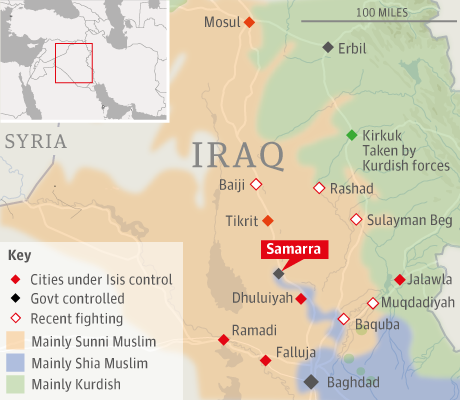
Iraq crisis: Shia volunteers confront Sunni insurgents in Samarra

Thousands of Shia fighters have rushed to the central Iraqi city of Samarra to defend two shrines that were blown up by insurgents eight years ago, sparking the sectarian war that almost destroyed the country.
Convoys of fighters were seen being escorted north by Iraqi police trucks from Baghdad early on Friday and many have now reached the city where insurgents were in control after a lightning strike south.
The volunteer Shia fighters were quickly assembled after Iraqi forcesabandoned their positions in most of the area, leaving only a small number of troops to guard the Imam al-Askarien shrines.
Samarra is the fourth northern city to have all but fallen out of government control. The embattled prime minister, Nouri al-Maliki, appears to have drawn battle lines further south in Taiji, hoping to defend Baghdad against insurgents who have occupied the north virtually unopposed.
Barack Obama on Thursday set the stage for renewed US military action in Iraq when he said his national security chiefs were looking at any and every way they could help the Iraqi authorities take the fight to the thousands of Sunni jihadists who have vowed to march on the capital.
White House officials said the president did not envision any circumstances in which ground troops could return to the country. Air strikes, however, are under active consideration.
Heavy clashes broke out by late Friday on the outskirts of Samarra between the Shia volunteers and Sunni insurgents who had been trying to win over residents, some of whom appear to view the new arrivals as liberators.
Witnesses said the shrines remained undamaged so far and that the insurgents had not been menacing residents. "Some of them have long hair and they are carrying black flags," said one man. "They are Arabs from other countries."
The Samarra shrines were twice reduced to rubble in February and April 2006 in attacks that sparked a brutal two-year sectarian war across Iraq. Since then, Shia Islamic sites have remained key targets as insurgent groups, led by the Islamic State of Iraq in the Levant (Isis) try to draw the Shia-led government back into the fight.
Source: theguardian

Thursday, 12 June 2014

Chinese Ambassador Cui dismisses concern that China is a threat to the US

Chinese Ambassador to the United States Cui Tiankai dismissed concern that a rising China will pose a threat to the US.
Noting that a lack of understanding and misunderstanding between the two nations may prompt some to suspect China's strategic intention, Cui said China's grand strategy is open and transparent.
"It is to achieve the rejuvenation of the Chinese nation and to build a strong, democratic, civilized and harmonious country,"he said. "It is not to seek global dominance, let alone challenge or replace any other nation.”
Cui's remarks were made on Wednesday evening at a reception at the US Congress to mark the 35th anniversary of diplomatic ties between the People's Republic of China and the US. Organized by the US-Asia Institute, and the US-China working groups of US Senate and House of Representatives, the event drew 150 guests, including many lawmakers, Congressional staff, think-tank pundits and business leaders.
Cui said that strategy used in the Cold War era cannot solve today's problems.
"Any attempt to establish confrontational military alliance will result in lose-lose outcome,"he said, adding that a strategy of betting on both sides won't be helpful either.
China has been wary of the US attempt to strengthen its alliance and military presence in the Asia-Pacific region, in particular with Japan, the Philippines and Vietnam, which have maritime territorial disputes with China.
Cui also warned against the possibility of a self-fulfilled prophecy caused by suspicion and fear.
He said statesmen in China and the US started the journey to build a new type of relationship three and four decades ago, by promoting the common interests of the two nations while constructively dealing with their differences.
"History shows that they made the right choice and laid a solid foundation for the bilateral relationship,"Cui said. "If they could understand the historic trend at the height of the Cold War, yet today's generation cannot see the reality of the 21st century and miss the historic opportunity, it will be truly regrettable,”
Cui, a former vice-foreign minister, described as "remarkable'' the progress made in the bilateral relationship in the more than 40 years since President Richard Nixon's first trip to China in 1972. He credited it to efforts by Chinese leaders and eight US presidents from both the Democratic and Republic parties.
While bilateral trade hit $500 billion in 2013, the relationship has expanded in every dimension. Exchanges between the two countries have increased dramatically, with close to 10,000 people traveling between them every day. And Chinese students in US colleges and universities numbered 230,000 a year ago, the largest group among international students.
Cui said that China and the US have maintained close cooperation on regional and global issues. Chinese military vessels are en route to participate for the first time in the Rim of Pacific naval exercise off Hawaii.
The two countries will also kick off the 6th session of the China-US Strategic and Economic Dialogue (S&ED) in Beijing next month to discuss a wide range of cooperation and differences.
Cui said China's development and China-US cooperation have not only brought tangible benefits to the peoples of the two countries, but also contributed greatly to the peace and prosperity to the Asia-Pacific region and the world.
"Today, China-US relations have again entered a critical juncture. The Chinese government has made a decision for comprehensive and deepened reform. Meanwhile, President Xi Jinping and President Barack Obama made a decision to make concerted efforts in building a new type of major country relationship.
"This isn't coincidence. It is because leaders of both nations have realized that the challenges in the 21st century are global and cannot be addressed by any one nation alone,"Cui said.
He said that he believes China and the US, as the largest developing nation and the largest developed nation, share huge common interests and shoulder great common responsibility for the world.
"(They) could first set up a partnership based on mutual respect and win-win cooperation,"Cui said.
China-US relations have suffered a setback in the last few months over issues of cyber security and the maritime territorial disputes in the South and East China seas.
Paul Haenle, director of the Carnegie-Tsinghua Center based in Beijing, said that despite the differences and tensions between China and the US, it's important for both leaders to put as much energy as possible into figuring out how to move forward on a positive agenda.
Source: ChinaDaily USA

Zhaopin IPO raises $76m on NYSE

Zhaopin Ltd, China's most popular online jobs site, went public Thursday on the New York Stock Exchange, raising $75.7 million and adding to the trend of Chinese companies offering IPOs in the United States.
Zhaopin CEO Evan Guo said the listing is a "very important event"for both the company's internal and external operations.
"Zhaopin is a very popular brand in China,"Guo said Thursday in an interview with China Daily. "The listing internally will bring us more rigid accounting policies, but I think the branding is quite critical."
"Externally, this will help us better establish a brand with job seekers,"he said. "And it fuels the credibility attached to the listing."
Zhaopin, founded in 1994, is a leading online-based employment recruitment platform in China. Operating out of its Beijing headquarters, the company offers services to more than 75 million registered users in China.
The company controls the most popular online jobs portal in China, as measured by unique daily visitors, per data from iResearch, a China-based Internet consulting group. And Guo said Zhaopin is also the second largest job recruitment provider based on revenue, second only to China-based 51job Inc.
SEEK International, Australia's largest online job site, is the majority owner of Zhaopin, with close to an 80-percent stake in the company, per data from company officials.
For the nine-month period that ended March 31, more than 11 million job postings were placed online with Zhaopin, a year-on-year increase of 56 percent according to company data.
Employers featured on Zhaopin's site include multinational corporations, small and medium-sized enterprises (SMEs) and state-owned entities (SOEs).
Managers of Zhaopin's offering sold 5.61 million American depositary shares (ADS) at $13.50, the midpoint of the marketed range of $12.50 to $14.50 apiece. Trading under the symbol "ZPIN", shares opened at $13.50 and hit a high of $16.20 in the early afternoon before eventually closing at $14.65, up $1.15, or 8.5 percent.
Managing the deal for Zhaopin were Credit Suisse Securities and UBS Securities Investment Bank.
Zhaopin has also secured a concurrent private placement deal with Apax Partners, a New York-based equity-management group, that in conjunction with stock options for underwriters, could bring the total raised through Zhaopin's offering to more than $100 million.
Zhaopin is the latest Chinese company to go public in the US this year, a list that now includes the better part of 20 companies, according to Bloomberg News.
Three weeks ago, e-commerce giant JD.com raised $1.78 billion in the biggest IPO in the US by a Chinese company to date; it also gave the firm a foothold in the US market ahead of its much larger rival Alibaba Holdings Group Ltd, China's No 1 e-commerce firm. Alibaba's IPO, expected to be held later this year, could exceed $20 billion, according to some estimates.
"[Zhaopin] wants to concentrate on the domestic market because that's where their stronghold is,"said Josef Schuster, founder of Ipox Schuster LLC, a Chicago-based independent financial-services firm specializing in global IPOs. "They seem to be valued in line, but it always depends on whether they meet the fundamentals of earnings and revenue growth.”
Schuster also said Zhaopin is part of "another huge wave of Chinese IPO activity"taking advantage of the "window of opportunity"for Chinese IPOs ahead of Alibaba.
The other successful Chinese IPOs in the US this year may give investors confidence about Zhaopin's prospects, but at the end of the day Guo said US investors are looking for solid growth, "not just in revenue, but also for profits”.
"We're very proud not only because we have commercial value, but also social value,"Guo said. "We're not only helping people find a job, we're helping them develop a career.”
 Source: CHinaDaily USA

China's Natural response to US' encirclement. Military modernization to protect itself against military encirclement.

The Western media is again full of articles claiming a "China threat". This time the articles uncritically cite a Pentagon report that says China is engaged in "unprecedented" military development and is under-reporting the size of its military budget.
Chinas' military budget is about one-third the reported military budget of the United States. But what is virtually never mentioned is that US military and security-related costs may themselves be grossly under-reported. The US War Resistors League estimates that when other related costs are added, military costs jump up from the officially claimed 25 percent of annual Federal expenditures to 49 percent.
What's more, China's military spending must be seen against the backdrop of US foreign policy - policy which seeks to gain military, political, and economic control of the Eurasian land mass, on which China and Russia occupy central positions.
Two doctrines embodied in US foreign policy attest to this policy.
The first is the so-called Wolfowitz Doctrine, which argues that the US must never allow another superpower to emerge.
Former US under secretary of defense for policy Paul Wolfowitz stated in the initial version of the Defense Planning Guidance for the 1994-99 fiscal years: "Our first objective is to prevent the re-emergence of a new rival, either on the territory of the former Soviet Union or elsewhere, that poses a threat on the order of that posed formerly by the Soviet Union. This is a dominant consideration underlying the new regional defense strategy and requires that we endeavor to prevent any hostile power from dominating a region whose resources would, under consolidated control, be sufficient to generate global power."
The document containing this statement and similar notions was changed for public consumption after the original provoked an outcry when it was leaked to the press.
The second doctrine is that US dominance depends on control of the Eurasian landmass. This doctrine has been heavily promoted by former US national security advisor Zbigniew Brzezinski, who wrote in The Grand Chessboard: American Primacy and its Geostrategic Imperatives: "For America, the chief geopolitical prize is Eurasia. Eurasia is the globe's largest continent and is geopolitically axial. A power that dominates Eurasia would control two of the worlds' three most advanced and economically productive regions. Eurasia is thus the chessboard on which the struggle for global primacy continues to be played."
To that end, the US military is being expanded in an attempt to encircle both China and Russia. The US-led NATO military alliance has progressively squeezed Russia's' strategic space by enlisting one former Russian aligned state in Eastern Europe after another. Now, with a US-supported coup-imposed government in power in Ukraine , there is open talk of it being incorporated in NATO, a country right on Russia's border.
The US military has also been encircling China. Military bases and the transfer of billions of dollars in military equipment have been positioned around China for years in areas such as South Korea and Japan.
With the Obama administration's so-called "pivot to Asia," the US is employing a more ambitious program called the Air-Sea Battle Plan, which involves the deployment of large amounts of very expensive hi-tech military systems and equipment in the Pacific region aimed at China.
At the same time, new US military bases are being opened across the Pacific arena, from the Philippines to Australia, with no other conceivable target but China.
In conjunction with this Pacific military build-up, the US is attempting to use previously minor disputes over the ownership of maritime resources as a means of turning a number of smaller Asian nations into its proxies to help it destabilize China. These nations include Japan, South Korea, Vietnam, and the Philippines. By offering its support, and in some cases promises of military assistance in any maritime conflict with China, the US has stoked the ambitions and aggressive nationalist tendencies of these nations vis-a-vis China.
These nations should be warned that they are in fact being used as proxies. There is no guarantee that the US won't turn against them, as it did against its previous Islamic allies in Afghanistan and its previous alliance with Sadam Hussein's Iraq when it suited itself.
To put all these actions against China in perspective, we need to consider who is really the aggressive actor in Asia.
The US has several hundred military bases in other countries, including Asia, while China has none. The US is impinging militarily and politically in China's Asian backyard, but China is not interfering in the US' relations or military activities in the US' backyards of North and South America.
The US has a doctrine of global supremacy; China has no such notion and its foreign policy doctrine is "non-interference in the internal affairs of other nations" and "peaceful co-existence"; China basically wishes to be left alone to develop economically and to engage in economic trade with other nations.
China is no doubt engaged in military modernization. But protecting itself against menacing military encirclement, rather than alleged aggressive tendencies, is the key reason for this.
Source: ChinaDailyUSA

China to further simplify administrative approval procedures for investments and businesses

China's top economic planning body, the National Development and Development Reform Commission says it will delegate more powers and further simplify administrative approval procedures.
In a press conference on Thursday, the NDRC says China will continue to deepen reform of its administrative system. The Commission said that administration will be streamlined and more power will be delegated to lower-level governments. This year, China will cancel or delegate to lower-level governments an additional 200 plus items which earlier required State Council review and approval.
Meanwhile, it says China will deepen reform of the investment approval system, abolish or simplify preliminary review and approval procedures, give businesses full power over their investment decisions, and make it easy to make investments and start businesses.
Source: Xinhua

China plans to relax rules for permanent residence to welcome foreign talent.

With China becoming an increasingly attractive destination for global talent, the government  is considering revising rules to its permanent residency. The government is considering implementing more flexible and pragmatic standards for applications.
The green card system was introduced in China a decade ago. By 2012, only about 5,000 foreigners had obtained permanent residence— a very small number compared to 600,000 living in China at the time. About 1,300 of them were granted green cards through a foreign scientist recruitment plan.
South Korea, the Philippines and Brazil are the top three countries whose citizens settle down in China.
Having lived in Shanghai for the past ten years, Dai Liang has totally adapted to the city. Working as an independent artist, most of time in singing, Dai has enjoyed his life here, and six months ago he started to prepare his application for a green card.
"If you get a green card that is great so that you can have long-term plan, and also it feels like recognition of your achievements in the country," Dai said.
Dai’s old passport is a collection of all kinds of visa he required to stay in China, from student visa to business visa and his current work visa.
Working as an independent artist, he finds difficulties in finding specific documents required for the green card, so he can only try hard to collect recommendation letters by his own means. But the question is: where should he hand in these files?
Dai first went to the exit and entry bureau of the district in which he lives, but he was told only the municipal bureau has the right to deal with his case. He headed to the main bureau, and came out 45 minutes later.
"It is very difficult to get green card. First, the information is very hard to get, as to people like me who work for themselves, such as freelancer, the situation will be even more difficult, but at least I got the answer how to do it, already better than six months ago," Dai said.
China has not set up a complete migration system to cope with the global competition for human resources. The upcoming policy of lowering the threshold of green card could be step forward to welcome more talented people from around the world.
Source: Xinhua

China to relax control over Qulalified Domestic & Foreign Institutional Investors

 China has signaled it will relax control over Qualified Domestic Institutional Investors (QDII) and Qualified Foreign Institutional Investors (QFII) in a showcase of its determination to speed up the yuan's convertibility under the capital account.
The People's Bank of China, the country's central bank, said Wednesday in its 2013 annual report that it will further expand the group of institutional investors under the QDII and QFII schemes and raise their investment quotas.
"When the situation becomes ripe, the country will cancel the approval on qualifications and quotas to let all legitimate institutions at home and abroad enjoy investment opportunities," the report said.
China launched the QFII scheme in 2002 to allow licensed foreign investors to use offshore yuan to invest in China's capital market. Currently, 229 institutions are included in the program with a combined investment quota of 150 billion U.S. dollars.
The QDII scheme was launched in 2006 to allow domestic institutions to invest abroad. More than 100 institutions are qualified at present with a combined quota of 76.79 billion U.S. dollars.
Guo Tianyong, a professor at the Central University of Finance and Economics, said the central bank's decision to gradually cancel the approval signaled its determination to make the yuan convertible under the capital account.
"It shows that the process of making the yuan convertible will be accelerated in the future," Guo said.
The central bank did not give a timetable for any changes in the QDII and QFII programs.
Source: Xinhua

WSJ: Alibaba to Detail Internet Business in New IPO Document

      The WSJ reports,"Alibaba Group Holding Ltd., responding to concerns from investors that it has been too tight-lipped, plans to give out more details about its Internet empire as it readies its potential $20 billion initial public offering, said people familiar with the matter.
The Chinese e-commerce company, which plans to go public in the next few months, is preparing a new regulatory filing that will give metrics on some of its individual businesses, the people said. It will also disclose the names of the 28 partners with the power to nominate the company's board, the people said. The new filing could arrive as soon as Friday, but next week is more likely".
"Alibaba and its banks are responding to some complaints from investors that the company's initial IPO filing was too vague and didn't give them enough information to size up the company.
While companies are typically eager to keep investors happy, the stakes in this case are higher because the company's IPO could be the biggest ever. The sheer number of shares up for sale means bankers need to ensure there is deep enough demand from the largest investors.
Bankers have received some general feedback from investors, the people said, though the formal pricing and sales process isn't expected to begin until later in the summer.
Some big investment firms are expected to consider buying as much as $1 billion worth of stock, a slug that would make Alibaba one of the biggest holdings at some firms.
Alibaba's bankers hope to have demand from big fund firms for at least four or five times the amount the company is selling, people familiar with their thinking said, to help ensure there is ample demand once the company's stock trades publicly to buoy the price. In a typical IPO, bankers might seek orders from the biggest investors for just two or three times as much as they are selling.
That means if Alibaba wants to raise $20 billion, the underwriters will need to identify and generate demand for potentially more than $100 billion worth of shares to meet that goal.
Companies often revise IPO documents after the initial filing. Alibaba is in the process of fielding questions from the Securities and Exchange Commission, which must approve the document before shares can be priced and sold.
Before that approval comes, and before the company sets an expected price range on the stock, the company cannot speak to investors. Its bankers, however, can talk to investors generally about the company, though they cannot solicit from investors whether they would invest, or at what price they would buy in, according to U.S. rules.
The listing, in New York, is currently being planned for the first half of August, though the timing isn't set in stone, the people said. The company expects to shop the deal to investors globally, with large meetings in hubs possibly including Hong Kong, New York and London, they added".

WSJ: Iraq Conflict Weighs on Asian Shares

"Asian stocks moved lower on Friday, as concerns over growing instability in Iraq hit sentiment ahead of a flurry of Chinese economic data.
The Nikkei Share Average was down 0.6%, with the market weighed by a yen that strengthened as news reports showed Iraq edging toward all-out sectarian conflict. The dollar lost 0.4% against the safe haven currency in the previous session, its third consecutive decline, though it picked up a touch in Asian trade. It was last at ¥101.80, compared with ¥101.71 late Thursday in New York.
"Risk-off sentiment and the threat of renewed U.S. military involvement in Iraq, which looks like it might be headed for civil war, will keep investors in sell more—or sidelined," said Norihiro Fujito, a senior investment strategist at Mitsubishi UFJ Morgan Stanley Securities.
The unrest in Iraq also pushed the price of oil 0.8% higher in Asian trade, with the July Nymex crude futures contract trading at $107.33 per barrel, adding to a 2% jump on Thursday.
Furthermore, Asia got a negative lead from U.S. stocks, with Wall Street ending lower after retail sales numbers missed expectations.
South Korea's Kospi lost 1%, Australia's S&P/ASX 200 dropped 0.8%, and Singapore's Straits Times Index lost 0.1%.
The higher cost of oil boosted shares in energy companies, while hurting firms dependent on fuel, such as airlines. In Australia, Woodside Petroleum added 1.9% and Qantas Airways  lost 2.4%.
Also in Australia, miners took another hit after the price of iron ore fell to a 21-month low. Fortescue Metals Group  and Atlas Iron were down 4.4% and 3.3% respectively.
The main economic highlight for Asia will come from China, with the world's second largest economy releasing industrial output numbers and well as retail sales data. The trend for data this month has suggested stabilization in the Chinese economy, following upbeat export and manufacturing data.
Hong Kong's Hang Seng Index was mostly steady ahead of the data, up 0.1%, and the Shanghai Composite Index was flat"".

UCWeb founder and CEO Yu Yongfu : all the dirt on Alibaba’s acquisition of UCWeb

Yesterday, Alibaba and UCWeb jointly announced the former’s full acquisition of the latter, publicly calling it the biggest merger in the history of Chinese internet companies. Today, UCWeb founder and CEO Yu Yongfu gave an interview to foreign media to discuss his company’s role within Alibaba moving forward. While he remained vague about some of the details, here’s everything we’ve learned so far: Really bigger than Baidu’s $1.9 billion acquisition of 91 Wireless? Many were skeptical of this claim when it was put forward in the Chinese press release, and Yu avoided stating the exact sum of money involved in the merger. However, we do know that claim is based on UCWeb’s entire valuation, not just the remaining one-third of the shares that Alibaba didn’t already own. Yu said that because the majority of the transaction was paid for in Alibaba stock instead of cash, the final price will be dependent on Alibaba’s valuation, which analysts estimate around US$168 billion. In fact, Yu even boasted that UCWeb could drive Alibaba’s stock value. We can say with some confidence that UCWeb’s valuation lies somewhere south of US$3.4 billion. That’s because Alibaba is required to publicly report any acquisitions worth more than 20 percent of its assets, which now stand at around US$17 billion according to its SEC prospectus. We’ll know for sure how much Alibaba paid when it updates the prospectus. Where does UCWeb stand now? UCWeb will maintain all of its branding for UC products like its mobile browser as well as the two companies’ joint project, Shenma. Mobile search engine Shenma is aiming for 200 million users by the end of this year. “In our internal deliberations, mobile search will be an important sector for innovation,” Yu said. The company’s flagship mobile browser was last reported to have 500 million quarterly active users globally. UCWeb’s mobile ad revenues will generate an estimated US$200 million, which are shared roughly 50-50 between the company and its partners. That number is expected to exceed US$500 million next year. The company’s gaming arm will also pull in more than US$100 million this year, and is projected to surpass US$250 million in 2015. Yu says in three to five years, he plans to cross the one billion user mark across all the company’s products. Once UCWeb is fully integrated into Alibaba, it will become the ‘Ali UC mobile business group,’ which will jointly lead development for browsers, mobile search, mobile gaming, mobile reading, and location-based services. It will also control PP Assistant, which UCWeb acquired in December, and will work with Alibaba’s other portfolio companies like Youku and Weibo. Why Alibaba? Yu has famously said before that UCWeb is “not for sale,” but the CEO said today the offer came directly from Alibaba founder and executive chairman Jack Ma two months ago, and he hadn’t even considered an acquisition prior to that. Ma and Yu first met in December 2008, and shortly thereafter Alibaba invested in UCWeb. The two companies have been close ever since, and Yu says he trusts Ma. “We share the same vision and the same dream together,” Yu says.

Alibaba pumped an additional round into UCWeb last year, which brought Alibaba’s stake to 66 percent. So why wholly acquire UCWeb if Alibaba already owned a majority stake? Yu explained that the majority of UCWeb’s voting board members were from his own company, so Alibaba didn’t really have control. Also, being a separate company made it difficult to consolidate and share finances. Yu says he’s confident in Alibaba’s impending IPO. As for helping Alibaba spread to international markets where UCWeb has proven popular – India, Southeast Asia, Russia – Yu said the two companies “will help each other,” but didn’t give any specifics.

Source: TECHINASIA

WSJ: Iraq Scrambles to Defend Baghdad

      The WSJ reports, "Iraq's government girded to protect the capital from advancing insurgents, as Iranian security officials said their forces had joined the battle on Baghdad's side and the U.S. weighed military assistance, including airstrikes.
Iraq edged closer to all-out sectarian conflict as Kurdish forces took control of a provincial capital in the oil-rich north on Thursday and Sunni militants threatened to march on two cities revered by Shiite Muslims and the capital.
"What we have seen over the last couple of days indicates the degree to which Iraq is going to need more help—more help from us and more help from the international community," President Barack Obama said from the Oval Office. "My team is working around the clock to identify how we can provide the most effective assistance to them," he added. "I don't rule out anything."
The deteriorating situation in Iraq—a key global oil supplier—reverberated through financial markets Thursday, sending oil prices sharply higher, pushing U.S. stocks lower and igniting the latest rally in safe-haven bonds.
Faced with the threat of Sunni extremists eclipsing the power of Iraq's Shiite-dominated rulers, Shiite Iran sprang into action to aid its besieged Arab ally. It deployed Revolutionary Guards units to Iraq, Iranian security sources said. At least three battalions of the Quds Forces, the overseas branch of the Guards, were dispatched, the security sources said.
Some U.S. military officials cast doubt on the report that battalions of Iranian Quds Forces had deployed to Iraq, saying only militias controlled by or allied with Iran have been mobilized to fight alongside Iraqi forces.
One Revolutionary Guards unit that was already in Iraq fought alongside the Iraqi army against the Islamic State of Iraq and al-Sham, an offshoot of al Qaeda rapidly gaining territory across Iraq, the security sources said.
They offered guerrilla-warfare advice and tactics and helped to reclaim most of the city of Tikrit on Thursday, the security sources said. Two units, dispatched from Iran's western border provinces on Wednesday, were tasked with protecting Baghdad and the holy Shiite cities of Karbala and Najaf, they said.
Gen. Qasem Sulaimani, the commander of the Quds Forces and one of the region's most powerful military figures, traveled to Baghdad this week to help manage the swelling crisis, said a member of the Revolutionary Guards.
With Iraqi Prime Minister Nouri al-Maliki's government proving incapable of containing the widening strife, Iraq's mosaic of ethnic and religious groups has become combustible, as each is forced to take steps to defend its security. The prime minister's office hasn't responded to repeated requests for comment.
Iraqi officials have signaled they would allow U.S. airstrikes on militants, senior U.S. officials said. Iraqi officials have asked the U.S. to speed delivery of promised military support, particularly Apache helicopters, F-16 fighters and surveillance equipment, to help push back ISIS fighters. The U.S. said it has been expediting shipments of military hardware to the Iraqis all year.
ISIS is capitalizing on a wave of Sunni discontent with the Shiite-dominated governments that have ruled Iraq since Hussein's ouster in 2003.
The group aims to set up a state in a continuous stretch of territory from Sunni-dominated Anbar province in Iraq to Raqqa province in northeast Syria. Since capturing Iraq's second-largest city, Mosul, on Tuesday it has advanced south along the Tigris River toward Baghdad.
In another indication of the increasingly sectarian contours of Iraq's turmoil, ISIS on Thursday issued a threat against Baghdad as well as Karbala and Najaf. The latter two cities, along with Mecca and Medina in Saudi Arabia, are considered sacred to Shiites, who make up 60% of Iraq's population.
The threat by ISIS spokesman Abu Mohammed al-Adnani came a day after the powerful Iraqi Shiite leader Moqtada al-Sadr urged his followers to form military units to defend the two cities.
Before he suspended its operations in 2008, Mr. Sadr's Mahdi Army, a militia once estimated to have nearly 60,000 members, played a major role in the country's Sunni-Shiite sectarian conflict. That clash was fueled by the political emergence of Shiites, who had been marginalized and persecuted at the hands of Sunnis during Hussein's nearly 25-year rule".

Popular Posts