 |
|
Tuesday, 28 January 2014
Don't Cry for me Argentina Part I

Rovio Denies Providing Angry Birds User Data To The NSA

A new report originating from the ongoing Snowden document trove presents the terrifying possibility that our casual gaming habits offer government surveillance agencies a look at some key personal data, including but not limited to age, location and even sexual orientation. Angry Birds is cited by name by the documents as an example of the type of so-called “leaky” apps that can act as a source for this sort of information.
It’s a troubling revelation, but not all that surprising given the extent of the intelligence activities previously painted by Snowden’s cache of top-secret documents. Rovio has acted quickly to defend itself, however, and categorically denies any voluntary cooperation with government attempts to collect any data. From a Rovio company press release this morning:
Even if the only outcome of these revelations is a frank re-examining of third-party ad networks, and what kind of information is shared with said organizations by the companies that use them to monetize, that adds up to a win. There’s relatively little transparency in terms of what protections users of these apps are afforded, especially outside of the U.S., and it’s worth shining a light on that relationship given how widespread the ad-supported free software model has become on mobile.Rovio Entertainment Ltd, which is headquartered in Finland, does not share data, collaborate or collude with any government spy agencies such as NSA or GCHQ anywhere in the world.There has been speculation in the media that NSA targets Angry Birds to collect end user data. The speculation is based on information from documents leaked by Edward Snowden.The alleged surveillance may be conducted through third party advertising networks used by millions of commercial web sites and mobile applications across all industries. If advertising networks are indeed targeted, it would appear that no internet-enabled device that visits ad-enabled web sites or uses ad-enabled applications is immune to such surveillance. Rovio does not allow any third party network to use or hand over personal end-user data from Rovio’s apps.
nch
Source: TechCrunch
Chinese FM Wang Yi addresses World Economic Forum
In the Davos Forum, Chinese Foreign Minister Wang Yi is presently participating in discussions on the "global dimensions of China’s development".
Wang Yi is in discussion with Harvard Professor Joseph Nye, who is also former US Assistant Defense Secretary, and former US National Intelligence Council Chairman.
China has kept close engagement with the World Economic Forum and has sent delegations to the forum’s annual meetings since 1979. In June 2006, the forum opened its regional office in Beijing.
The theme for this year’s forum, "The Reshaping of the World: Consequences for Society, Politics and Business", exactly sets out the three dimensions of the world’s current circumstances. How China, the world’s most dynamic economy, lives up to its role in the reshaping of the world and how the world judges its reform has become a focus of this year’s forum.
In Davos and also other such occasions, China has been thinking about its changing relations with the world. China’s story of development is helping the emerging power know itself better, and its observation of the world’s current and future situation affects the whole world as well.
Source: Xinhua
91Mobiles, India doubled its number of mobile phone launches in the past year (INFOGRAPHIC)
91 mobiles,the Indian gadget research and pricing website, just came out with an excellent report on the state of mobile devices in the country.
The 50-page slideshow covers price segmentation in the Indian market among both domestic and international brands, and also takes a look at which companies have added more phones to their product portfolio over the past years.
Some key findings include:
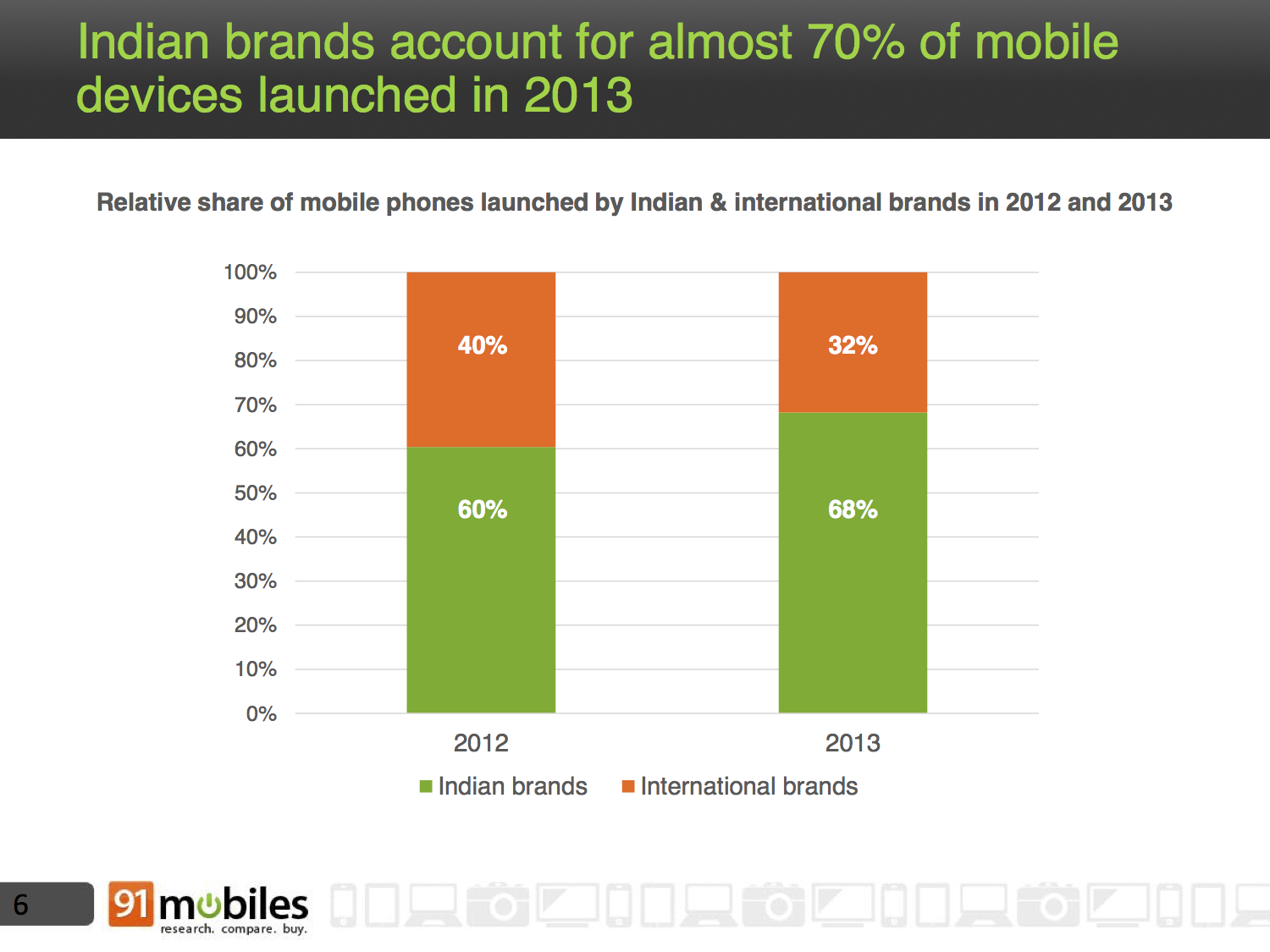
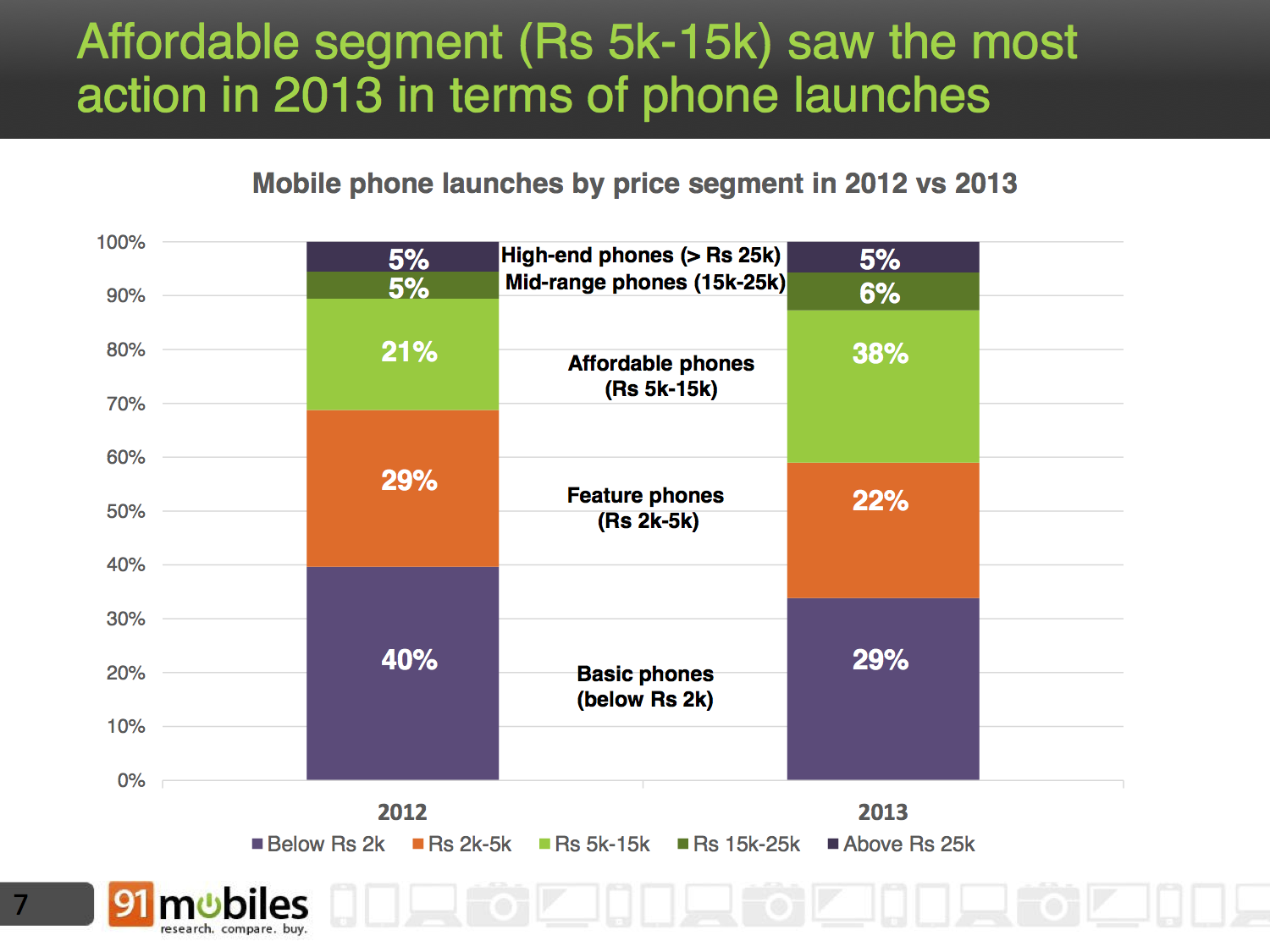
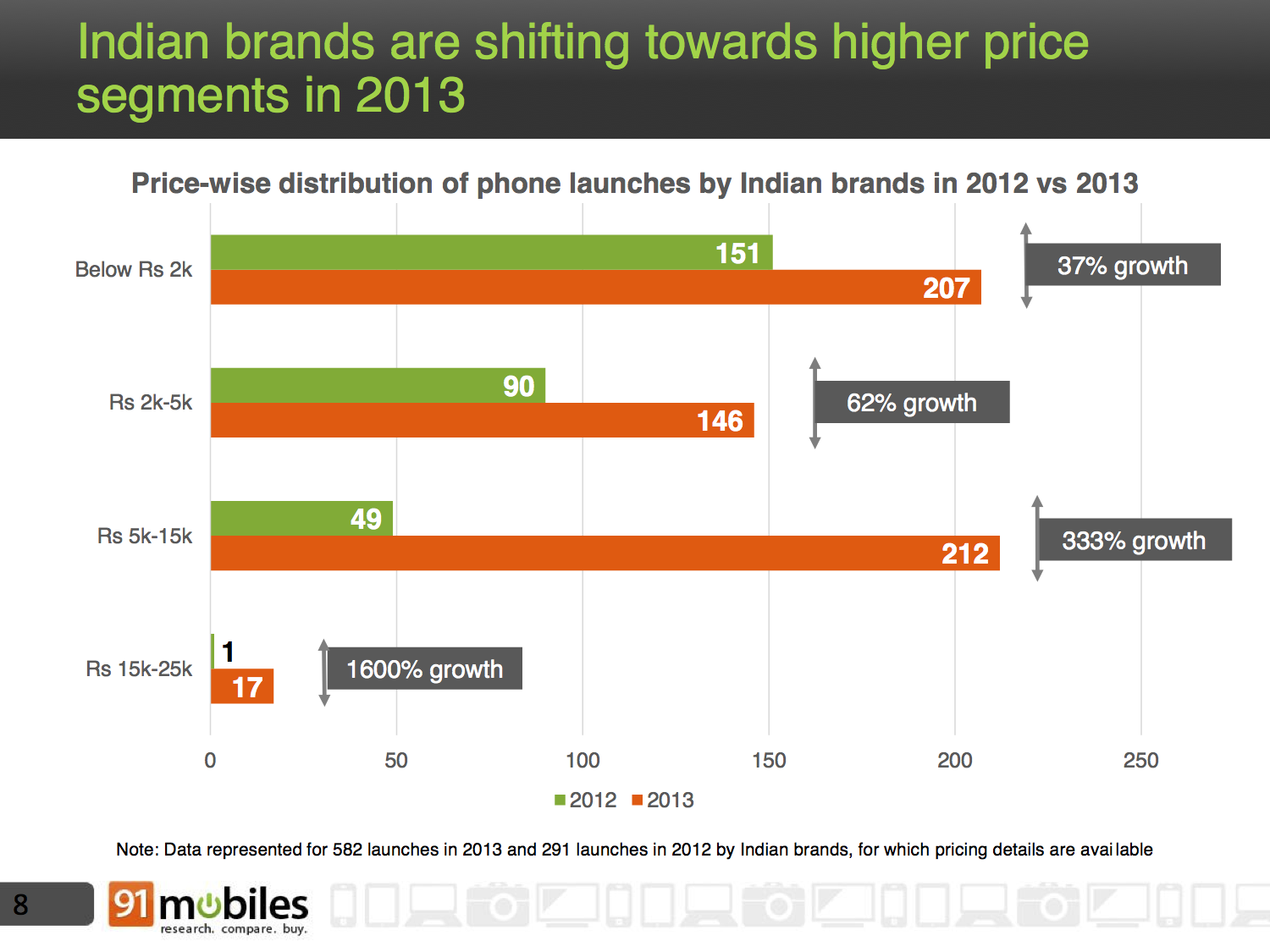
- Indian brands are shifting their production towards middle-end and high-end devices, and away from feature phones. In 2013, launches for devices priced in the Rs 5,000 – RS 15,000 range (about $80 – 240) more than tripled compared to 2012. Meanwhile, 17 devices priced between RS 15,000 – RS 25,000 (about $240 – 400) launched in 2013, compared to just one device the previous year.
- Micromax continued to focus on the low-end market, with the majority of its launches in the sub $80 price-segment, but it’s moving upward.
- When measuring brand pageviews as a means to assess “popularity,” Samsung received 20 percent of 91 mobile’s pageviews, while Micromax received 18 percent of pageviews.
- Budget devices priced under RS 10,000 (about $160) made up over 58 percent of tablet launches in India, with an overwhelming majority of those devices made by Indian manufacturers.
Below we’ve embedded selections from the slideshow’s section on mobile phones (which includes feature phones):



Source:
The Fed’s ‘No-Win Situation’
According to a report from the Wall Street Journal,''the meltdown in emerging-market currencies has added a bit of unwanted drama to Ben Bernanke’s last meeting as chairman of the Federal Reserve''.
Stocks around the world have slumped sharply in recent days. The Dow Jones Industrial Average is riding a five-day losing streak and is off 4.5% for the month; Japan’s Nikkei Stock Average stabilized Tuesday after plunging 5.2% over the previous three sessions; the United Kingdom’s FTSE 100 dropped 4.2% over a five-day skid.
The global rout has prompted some to hope that the Fed might not scale back, or “taper,” the pace of its bond-buying program that was outlined at last month’s meeting.
While that seems unlikely, the debate over what the Fed should do next has put the central bank in a tough spot.
The two-day Fed meeting starts later today and concludes Wednesday with a policy statement and the handoff from Mr. Bernanke to incoming Chairwoman Janet Yellen. She will be tasked with unwinding the Fed’s multi-trillion-dollar stimulus program in delicate fashion without further stirring markets around the globe.
The longer that financial market disruptions persist, the greater the likelihood that the Fed will have to temporarily halt the pace of tapering.
That’s the conundrum the Fed potentially finds itself in.
IMF Executive Board Concludes 2013 Article IV Consultation with Peru
Peru’s economy continues to be a leader in high growth and low inflation in the region, which has been achieved through a prudent macroeconomic policy implementation, a far-reaching structural reform agenda and taking advantage of the benign external environment. No least due to these factors, the economy came out virtually unscathed from the 2008‒09 global financial crisis, with growth rebounding to 8.8 percent in 2010 and then being sustained at high levels in 2011–12. After reaching 4.7 percent in 2011, end-period inflation fell to 2.6 percent in 2012, within the 1-3 percent target range. Stimulative monetary and fiscal policies played an instrumental role in supporting the recovery, and were smoothly unwound as growth accelerated and the negative output gap was closed.
Activity has slowed this year on the heels of adverse external shocks and a decline in domestic confidence. Real GDP is expected to have grown around 5 percent in 2013.
Activity has slowed this year on the heels of adverse external shocks and a decline in domestic confidence. Real GDP is expected to have grown around 5 percent in 2013.
Inflation remained within the 1-3 percent target range, reaching 2.9 percent by end-2013 due to increases in food and fuel prices and some pass-through from the exchange rate depreciation. Private credit growth slowed in real terms to 12.5 percent at end-2012 (from 14.0 percent at end-2011) due to macro-prudential measures aimed at mitigating the impacts of surges in capital flows. The financial sector remains sound, profitable and well-capitalized, supported by the authorities’ pro-active use of prudential measures.
The outlook remains favorable in the near term despite challenging external conditions. The projected growth deceleration in China (one of Peru’s main trading partners) and the unwinding of monthly purchases of securities by the U.S. Federal Reserve will result in a lower external demand and terms of trade deterioration. Against this background, real GDP growth is projected to be 5.5 percent in 2014, slightly below potential, while inflation is projected to decline to about 2.5 percent as expectations are well-anchored owing to the strong inflation targeting framework. The current account deficit is projected to remain elevated at 4.8 percent of GDP in 2014, but will decline gradually over the medium-term on account of expected pickup in mining exports.
In concluding the 2013 Article IV consultation with Peru, Executive Directors endorsed staff’s appraisal, as follows:
The overall state of the economy remains strong despite lower metal prices and recent market turbulence. Peru continues to be one of the most dynamic economies in the region, and one with the largest buffers thanks to past strong policy implementation. With an economy growing somewhat near potential, macroeconomic policies should remain relatively neutral, unless additional turbulence in markets emerges or other downside risks materialize. Preserving policy flexibility by continuing with a good track record of appropriate policy responses to adverse circumstances remains instrumental to addressing future challenges. Risks are balanced. While external risks are tilted to the downside, domestic risks are on the upside. Significant terms of trade gains could be reversed if growth deteriorates in main trading partners, reducing income, investment, and growth. Sudden stops and reversal of some non-Foreign Direct Investment (FDI) capital flows to Peru (due to tightening of global financial conditions) could put pressure on the financial system and further decelerate growth.
While vulnerabilities have increased, current buffers are sufficient to address possible short-term shocks. Increased risk aversion due to the expected “tapering” of asset purchases by the USFR could lead to a reversal of capital inflows, necessitating the central bank to deploy resolute actions to maintain confidence and ensure orderly functioning of markets as was done during the global financial crisis in 2008–09. Slower global growth could lead to lower external demand and deterioration in terms of trade, the exchange rate should work as a shock absorber, although there are risks given the dollarization of the financial system. Monetary and macro-prudential policies should be relaxed to support economic activity. If the economic slowdown is too pronounced, consideration could be given to use a measured and temporary fiscal impulse.
A patronizing article from the WSJ about Emerging Markets
"The question now is whether the asset class faces seven lean years after (roughly) seven fat ones. Or whether the recovery will be sooner and sharper than it has tended to be in past cycles".
"The MSCI emerging markets equity index is down 13% over the past year in dollar terms–with the leading BRIC countries, Brazil, Russia, India and China, down 17%. An index composed of the seven leading industrialized countries’ shares is up 16% over the same period.
That’s a dramatic reversal of relative performance.
Emerging markets equities were up 270% in the decade to 2013–notwithstanding they had fallen 20% from October 2007 peak. G-7 equities were up a mere 57% over the same period''.
''Maybe it should come as no surprise that just as developed economies seem to be emerging from the worst of the financial crisis’ after-effects, emerging economies are stuttering. The current malaise started last spring when the Federal Reserve started dropping heavy hints about winding down its stimulus effort. This makes sense. A flood of developed economy central bank liquidity flowed into emerging markets following the financial crisis, seeking out a dribble of positive yield. But with the outlook for developed economies improving, some of that started to reverse".
"There are plenty of problems specific to some of the hardest hit emerging markets, not least political turbulence in Turkey and Thailand, inflation in Brazil and India, and China’s increasingly precarious financial system".
''Historically, emerging market performance has tended to move in five- to ten-year cycles, usually driven by extended credit booms followed by deep busts during which time default, devaluation and inflation have crushed investor returns''.
The author of this article is saying that all EM are on the same bag something that I deeply disagree, because it is clearly a mistake
''There are plenty of reasons, however, to believe that things haven’t changed that much. There have been huge credit booms in Turkey, Brazil and especially China. There has undoubtedly been vast misallocation of capital which will have to be recognized one way or another. If defaults don’t follow, government bailouts will. Devaluation and low growth are highly likely as economies adjust. A flow of bad news will drive investors away and keep them there until they’ve sufficiently forgotten the pain and are once again attracted by the potential".
If it not where for China's purchases of treasuries, the US economy would still be in a very,very deep recession.
Talking about misallocation of resources,has the author forgot of the Dot.com bubble?,the commodities bubble?,and the real state bubble? of the past 15 or 20 years in the US Markets.
If it not where for China's purchases of treasuries, the US economy would still be in a very,very deep recession.
Talking about misallocation of resources,has the author forgot of the Dot.com bubble?,the commodities bubble?,and the real state bubble? of the past 15 or 20 years in the US Markets.
Source: WSJ Falling Like A Brick by Allen Mattich
US Bureau of labor Statistics Press Release Data December 2013
 REGIONAL AND STATE EMPLOYMENT AND UNEMPLOYMENT -- DECEMBER 2013


Regional and state unemployment rates were generally lower in December.
Thirty-nine states and the District of Columbia had unemployment rate
decreases from November, two states had increases, and nine states had
no change, the U.S. Bureau of Labor Statistics reported today. Forty-two
states and the District of Columbia had unemployment rate decreases from
a year earlier, six states had increases, and two states had no change.
The national jobless rate declined to 6.7 percent from November and was
1.2 percentage points lower than in December 2012.

In December 2013, nonfarm payroll employment increased in 30 states,
decreased in 19 states and the District of Columbia, and was unchanged
in Vermont. The largest over-the-month increases in employment occurred
in Texas (+17,600), Florida (+14,100), and California (+13,600). The
largest over-the-month decrease in employment occurred in New Jersey
(-36,300), followed by Pennsylvania (-11,400) and Kansas (-7,400). The
largest over-the-month percentage increases in employment occurred in
Alaska and Hawaii (+0.5 percent each). The largest over-the-month
percentage decline in employment occurred in New Jersey (-0.9 percent),
followed by Kansas (-0.5 percent) and Idaho (-0.4 percent). Over the
year, nonfarm employment increased in 49 states and decreased in Alaska
(-0.7 percent) and the District of Columbia (-0.1 percent). The largest
over-the-year percentage increase occurred in North Dakota (+4.0 percent),
followed by Florida (+2.6 percent) and Oregon (+2.4 percent).

Regional Unemployment (Seasonally Adjusted)

In December, the West continued to have the highest regional unemploy-
ment rate, 7.4 percent, while the South had the lowest rate, 6.4
percent. Over the month, all four regions had statistically significant
unemployment rate declines: the Northeast and South (-0.3 percentage
point each) and Midwest and West (-0.2 point each). Significant declines
also occurred over the year in all regions: the West (-1.2 percentage
points), Northeast (-1.1 points), South (-0.9 point), and Midwest
(-0.5 point). (See table 1.)

Among the nine geographic divisions, the Pacific had the highest jobless
rate, 7.8 percent in December. The West North Central again had the
lowest rate, 4.7 percent. Six divisions had statistically significant
over-the-month unemployment rate changes, all of which were declines.
The largest of these declines occurred in the Middle Atlantic and South
Atlantic (-0.3 percentage point each). Five divisions had significant
rate changes from a year earlier: the Pacific and South Atlantic (-1.4
percentage points each), Middle Atlantic (-1.3 points), Mountain
(-0.8 point), and West North Central (-0.7 point).

State Unemployment (Seasonally Adjusted)

Rhode Island had the highest unemployment rate among the states in
December, 9.1 percent. The next highest rates were in Nevada, 8.8
percent, and Illinois, 8.6 percent. North Dakota continued to have the
lowest jobless rate, 2.6 percent. In total, 17 states had jobless rates
significantly lower than the U.S. figure of 6.7 percent, 9 states and
the District of Columbia had measurably higher rates, and 24 states had
rates that were not appreciably different from that of the nation.
(See tables A and 3.)

Twenty-one states and the District of Columbia had statistically
significant over-the-month unemployment rate decreases in December,
the largest of which occurred in Louisiana (-0.6 percentage point). The
remaining 29 states had jobless rates that were not measurably different
from those of a month earlier, though some had changes that were at
least as large numerically as the significant changes. (See table B.)

Twenty-one states had statistically significant unemployment rate
changes from December 2012, all of which were declines. The largest of
these occurred in North Carolina (-2.5 percentage points), followed by
New Jersey (-2.2 points) and South Carolina (-2.0 points).
(See table C.)

Nonfarm Payroll Employment (Seasonally Adjusted)

In December 2013, six states had statistically significant over-the-
month changes in employment, four of which were increases. The
statistically significant job gains occurred in North Carolina
(+11,100), Massachusetts (+10,300), Minnesota (+9,500), and Hawaii
(+3,300). The two statistically significant job decreases occurred
in New Jersey (-36,300) and Kansas (-7,400). (See tables D and 5.)

Over the year, 29 states had statistically significant changes in
employment, all of which were positive. The largest over-the-year
job increase occurred in Texas (+252,400), followed by California
(+235,700) and Florida (+192,900).
Emerging Markets Countries policies response to market turmoil and Fed Tapering Decision
The Wall Stree Journal reports,after a week of nervous selling in emerging market currencies and a relentless selloff in U.S. stocks, there are signs Tuesday that markets are stabilizing. In Asia the trading day went off relatively calmly and in Europe the Turkish lira has stabilized after the central bank said it would hold an emergency meeting later tonight. (See the “Coming Up” section). Meanwhile, more positive signals out of European data sources have helped to remind investors of the relatively improved economic backdrop in that part of the world.
It’s clear, however, that the market turmoil is putting pressure on central banks to take aggressive actions that don’t necessarily fit with the underlying state of their economies. In addition to Turkey’s action, the Reserve Bank of India surprised observers by hiking rates today, a move that was no doubt at least partly triggered by the heavy selling pressure on the rupee, and others, such as Indonesia’s central bank, are expected to follow. Yet for now the global investment community’s eyes are most firmly fixed on the U.S., where President Obama delivers his State of the Union speech tonight and, most important, the Federal Reserve begins a two-day meeting. The Fed had been expected to announce another $10 billion reduction in its bond-buying program tomorrow, but this stress in financial markets has become a wild card. It could well choose to stand pat, a move that would be welcomed with great relief in emerging markets.
U.S. home prices drop 0.1% in November
U.S. home prices ticked down 0.1% in November, the first decline in a year, with nine of 20 tracked cities posting price drops as winter approached, according to data released Tuesday. After seasonal adjustments, home prices in November rose 0.9%, according to S&P/Case-Shiller's 20-city composite index. On a year-over-year basis, home prices rose 13.7% in November, the fastest growth in more than seven years. Pent-up demand and low inventories of homes for sale have been supporting price growth. Including November's results, prices remain about 20% below a 2006 peak, though certain cities, such as Dallas, have recently posted fresh record highs. "Home prices continue to rise despite last May's jump in mortgage interest rates," said David Blitzer, index committee chairman at S&P Dow Jones Indices. "While housing will make further contributions to the economy in 2014, the pace of price gains is likely to slow during the year."
Source: Marketwatch
Source: Marketwatch
Europe's stock markets Indixes

Source: BBC
LONDON MIDDAY: STOCKS RISE AS EMERGING-MARKET TURMOIL EASES
Data showing the best annual growth in Britain since 2007 gave UK markets a lift on Tuesday, helping stocks to recover from their worst levels in nearly six weeks.
According to the Office for National Statistics (ONS), UK gross domestic product (GDP) rose by 0.7% in the fourth quarter, a slight slowdown from the 0.8% growth registered the preceding three months but in line with expectations.
However, over 2013 as a whole, the economy expanded at a 1.9% rate, compared with just 0.3% growth in 2012.
"Today's estimate suggests over four-fifths of the fall in GDP during the recession has been recovered, although it still remains 1.3% below the pre-recession peak," said ONS Chief Economic Advisor Joe Grice.
The FTSE 100 was trading up 0.4% at 6,579 by midday, rebounding after hitting 6,550.66 on Monday - its worst closing price since December 18th.
The sell-off in emerging-market currencies - which had sparked big falls across global stock markets in recent days - stabilised today after Turkey's central bank said it would hold an emergency monetary policy meeting to take measures to halt the sharp slide in the lira.
Investors were also beginning to look ahead to the Federal Open Market Committee meeting which concludes tomorrow. The Fed, which began scaling back its monthly asset purchases in December from $85bn to $75bn, will make another $10bn cut this month, according to the consensus forecast.
Ahead of the meeting, investors Stateside will be focusing on a number of key economic indicators out today, including US durable goods orders for December, US home-price figures for November and US consumer confidence data for January.
Source: LiveCharts
According to the Office for National Statistics (ONS), UK gross domestic product (GDP) rose by 0.7% in the fourth quarter, a slight slowdown from the 0.8% growth registered the preceding three months but in line with expectations.
However, over 2013 as a whole, the economy expanded at a 1.9% rate, compared with just 0.3% growth in 2012.
"Today's estimate suggests over four-fifths of the fall in GDP during the recession has been recovered, although it still remains 1.3% below the pre-recession peak," said ONS Chief Economic Advisor Joe Grice.
The FTSE 100 was trading up 0.4% at 6,579 by midday, rebounding after hitting 6,550.66 on Monday - its worst closing price since December 18th.
The sell-off in emerging-market currencies - which had sparked big falls across global stock markets in recent days - stabilised today after Turkey's central bank said it would hold an emergency monetary policy meeting to take measures to halt the sharp slide in the lira.
Investors were also beginning to look ahead to the Federal Open Market Committee meeting which concludes tomorrow. The Fed, which began scaling back its monthly asset purchases in December from $85bn to $75bn, will make another $10bn cut this month, according to the consensus forecast.
Ahead of the meeting, investors Stateside will be focusing on a number of key economic indicators out today, including US durable goods orders for December, US home-price figures for November and US consumer confidence data for January.
Source: LiveCharts
WSJ: Heavy Selling Abates in Asian Markets
The Wall Street Journal reports, that asian stocks stabilized on Tuesday, with many markets trading around the break-even mark as the region paused after a global selloff that saw heavy losses in recent sessions.
The region was relatively calm after three days of downward movement. Japan's Nikkei dropped just 0.2% to 14980.16 after plunging a total of 5.2% over the last three sessions. Hong Kong's Hang Seng Index ended less than 0.1% down at 21960.64, South Korea's Kospi added 0.3% to 1916.93 and Singapore's Straits Times Index was up 0.3% late in Asia.
Australia's S&P/ASX 200 made the biggest move lower, down 1.3% at 5175.10, as the market played catch-up with a global selloff that started late last week. A public holiday on Monday meant Sydney missed a brutal session that put many of the region's markets more than 2% lower.
Global markets have been under pressure since last Thursday, when data pointed to a contraction in China's manufacturing sector. This triggered selling in many emerging markets, with countries such as Turkey and Argentina in focus, which then spread to developed markets like the U.S. and Japan.
There was some relief after China avoided what could have been a destabilizing hit to its financial system after a major shadow lender arranged a bailout for investors who bought an investment product that was about to go bust. China's largest bank by assets, Industrial & Commercial Bank of China, had sold the product and its shares were up 0.9% in Shanghai.
Also in China, the Shanghai Composite rose 0.3% to 2038.51 as Shaanxi Coal Industry Co. had a strong debut after raising 4 billion yuan ($661 million) via an initial public offering earlier this month—the largest IPO in mainland China since new listings resumed at the beginning of the year. Shares in China's biggest coal producer soared 13.8%.
US New Orders for Durable Good Manufacturers' in December fell 4.3%
Advance Report on Durable Goods Manufacturers’ Shipments, Inventories and Orders
December 2013
New Orders
New orders for manufactured durable goods in
December decreased $10.3 billion or 4.3 percent to
$229.3 billion, the U.S. Census Bureau announced
today. This decrease, down two of the last three months,
followed a 2.6 percent November increase. Excluding
transportation, new orders decreased 1.6 percent.
Excluding defense, new orders decreased 3.7 percent.
Transportation equipment, also down two of the last
three months, led the decrease, $7.7 billion or 9.5
percent to $73.1 billion. This was led by nondefense
aircraft and parts, which decreased $3.8 billion.
Shipments
Shipments of manufactured durable goods in
December, down following four consecutive monthly
increases, decreased $4.5 billion or 1.9 percent to $232.8
billion. This followed a 1.3 percent November increase.
Transportation equipment, also down following four
consecutive monthly increases, led the decrease, $4.1
billion or 5.7 percent to $68.3 billion.
Unfilled Orders
Unfilled orders for manufactured durable goods in
December, up ten of the last eleven months, increased
$3.9 billion or 0.4 percent to $1,061.5 billion. This was
at the highest level since the series was first published on
a NAICS basis in 1992, and followed a 0.9 percent
November increase.
Transportation equipment, up four consecutive months,
drove the increase, $4.8 billion or 0.7 percent to $659.1
billion.
Inventories
Inventories of manufactured durable goods in
December, up eight of the last nine months, increased
$3.0 billion or 0.8 percent to $387.8 billion. This was at
the highest level since the series was first published on a
NAICS basis, and followed a 0.3 percent November
increase.
Transportation equipment, up nineteen of the last
twenty months, led the increase, $1.3 billion or 1.1
percent to $122.1 billion.
Capital Goods
Nondefense new orders for capital goods in December
decreased $4.3 billion or 5.0 percent to $82.5 billion.
Shipments increased $0.6 billion or 0.8 percent to $75.4
billion. Unfilled orders increased $7.1 billion or 1.1
percent to $642.7 billion. Inventories increased $1.2
billion or 0.7 percent to $176.7 billion.
Defense new orders for capital goods in December
decreased $1.9 billion or 21.5 percent to $6.8 billion.
Shipments decreased $1.3 billion or 11.5 percent to $9.6
billion. Unfilled orders decreased $2.8 billion or 1.7
percent to $161.9 billion. Inventories increased $0.5
billion or 2.1 percent to $22.9 billion.
Revised November Data
Revised seasonally adjusted November figures for all
manufacturing industries were: new orders, $495.9
billion (revised from $497.9 billion); shipments, $493.6
billion (revised from $494.6 billion); unfilled orders,
$1,057.6 billion (revised from $1,058.5 billion); and
total inventories $633.8 billion (revised from $633.4
billion
Source: US Department of Commerce
December 2013
New Orders
New orders for manufactured durable goods in
December decreased $10.3 billion or 4.3 percent to
$229.3 billion, the U.S. Census Bureau announced
today. This decrease, down two of the last three months,
followed a 2.6 percent November increase. Excluding
transportation, new orders decreased 1.6 percent.
Excluding defense, new orders decreased 3.7 percent.
Transportation equipment, also down two of the last
three months, led the decrease, $7.7 billion or 9.5
percent to $73.1 billion. This was led by nondefense
aircraft and parts, which decreased $3.8 billion.
Shipments
Shipments of manufactured durable goods in
December, down following four consecutive monthly
increases, decreased $4.5 billion or 1.9 percent to $232.8
billion. This followed a 1.3 percent November increase.
Transportation equipment, also down following four
consecutive monthly increases, led the decrease, $4.1
billion or 5.7 percent to $68.3 billion.
Unfilled Orders
Unfilled orders for manufactured durable goods in
December, up ten of the last eleven months, increased
$3.9 billion or 0.4 percent to $1,061.5 billion. This was
at the highest level since the series was first published on
a NAICS basis in 1992, and followed a 0.9 percent
November increase.
Transportation equipment, up four consecutive months,
drove the increase, $4.8 billion or 0.7 percent to $659.1
billion.
Inventories
Inventories of manufactured durable goods in
December, up eight of the last nine months, increased
$3.0 billion or 0.8 percent to $387.8 billion. This was at
the highest level since the series was first published on a
NAICS basis, and followed a 0.3 percent November
increase.
Transportation equipment, up nineteen of the last
twenty months, led the increase, $1.3 billion or 1.1
percent to $122.1 billion.
Capital Goods
Nondefense new orders for capital goods in December
decreased $4.3 billion or 5.0 percent to $82.5 billion.
Shipments increased $0.6 billion or 0.8 percent to $75.4
billion. Unfilled orders increased $7.1 billion or 1.1
percent to $642.7 billion. Inventories increased $1.2
billion or 0.7 percent to $176.7 billion.
Defense new orders for capital goods in December
decreased $1.9 billion or 21.5 percent to $6.8 billion.
Shipments decreased $1.3 billion or 11.5 percent to $9.6
billion. Unfilled orders decreased $2.8 billion or 1.7
percent to $161.9 billion. Inventories increased $0.5
billion or 2.1 percent to $22.9 billion.
Revised November Data
Revised seasonally adjusted November figures for all
manufacturing industries were: new orders, $495.9
billion (revised from $497.9 billion); shipments, $493.6
billion (revised from $494.6 billion); unfilled orders,
$1,057.6 billion (revised from $1,058.5 billion); and
total inventories $633.8 billion (revised from $633.4
billion
Source: US Department of Commerce
India's RBI Surprises With Rate Hike
According to a report from the Wall Street Journal, India's central bank announced a surprise increase in its key lending rate Tuesday, signaling its resolve to fight rising prices even as the South Asian economy faces its slowest growth in a decade.
The Reserve Bank of India increased the rate at which it lends to banks overnight by 0.25 percentage point to 8.0%. This is the third rate hike in five months and indicates the central bank's continued hawkish stance. The central bank also gave indications that it is hoping that this could be its last rate increase in this round of tightening as some prices are showing signs of cooling.
All 14 economists polled by The Wall Street Journal last week had expected the RBI to leave rates unchanged after inflation—measured by both wholesale and retail prices—showed signs of easing last month, helped by lower food prices.
Wholesale inflation, the main gauge of prices in India, slipped to a five-month low in December to 6.16% while retail inflation—measured by the country's two year old consumer-price index—eased from an all-time high of more than 10% in recent months to 9.87%.
The central bank noted Tuesday that if volatile food and fuel prices were stripped out, CPI inflation rates have remained flat while WPI inflation has risen.
"It is critical to address these risks to the inflation outlook resolutely in order to stabilize and anchor inflation expectations, even while recognizing the economy is weak and substantial fiscal tightening is likely in Q4," RBI Governor Raghuram Rajan said in the policy document.
Mr. Rajan also indicated that he agreed with the recommendation of a central bank panel, which last week suggested the RBI start using a CPI inflation target to determine monetary policy.
The target should be within two percentage points above or below 4%, the panel said.
If the RBI decides to accept the proposal, it would align India with other economies and mean the RBI would have to move away from its current approach of looking at more than one indicator—inflation, growth and exchange rates-when it set its policy rate. That would mean the RBI may be headed toward a tighter monetary policy until inflation is brought down to the indicative band.
The RBI panel said the central bank should move to lower India's consumer inflation to 8% within the next 12 months and to 6% in 24 months, before adopting the target.
Still, most executives and politicians would like to see the central bank start worrying more about growth so India can create the jobs and higher incomes it population of more than 1.2 billion wants.
India's gross domestic product expansion slowed to 4.8% in the quarter ended September, down sharply from 9.9% during one quarter 2½ years earlier. Its full year growth in the fiscal year ending March is likely to slide to an 11-year low of less than 5%, economists say.
Monday, 27 January 2014
2014 Davos meeting ends with cautious optimism
The annual meeting of the World Economic Forum (WEF) concluded here Saturday on a note of cautious optimism about the world economy.
The idea that global economy is on a bumpy path of recovery, but is shadowed by uncertainty, potential risks and challenges was shared by a couple of leading economists at the meeting, including Jim Yong Kim, president of the World Bank, Christine Lagarde, managing director of the International Monetary Fund and Mario Draghi, president of the European Central Bank.
The hot political issues such as the Syrian crisis and Iran's nuclear program riveted more attention this year, with couples of political leaders expressing their views and positions via the platform of the WEF.
During the four-day meeting, over 2,500 participants from almost 100 countries, including more than 1,500 business leaders and over 40 heads of state or government, exchanged views on and probed into possible approaches to problems such as global economic recovery, financial outlook, new energy, health and climate change.
All the issues are under four major topics, namely Embracing Disruptive Innovation, Achieving Inclusive Growth, Meeting Society's New Expectations and Sustaining a world of 9 Billion.
Source: Xinhua
Subscribe to:
Posts (Atom)
Popular Posts
-
President Barack Obama won the backing of key figures in the U.S. Congress, including Republicans, in his call for limited U.S. strikes o...
-
U.S. crude prices gained a dollar to over $100.50 a barrel on Wednesday as data from China showed its economy grew faster than expected an...
-
Iraqi government forces battled Sunni rebels for control of the country's biggest refinery on Thursday as Prime Minister Nuri al-Maliki...
-
The Chang´e-3 , named after a Chinese lunar goddess, is China’s first spacecraft to make a soft landing on the moon. It comprises a lander...
-
Japan's financial watchdog said Tuesday it would probe the country's top three banks in the wake of a loans-to-mobsters scandal th...
-
Activity in China's factory sector contracted in January for the first time in six months, a preliminary survey showed on Thursday, p...
-
Asian shares recouped early losses on Friday as sentiment in the region proved resilient to Portuguese bank concerns amid signs offshore f...
-
June 6 (Reuters) - Hedge funds and money managers cut their bullish bets in gold futures and options in the week to June 3 to their lowest...
-
BANGKOK, Oct. 23 (Xinhua) -- China is not only moving to achieve a strategic balance with the United States in Southeast Asia but is also ...
