Thursday, 27 March 2014

IMF: Even with a Slower Growth China will continue to be an engine of Global Output.

Mongolia’s economy grew nearly 12 percent last year, the United States around 2 percent. So Mongolia grew around 6 times faster than the United States, yet of course the United States contributed more to GDP growth—over 150 times more. Why, because size matters.
Let’s apply this logic to China. A bigger but somewhat slower growing China of the future will contribute about as much to global demand as the smaller but faster growing China of before. This is arithmetic: An economy that is twice as big can grow by ½ as much and contribute the same to global demand. By the way, China today is more than twice as big as it was a decade ago.
So, the good news is, even with slower growth, China will continue to be an engine of global output. Indeed, an even bigger engine than before.

By Steven Barnett
Division Chief in the Asia and Pacific Department of the International Monetary Fund (IMF)

IMF CHRISTINE LAGARDE, THOUGHTS AFTER END OF ITS LATEST VISIT TO CHINA MARCH 24TH 2014

“It has been a great pleasure to be back in China. I had the privilege of meeting with Premier Li Keqiang and Vice Premier Ma Kai. I had very productive discussions with the People’s Bank of China Governor Zhou Xiaochuan and Finance Minister Lou Jiwei.
“In my meetings with the authorities, we exchanged views on the global economy, the next phase of China’s development, and China’s increasingly important leadership role at the IMF. As the world’s second largest economy, China has played an important part in helping to stabilize the global economy during the financial crisis. Going forward, China will continue to be a key driver of the global recovery.
“I am deeply impressed and encouraged by the strong commitment of the Chinese authorities to continue the ongoing rebalancing of the economy and to make growth more inclusive, friendlier to the environment, and more sustainable, as outlined in the 3rd Plenum Decision. To tackle challenges facing the next phase of the economic transformation, China needs to comprehensively deepen reforms. Unleashing the potential of the services sector, building a modern financial sector, and promoting inclusive growth, combined with pro-green policies, will help ensure that China achieves such a transformation.
“During my visit I was honored to speak at the 2014 China Development Forum where I met with Vice Premier Zhang Gaoli and other senior policymakers, academics, women leaders and private sector representatives on major issues facing the world and China. Topics included reform of financial systems and moving towards more sustainable growth, building better social safety nets, and empowering women.
“I was also encouraged by the creativity, dynamism, and optimism of the Chinese women, youth, entrepreneurs and “netizens” with whom I met over the past three days, including through a live chat on Sina Weibo and at Tsinghua University where I was privileged to exchange views with faculty and students.
“I would like to express my profound gratitude to the Chinese government and people for their gracious hospitality. I look forward to my next visit in the near future.”

Partial Transcript of a Press Briefing by William Murray, Deputy Spokesman, Communications Department, International Monetary Fund

IMF FINANCIAL SUPPORT TO UKRAINE
QUESTIONER: On Ukraine, can you give us an understanding about the potential bank recapitalization needs, and where will the money for those potential needs come from?
MR. MURRAY: I'm really not able, at the moment, to go beyond what we brief on in Kiev. We just wrapped up a press conference a couple hours ago in Kiev, where we announced to have reached staff-level agreement with Ukraine. There's a fairly detailed press release. We have a staff-level agreement, still subject to approval by our management and the executive board. There's a $27 billion package. The IMF will contribute somewhere between $14-$18 billion towards that package. The reason we're giving a range is because we're still working on lining up bilateral and multilateral contributions to the overall $27 billion.
QUESTIONER: There was no mention of a debt-restructuring. So, to be clear, there's not going to be a need for debt-restructuring at this point in the program?
MR. MURRAY: We don't proceed with programs if they're deemed to be unsustainable. So, the fact that we're proceeding with the program indicates that we don't envisage, at this point, a debt-restructuring. But, you know, let's wait for the staff report to be published so we can get into more detail on that.
QUESTIONER: Staying with Ukraine -- and I also apologize that I'm not familiar with the contents of the press conference in Kiev --I understand that the rules of the IMF also precludes it from lending to a country into arrears. That is, a country needs to be current in their debt payments? Basically, does it mean that if and when the first disbursement comes, it will probably go into paying debts?
MR. MURRAY: I can't answer that question right now. I have to see the full program. But that's an assumption you're making. I can't jump to that conclusion. The program is to assist Ukraine. There's conditions attached to how they use the money -- but we'll see what happens.
QUESTIONER: I understand there is a financing need.
MR. MURRAY: So it's a balance of payments support program.
QUESTIONER: Do you know the amount of the need for the nearest future?
MR. MURRAY: Well, like I said, it's a $27 billion package, over two years, somewhere between $14 and $18 billion dollars. That's about as far as I can go right now, in terms of context.
QUESTIONER: My question is mostly about timetable. We've got the staff-level agreement, it has to go to management. When will that happen? Then, I gather, from the time that management accepts it, it has to be two weeks before it goes to the Executive Board. Will this get decided before the spring meeting or after? Because I gather you can't do any decision during the spring meeting. And the third part is whether this will be released after Ukrainian elections or before?
MR. MURRAY: There's no hard rule in terms of timeline. So the fact that we issued a press release today doesn't start a specific calendar. We hope at wrap everything up sometime in April. I can't be any more precise about that right now.
What are the outstanding issues? Well, I already mentioned one: finalizing the bilateral, multilateral components of this $27 billion financing package. There are a number of prior actions that the Ukrainian officials have to implement. That means going to their parliament. I believe there was interaction with the Ukrainian parliament today on the program.
So, there's a process underway in Kiev itself that has to fall into place to facilitate, action and discussion by our executive board. I can't rule in or rule out the timeline you described.
QUESTIONER: Will money be released in April?
MR. MURRAY: Assuming the IMF Executive Board approves what's brought to them, there is typically an immediate disbursement. It could be April.
QUESTIONER: Would you say that it is risky for the IMF to get involved in Ukraine, given the very poor track record of the country with the institution?
MR. MURRAY: We've been in discussions with Ukraine for two years, essentially two years. We have a lot of experience in Kiev. The program is proceeding because of the fact that the authorities have voiced commitment. We've consulted widely in Ukraine, across the political spectrum. So we're confident that they're going to move forward. We wouldn't be bringing the program forward if we weren't confident.
QUESTIONER: But there were two previous programs who went off track since 2008.
MR. MURRAY: We bring a program forward, we work on implementation, and that's where we're at right now. We're confident that this program can move forward.
QUESTIONER: So is it not risky for the IMF to get involved?
MR. MURRAY: We're pretty confident that this program can move forward. The Ukraine authorities have voiced, publicly and privately, a keen interest in getting their economic house in order.
QUESTIONER: That was essentially my question. Do you view the Ukrainian authorities as committed to reforms? But, just as a follow-up on something asked earlier, are you able to share at all anything about what kind of loan tranche Ukraine would get when the program is first approved? Because they do have a lot of financing needs coming up by June, and after that, maybe it would be less urgent. So, do you think it could be a bigger chunk of money right at the beginning?
MR. MURRAY: I can't get into details about tranching at this stage, because we've got to finalize that bilateral-multilateral component. But, they have balance of payments needs. But, I can't get into that detail now.

Xiaomi's Hugo Barra: True world phones in 2 years, Android all the way

"Things have been fantastic," he says. "The culture here is very similar [to the culture at Google] -- this notion of having a company formed by a large number of small teams that move very quickly, have a sense of ownership, and are somewhat autonomous and independent."

Asked how this Google-style corporate culture compares with general Chinese corporate culture, Barra has no direct comparison: "It's hard for me to comment on whether this is the same culture that exists in larger Chinese companies. We're not a large company but we're not a startup either. I believe that Xiaomi is ahead when it comes to establishing a culture that borrows well from Silicon Valley."
"When you get a lot of people together who are intelligent or passionate, and you allow the organization to flow as it should, you end up with a lot of small teams," he adds.
And while it could still be a honeymoon period for Barra, the former Googler passionately believes Xiaomi has what it takes to to conquer the world.
"We're just starting to think about building truly, truly global products. I think Xiaomi's already good at that because of the mentality of some of the senior engineers. A lot of them have worked at Google or in Silicon Valley, and we have a bunch of ex-Facebook engineers. We have people with the global mentality," he says.
"In a year or two, we will have completely shifted towards building inherently global products. Whenever we think about a new feature, we try to think about it from a Chinese perspective and a global perspective."
The numbers show how precipitously Xiaomi is growing. The 4-year-old company is making phones as fast as it can sell them, and it's selling a lot of phones. In 2012, the company sold 7.2 million smartphones. In 2013, Xiaomi doubled that number, selling 18.7 million handsets. Xiaomi doubled its office space in lockstep -- the new, second building looking awfully Googley inside, complete with a giant slide from the second floor down to the first. 
The culture here, Barra says, blends Silicon Valley heritage with the Chinese drive for competitiveness and penchant for working long hours (and loving it). Barra cheerfully admits he has a lot more gray hair now.
"The engineers that I deal and work with on a regular basis here are really hardworking. They might even be more hardworking than some of the engineers in the Valley."
"It's the Chinese culture of revering work. People take work very seriously -- not that they don't in Silicon Valley, but it's more impressive here. I noticed that people here are extremely passionate, almost to a personal level. They take competition seriously. I certainly don't see that in the Valley as much, but you do see it from time to time," he says.
"I noticed that people here are extremely passionate, almost to a personal level. They take competition seriously. I certainly don't see that in the Valley as much, but you do see it from time to time."
"Taking it personally, I think, makes you even more passionately involved in what you're working on. [The personal connection] helps you become more productive, more creative. It happens at the engineering level; it happens at the founder and CEO level as well." Barra, in particular, loves the way Chinese CEOs debate their industry publicly and energetically on Weibo, the Chinese social network.
"Based on what I've seen at Xiaomi, the company is going to show the world its teeth in a major way over the coming decade," he says.
It is this competitive environment that Barra seems to thrive in. He's busy planning Xiaomi's expansion with its Redmi and Mi-3 handsets into other markets -- the company has already made inroads into Taiwan, Hong Kong, and Singapore, with Malaysia next on the list for a launch. An LTE handset is forthcoming, but Barra declined to reveal more details.
Xiaomi is looking to the Indian market next, where Barra will be following Xiaomi's already established modus operandi with a new office and new relationships with telecoms and partners, all alongside the company's successful e-commerce portal as a platform to sell its handsets directly. According to Barra, this business model will allow Xiaomi to maintain its strategy of selling its smartphones at a really low price, almost close to cost.
But that doesn't mean Xiaomi will start at the market's low end. Barra emphasizes to me the company's core mission to produce "aggressively priced phones focused on performance and quality." He also says Xiaomi won't be making a Firefox OS or an Ubuntu handset.
"We have no plans to do anything other than Android. There's no point. Android has a phenomenal ecosystem. I'm saying this from a practical perspective. If you look at other players who have attempted to build ecosystems and failed despite having great platforms, it's because it takes a lot of work and a lot of time to build an ecosystem," he explains.
"Google has done that with Android, and we're firmly behind it. We're heavily invested as well. We don't just take Android from Google -- we make a significant amount of improvements, changes, and additions to Android. We think we've made Android an even better operating system.
Not everything has been easy, though. Xiaomi has come under criticism for its marketing model -- offering a limited run of handsets that quickly sell out, leading some critics to accuse the company of purposely selling only a small number to drive up hype and demand. Barra denies this.
"We're not [doing that]. It astonishes me that people don't understand some very basic things about supply chain. Just consider the fact that there are a dozen of companies, including a handful that are very, very big, all competing for the same components, the same production capacity ... there's no infinite supply of any of those," he says.
"When we try to expand our production line and try to increase our orders of basic components from our suppliers, we're essentially relying on them increasing their production capacity and them deciding to shift allocation to us."
Barra admits that this is a tough argument for Xiaomi to make, especially when their competitors are many times their size. He calls it a long-term fight to convince manufacturers to support the company. In fact, Barra was recently in Shenzhen to meet up with Foxconn to discuss the increase in production capacity.
"We are not artificially reducing our capacity -- we are making phones as fast as we can."
As Xiaomi continues its march for global domination, one thing's for sure: Barra is thriving in his new environment. He's taking Mandarin lessons and has gotten used to crossing the perilous Beijing roads, which he says are safer than those in his childhood home of Brazil. 
Source: C|NET

Standard & Poor's Revised Outlook for Russian Oil And Gas Companies


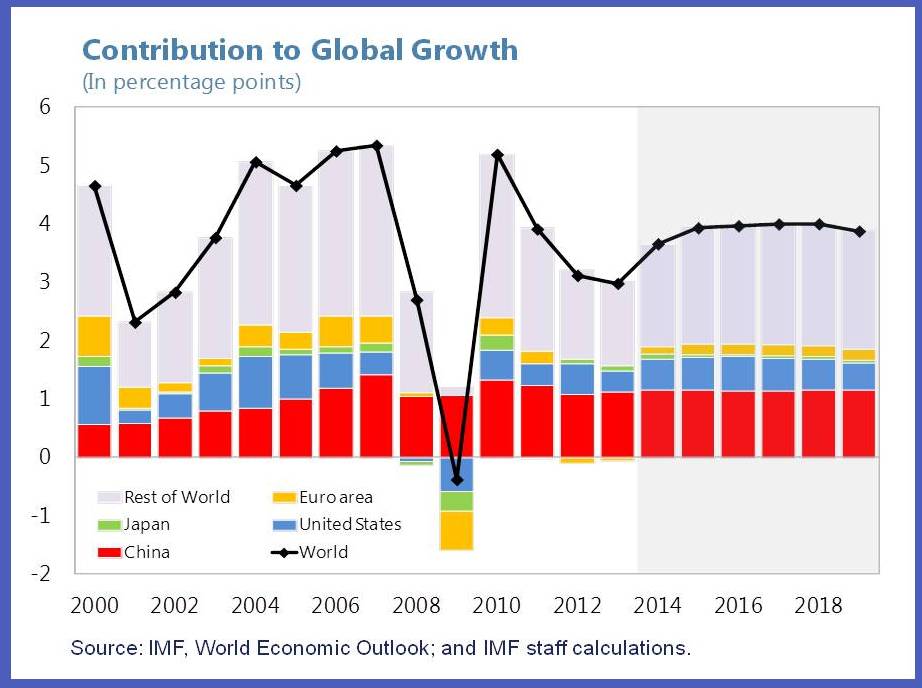
FMI: In the coming five years (2015-19) we expect China's average contribution to global growth will actually increase slightly—rising from 1.0 (2003-7) to 1.1 (2015-19) percentage points.

China is big but not rich
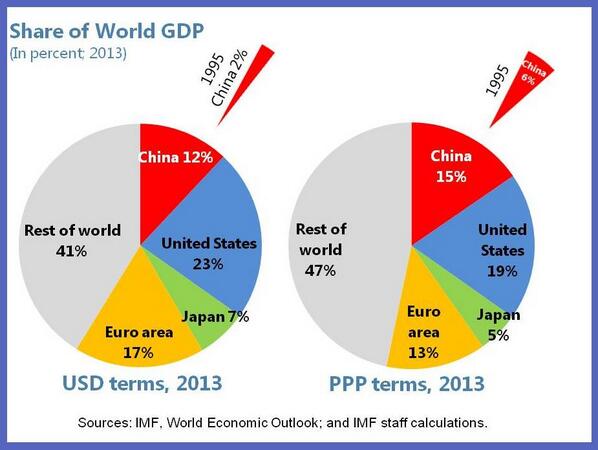
China is the world’s most populous country. So per person, GDP in China is US$ 6,500, compared to US$53,100 in the US (see chart). Even the most developed cities in China do not approach the income levels of advanced economies. This underscores that China still has considerable room to grow. Indeed, as the IMF’s Managing Director noted in her recent address at the China Development Forum, China has its eyes fixed firmly on its next destination—aiming for “higher quality, more inclusive, and more sustainable” growth.
China Size Matters 2
Size matters…contribution to global demand
The chart shows how much China is contributing to global growth. In 2003-7, China averaged 11.7 percent growth whereas in the coming five years (2015-19) we expect growth to average ‘only’ 6.8 percent. Yet, because China’s economy is much bigger, the average contribution to global growth will actually increase slightly—rising from 1.0 (2003-7) to 1.1 (2015-19) percentage points.
Size matters. Thus, we forecast China to contribute more than before to global output, even though growth is slowing. For exporters, this means China’s expanding market will continue to be a great source of future customers.
China Size Matters 1
And, in the end, the world economy benefits the most from sustainable growth in China. As argued before, the world should welcome the slowdown in China to a more sustainable growth rate. Welcome, because it means much higher income in the future. And, as shown above, it means that China will continue to be an engine of global growth.

U.S. US$ 14-18 billion for Ukraine IMF stand-by arrangement


Christine Lagarde at the China Development Forum

By Christine Lagarde
Managing Director, International Monetary Fund
Beijing, China, March 24, 2014

"China's enormous economic progress is due to the courage of its leaders and people who were not afraid to undertake bold reforms, even if they were costly in the short term. China is again at a crossroads. While headline growth numbers remain impressive, this disguises some serious obstacles that need to be overcome.
In a recent address, President Xi Jinping put it this way:" Pausing and withdrawing are not a way out. Reforming and opening up only has a progressive tense, not a perfect tense.”
The challenge is clear: to make growth more inclusive, friendlier to the environment, and more sustainable. The reform blueprint announced at the Third Plenum is an impressively ambitious and comprehensive response to this challenge. 
From that blueprint, I would emphasize three key steps:
(i) Unleashing the potential of the services sector;
(ii) Building a modern, globally integrated financial sector; and
(iii) Strengthening inclusion and safeguarding the environment.
Let me elaborate on each:
(i) Unleashing the potential of the services sector
China's previous round of reforms transformed it into a manufacturing powerhouse. The next round of reforms must be aimed at increasing the role of the modern services sector.
This will not only unlock the substantial growth potential in that sector, but also boost employment, consumption and living standards. As with the previous reforms, removing barriers blocking development of the private sector will be key.
For example: China is currently among the top three countries in the world in filing patent applications—more than 435,000 of them in 2011 alone. It also ranks first worldwide in terms of creative exports—that is, export products based on exclusive trademark registrations in China.
The question is how to safeguard and nurture this success?
Productivity and innovation can only flourish with modern education, advanced health, and integrated financial systems. So the barriers to entry in these key areas need to be reduced—so that innovation can keep China at the leading edge of economic progress.
 (ii) Building a modern, globally integrated financial sector
What about the financial sector? It too holds great potential to increase growth and improve welfare.
China has taken commendable steps—including in recent days—to modernize its financial sector.  Progress has been made in widening the exchange rate band, and People’s Bank Governor Zhou has committed to complete the process of interest rate liberalization in two years. The market orientation of monetary policy implementation has also increased.
Yet, there is still some way to go to establish the modern, robust, and globally integrated financial system that is essential to support China’s next transformation.
For one thing, Chinese financial institutions would benefit from more competition and knowledge-transfer. This would help to better intermediate the vast pool of domestic savings to the most productive uses. It would also prepare Chinese banks to play a bigger role globally.
A gradual opening up of the capital account would facilitate this process, while helping to diversify domestic savings—and make the economy more resilient to shocks. It would also strengthen the potential role of the renminbi as a global currency.
Of course, opening up the financial sector must go hand-in-hand with a strengthening of macroeconomic policy frameworks and the constant upgrading of regulation and supervision. The crisis has taught us all this very important lesson.
(iii) Strengthening inclusion and safeguarding the environment
I have talked about the services sector and the financial sector as important steps toward improving the quality of growth. The sustainability of growth is just as important. And for growth to be sustainable, it needs to be inclusive, its benefits need to be more widely shared, and it needs to be environmentally viable.
As with many countries around the world, China’s economic success came at a price—increasing inequality and increasing environmental damage.
The IMF's research shows that excessive inequality is bad for sustainable growth. Increasing opportunities in education, health care, and financial services can help greatly to address inequality. So too can reforms to increase competition. Social cohesion can also benefit from the right kinds of redistributive policies and a strong safety net.
Other recent work by the IMF also shows that there are significant economic gains to be made from increased participation of women in the labor market. In some parts of the world, per capita GDP could be as much as 27 percent higher if gender gaps in the labor market were closed.
Fortunately, China has made important strides in leveling the playing field for women, especially in senior positions. It has also encouraged female entrepreneurship—a quarter of all business people in China are women.
Even so, there are still many constraints. Addressing them will be good for Chinese women and men—and good for China.
In terms of the environment, the challenge is well known. Poor air quality, severe water shortage, and desertification are major health and economic hazards. They pose a serious risk to the next stage of China's development.
Encouragingly, China has taken some important steps to improve its environmental footprint. An environmental protection tax is being considered and resources are being allocated to close down polluting factories. 
And yet, more must be done to make growth greener. One issue that the IMF has been emphasizing for many countries is the better pricing of natural resources—and stricter enforcement of rules. This powerful combination can lead to a significant improvement in the quality of the environment. 
I fully appreciate the breadth and depth of these reforms—in the services, financial, and environmental areas—and the courage and commitment needed to see them through. They will not be easy to implement but, if done well, they will indeed support China's next transformation. 
As the wise Chinese proverb says: "Do not fear going forward slowly; fear only to stand still”.
3.  China’s Global Leadership in the 21st Century
This brings me to my third and final topic—China’s global leadership in the 21st century.
I have just discussed China’s economic leadership at the global level. China has also affirmed its global leadership in many other areas.
In technology, for example: China is now home to the world’slargest network of high-speed railways. In just six short years, China has gone from importing this technology to exporting it.
China is a leader in science—from sea to sky. China’s manned ocean research vehicle boasts the greatest depth range of any in the world. China’s lunar lander has already docked on the moon, and the Shenzhou-10 spacecraft is now in orbit.
China is also a leading partner for development in many low-income countries, including in Africa.
In addition, China is playing an increasing role in majorinternational fora—the G20, APEC—and in strategic dialogue at the highest levels.
As China moves forward, there is potential for an even greater global role. I mentioned earlier, for example, that with appropriate financial reforms, the renminbi could over time achieve the status of an international reserve currency—and occupy a position on a par with China's economic size.
China can also play an even greater role in international institutions. At the IMF, China will become our third largest member once the 2010 governance reforms become effective—an objective on which we continue to push hard. China is already an important contributor to the IMF’s financial resources and operations.
In addition, China is providing leadership at all levels of the IMF. I am extremely grateful to Min Zhu for bringing his wisdom and experience to our Management team, and to the young Chinese economists we recruit every year—in 2013 alone, Chinese nationals accounted for a third of our new intake of talent.
Through the IMF, China can play a leading role in international cooperation—the “new multilateralism”—which I believe is crucial to the success of every nation in the 21st century.
Conclusion
Let me conclude.
By taking the steps to achieve its next transformation, China will not only help itself, it will also help the world. Indeed, China's success is critical to the success of the global economy.
The steps to be taken are clear. China has risen to the challenge before. I am confident that it will do so again.
 As Lao Tzu wisely said: “Do the difficult things while they are easy and do the great things while they are small. A journey of a thousand miles must begin with a single step.”"

@IMF News Size Matters. Share of World GDP

View image on Twitter

US Jobless Claims fell to 311k in the March 22 Week

Source:  Bloomberg

Jobless Claims
Released On 3/27/2014 8:30:00 AM For wk3/22, 2014
PriorPrior RevisedConsensusConsensus RangeActual
New Claims - Level320 K321 K323 K295 K to 335 K311 K
4-week Moving Average - Level327.00 K327.25 K317.75 K
New Claims - Change5 K6 K-10 K
Highlights
Jobless claims continue to come down signaling improvement in the labor market. Initial claims fell 10,000 in the March 22 week to 311,000 which is 12,000 below the Econoday consensus. The 4-week average is down a very sharp 9,500 to 317,750 which is the lowest level in 6 months.

Continuing claims are also coming down, down 53,000 in data for the March 15 week. The 4-week average is down 31,000 to 2.863 million which is the lowest level in 3 months. The unemployment rate for insured workers is unchanged for a fourth week at 2.2 percent.

There are no special factors in today's report, one that should build confidence for a favorable March employment report.

U.S. Real GDP grew at an annual rate of 2.6% in Q4 2013

Bureau of Economic Analysis
U.S. Department of Commerce


G7 ready to intensify sanctions on Russia over Ukraine

Leaders of the Group of Seven say they’re ready to intensify sanctions on Russia if there’s any more destabilization of Ukraine. Leaders from Italy, Britain, Japan, France, Germany, Canada and the U.S. spoke after a meeting in The Hague.
The group says it’s ready to step up actions, including coordinated sectoral sanctions, if Russia escalates the situation after its excursion into Ukraine’s Crimea. The coalition urged Russia to respect Ukraine’s territorial integrity and sovereignty, and to begin discussions with the troubled country.
The G7 plans to hold a summit in Brussels in June instead of a scheduled G-8 meeting including Russia in Sochi. The coalition says Russia’s participation in the G-8 will be suspended until Moscow changes course on Ukraine.
Source: CCTV

Shanghai pilot zone to see set-up of global trading platforms

The Shanghai government says the city’s free-trade zone will be home to a host of global trading platforms. It’s part of the 51 policies and regulations to support the free trade zone.
Major financial market players, including the Shanghai Stock Exchange, China Financial Futures Exchange, and Shanghai Equity Exchange, are all planning to set up international trading centers in the free-trade zone--they are expected to be up and running by the end of the year. China opened the Shanghai free-trade zone last September to test drive financial reforms.
Source: CCTV

Xinhua In-Depth: Egypt's mass death sentences raise human right concerns

The recent ruling that handed down death sentences to more than 500 supporters of Egypt's ousted President Mohamed Morsi has raised serious concerns on human rights in the turmoil-stricken country.
On Monday, a criminal court in Upper Egypt sentenced some 529 people suspected of being "Muslim Brotherhood loyalists" to death over charges of assaulting police stations last year. Earlier the security forces violently dispersed two major pro-Morsi sit-ins, which left about 1,000 people dead and lead to the arrest of thousands more.
On Tuesday 14 Egyptian human rights organizations issued a joint statement condemning the verdict as "dangerous and unprecedented transformation of the Egyptian judiciary and massive violation of the rights to fair trial and to life."
"It took only three days for the court to decide to execute over 500 humans, raising questions about human rights in general and justice in particular, which is one of the most important pillars of the state," said Mohamed Zarie, a lawyer and also a human rights activist.
Zarie argued that such a verdict might shake people's faith in Egypt's judiciary, adding that the defense team was not given a chance to defend their clients. He said all defendants deserve a fair trial regardless of whether they are affiliated with the Muslim Brotherhood.
The verdict comes while Egypt's security is launching a massive crackdown on Morsi supporters, particularly the recently- blacklisted Muslim Brotherhood group, who have been staging anti- government protests since Morsi's removal by the military in last July.
"It is catastrophic if the judiciary gets involved in political disputes," Zarie warned, noting that even the government of former President Hosni Mubarak, who was ousted by popular protests in 2011, did not neutralize or manipulate judiciary.
Zarie reassured that it is "impossible" to carry out the mass death verdict as it will be appealed for lacking proper procedures and legal bases.
"The issue is not whether it will be carried out or not but about a big mistake that must be avoided because it negatively affect the reputation of the Egyptian judiciary," he lamented.
The UN human rights office said Tuesday that it is "deeply alarmed by the imposition of the death penalty against 529 people in Egypt on Monday after a cursory of mass trial."
Also on Tuesday, the same criminal court in Minya province in south Egypt adjourned a mass trial of 683 pro-Morsi defendants who are accused of inciting violence and riots.
Although Mohamed Fayek, head of Egypt's National Council for Human Rights, said he had full respect for the Egyptian judicial institution and its independency, he saw the mass death verdict was "very shocking and alarming."
"I feel concerned especially because the verdicts come at a time when the council is working on limiting the crimes incurring death penalties in Egypt," Fayek said.
With all due respect for the judiciary, it is "unacceptable" to issue death penalties against 529 people in this way, the human rights activist said, emphasizing the verdict is still subject to appeal.
The controversial mass death sentences come as Egypt is preparing the final phases of its post-Morsi transitional roadmap symbolized in the upcoming presidential and parliamentary elections, following approval of the newly-drafted constitution.
Meanwhile some commentators believe that a dire human rights situation is exaggerated by the Western media to criticize Egypt and pressure the interim leadership.
Saeed Sadeq, professor of political sociology at the American University in Cairo, said that media criticism of the government is "a foreign conspiracy carried out by local tools," reflecting the sentiment of some Egyptians who see criticism of the interim government as supporting "terrorism."
The professor said that the "pro-Brotherhood media" wanted to depict the issue as military fascism, a crackdown on protesters and violation of human rights, "while in fact it is a war against terrorism."
"The verdict is still not final, but it is only a message," Sadeq continued, "It has political and psychological goals, namely to intimidate assailants against the military, the police and the judiciary, which are the pillars of any state."
However, Sadeq agreed with others that it is unlikely that the death sentences will be carried out, "because more than 350 of the defendants were not present and it is only meant to intimidate others."

Wednesday, 26 March 2014

Japan, U.S., EU win rare earth dispute with China

The World Trade Organization said Wednesday that China's curbs on rare earth exports violate global trade rules.
A WTO dispute settlement panel fully backed a joint complaint from Japan, the United States and the European Union, urging China to take corrective measures.In its report, the panel said that China's restrictions on exports of rare earths, tungsten and molybdenum violate its pledge to abolish export duties, made when the country joined the WTO in 2001

Source: Jiji News

China-EU to forge bilateral investment agreement

China and the European Union will finish two days of talks on Tuesday to forge a bilateral investment agreement. The negotiations are expected to clarify each side’s approach to key elements of the agreement.
The EU says the pending visit of Chinese President Xi Jinping on March 31 will add dynamism to the talks. The EU also says securing an investment agreement will be vital for improving market access, investor protection, and overall trade relations. China and the EU agreed to launch talks for an investment deal in February 2012.
Source: CCTV

Snowstorm payments to reach Y100 billion

Nonlife insurance payments related to February's snowstorms, which mainly hit the Kanto and Koshin regions, are expected to top ¥100 billion, according to industry sources.

Payments by Tokio Marine & Nichido Fire Insurance Co. total ¥31.7 billion, based on data available as of Tuesday, its parent, Tokio Marine Holdings Inc., said Monday.
Source: The Japan News

Japan lifts offshore wind tariff, cuts solar prices

Japan will lift the amount utilities must pay for electricity from offshore wind farms while cutting prices for power fed in from solar projects, as the country looks to diversify its use of renewable energy.
The decision by Ministry of Economy, Trade and Industry (METI) follows a recommendation made by a government panel earlier this month and aims at boosting business for companies connected to the wind sector both at home and abroad such as Hitachi Ltd and Mitsubishi Heavy Industries.Japan, hoping to boost alternative energy in the wake of the Fukushima nuclear disaster, introduced a feed-in tariff scheme in 2012, under which utilities must buy all power generated from renewable sources such as wind, solar or geothermal.
But wind projects accounted for only 3 percent of development approvals under the programme as of November, with solar making up 94 percent.

Source: Reuters

China's COFCO buys 51% stake in Dutch trading firm Nidera

China National Cereals, Oils and Foodstuffs Corp--the country’s largest food trader, has acquired a 51 percent stake in the Dutch trading group Nidera. This is part of agreements signed during Chinese President Xi Jinping’s visit to the Netherlands.
COFCO says the stake buy is the largest global acquisition in China’s agricultural industry, the deal is estimated at 1.2 billion US dollars. The share purchase helps COFCO gain a bigger voice in global grain pricing, as well as secure more supplies from major grain growing regions. Nidera is seen as benefiting from COFCO’s logistics, processing and sales network in China.
Source: CCTV

China's first large-scale shale gas field found in Chongqing

China’s growth and reforms will have a major impact on neighboring Asian economies. Michelle Xing sat down with Takehiko Nakao, President of the Asian Development Bank, to talk about the growth outlook for Asia’s economies and the risks ahead.
State-owned Chinese oil and gas giant, Sinopec, announced Monday that its discovered a major shale gas field near Southwest China’s Chongqing. The Fu-Ling field has estimated reserves of 2.1 trillion cubic meters. It's also the first large-scale discovery of its kind in China.
The discovery in Chongqing’s Fuling district means that China can enter into large-scale commercial development of shale gas much earlier than anticipated. Sinopec’s Chairman -- Fu Chengyu -- says 10 years can now be cut off from China’s planned development time for shale gas energy.
"Our Fuling project, which will ultimately produce 10 billion cubic meters a year by 2017, will build shale gas capacity to 5 billion cubic meters a year by 2015." Fu Chenyu said.
The discovery of the Fuling field means China’s official target for annual shale gas production, 6.5 billion cubic meters a year, will be easily surpassed. But Sinopec may be faced with a cash squeeze as it looks to develop the field. That’s because SinoPec’s major competitor, PetroChina, reportedly will seek private investment in order to help it get into shale gas production.
Sinopec and state-owned PetroChina both cut their capital expenditures for 2014 from a year ago but analysts say Sinopec may have less flexibility on spending than its competitor. The reason for that is that PetroChina has a stronger balance sheet while Sinopec faces rising refining costs and weaker income from oil and gas production.
Source: CCTV

China's No.1 online travel firm Ctrip hit by security scare

Ctrip.com is China's No.1 travel booking website in terms of market share but it gave its users a good scare this weekend. More than 10 million Ctrip users and their personal and financial information were apparently exposed to two security flaws. The bugs were discovered Saturday by Wooyun.org, an independent web security monitor.
"A server, if run normally, usually hides logs and sensitive records in the background. No one can see that data. But some security breakdowns may give hackers an opportunity to download that information," said Fang Xiaodun from Wooyun.org.
Wooyun says that the security flaws were so obvious that even a greenhorn hacker could have easily obtained all of the stored credit card numbers, passwords and CVV codes of Ctrip's users.
Ctrip responded to the report by immediately correcting the security issue and announcing that it would provide full compensation to anyone suffering a loss because of the problem.
"If any losses are incurred by our users because of the loopholes we will provide compensation. We will also reward discoverers of any security flaws in the future. We've set up a 5 million yuan fund to encourage people to help us improve our web security," said He Jing, Public Affairs Manager at Ctrip.com.
Some Ctrip users have reported that money was stolen from their credit cards that were linked with their Ctrip accounts. Legal experts say it's illegal to store consumers' sensitive credit card information such as CVV numbers without advance notification, and that Ctrip is likely to face administrative punishment.
Many users have already unlinked their credit cards and bank accounts with Ctrip and analysts say that will be a huge blow to Ctrip's financial performance this year.
Source:CCTV

King Digital debut hit by ‘extremely fast money

 “Candy Crush” got crushed.
That was the popular way to describe the social game maker’s public trading debut, as King Digital’s stock tumbled from the opening trade.
King shed 15.6% to close at $19, the worst trading debut this year, according to data from Renaissance Capital. The company priced its initial public offering at $22.50.
The drop was so steep that analyst Scott Sweet, senior managing partner at IPO Boutique, said the IPO was hit by “extremely fast money,” as investors appeared to make a quick exit.
“It almost stood no chance,” he told MarketWatch. “It wasn’t surprising. It’s getting pounded.” He said there appeared to be “a hope for a pop that never materialized” as “traders immediately pulled the trigger.”
King saw strong demand in the days leading up to the IPO, even as doubts lingered over the company’s growth potential. Some analysts said the company was too dependent on one hit and called King a one-trick pony.
Sweet compared the King IPO to that of another social gaming company, Zynga,  whose shares also fell when it went public in 2011. Zynga shares are still down more than 50% from its IPO price.
King’s disappointing debut follows what has been a strong quarter for IPOs.
According to Renaissance Capital, the average IPO pop on the first day of trading has been 22% this year, “far above the 13% to 15% norm.”
Source: Marketwatch

6 awesomely bold companies you’ll meet at Startup Asia Singapore

For every Samsung, Amazon, or YouTube, there are dozens of scrappy startups trying to trip up the web giants. It’s a tough task. Each young company will have a different strategy that fits their market. When these smaller companies start succeeding, it’s time for entrepreneurs to sit up, take notice, and learn lessons. Asia already has a good number of highly disruptive and well-established companies that are challenging the leading tech companies in a number of sectors. These set a great example to all startup entrepreneurs across the region. At our Startup Asia Singapore conference on May 7 and 8, we’ll be looking at six of them: Xiaomi, Redmart, Viki, Gumi, Razer, and MyRepublic. China’s Xiaomi started out with just an Android ROM that any avid tweaker could flash onto their own Android phone, then in 2011 Xiaomi unveiled its first phone. Growth came fast as Xiaomi undercut phones from HTC and Samsung with price-tags half the size, yet the phones didn’t feel low-grade, boosted by its good-looking and super slick Android skin. In 2014, Xiaomi is aiming to sell 40 million phones, and it’ll likely hit that target. The phone-maker recently expanded to Singapore. Lessons worth learning Because these companies are doing so well and have so many lessons to teach young entrepreneurs, we’ll be hearing directly from all six during the upcoming Startup Asia Singapore event. Aside from Xiaomi, here’s why the other five are important: Singapore’s Redmart is shaking up grocery shopping by bringing it online. Singapore might be small, but it’s a shopping niche worth US$5.2 billion. Regional expansion is a possibility, but that’s not yet been laid out. Redmart got $5.4 million in bridge funding in January. Viki is a sprawling mix of Youtube and Hulu, focusing on TV series, movies, and news – particularly ones that will be popular in Asian markets. In a novel twist to the difficult business of online content, Viki features crowdsourced subtitles for many of its videos. Ecommerce titan Rakuten acquired Viki last year for US$200 million, but the video site still runs independently. Japanese mobile game developer Gumi is avoiding the travail of fellow Japanese gaming companies such as Nintendo or DeNA by making social games that are tuned into what smartphone gamers want. It raised $19 million in funding late last year. Battling telcos and ISPs sounds nuts, but that’s what MyRepublic is doing in Singapore. At the start of this year, MyRepublic has reached 15,000 residential households and businesses with its ISP business so far, and is looking for a big boost in numbers with its insanely cheap 1Gbps broadband package. Razer, like Xiaomi, is doing hardware. The Singapore-based company makes hardcore gaming laptops and tablets, as well as a plethora of gaming-related accessories. Live onstage These are the sessions where those companies will spill the beans on growth and future plans: How Xiaomi Became A $10 Billion Startup In 4 Years – Hugo Barra, VP for Xiaomi global, will sit down for a fireside chat with Tech in Asia’s’ Willis Wee. With Xiaomi starting to expand across the region, Xiaomi is proving to be the first Chinese brand that people are passionate about. Redmart’s Reinvention Of Grocery Shopping In Singapore – Redmart co-founders Roger Egan and Vikram Rupani will be interviewed onstage at Startup Asia Singapore about the site’s growth, getting funding, and expansion plans. Viki’s Backstory And Its Rakuten Sequel – Razmig Hovaghimian, co-founder and CEO of Viki, will be quizzed about its growth and life under the Rakuten umbrella. How Gumi Plans To Dominate The Mobile Gaming World – Hironao Kunimitsu, founder and CEO of Gumi, will be discussing with us about mobile gaming, and his company’s growth to becoming one of Japan’s largest game developers with over 35 titles. How MyRepublic Is Fighting Against The Giants – Malcolm Rodrigues, co-founder and CEO of MyRepublic, will be dishing out lessons about battling tech giants in this fireside chat session. It’s Razer’s Game – Min-Liang Tan is the founder and CEO of Razer. The Singapore-born, San Francisco-based entrepreneur will talk about sharpening his craft to bring high quality devices to grateful gamers across the world.

Source: TECHINASIA

Japan’s smartphone games market now worth $5.4 billion, half of total gaming industry

Source: TECHINASIA
Japan's smartphone gaming market value 2013

According to a new report, Japan’s domestic smartphone gaming market was worth JPY 546.8 billion (US$5.4 billion) in 2013, up a staggering 178 percent from 2012. The report comes from CyberZ, a subsidiary of Tokyo-based internet conglomerate CyberAgent (TYO:4751). What’s interesting about the new figures is that the smartphone gaming sector has now reached roughly half the value of the overall Japanese gaming industry, which is sized at JPY 1.1 trillion yen (US$10.8 billion) in 2013. Observe how that ratio increased from less than 30 percent a year earlier:
The reason why CyberZ focuses on smartphones in particular is that Japan is the only country in the world that still has a big feature phone game industry: Japan’s Mobile Content Forum (MCF) last year said that the feature phone gaming industry by itself was still worth US$2.4 billion in 2012. By way of comparison, MCF estimated a size of US$2.7 billion for Japan’s smartphone game market in 2012, while the chart above, at roughly US$3 billion, lands in the same ballpark for that year.

Japan's smartphone gaming market value 2013

Line Game hits 300 million downloads as social gaming takes off

Source:   TECHINASIA

Last week, chat app Line announced that it passed the 300 million download milestone for its gaming platform Line Game. That’s a huge achievement considering it is under two years old, launching just in July 2012. Currently Line has 50 game titles which include Line Pokopang (30 million downloads since February 2014), Line Cookie Run (18 million downloads since March 2014), and Line Rangers (6 million downloads since March 2014). All of those hefty downloads and gaming activities contribute significantly to Line’s $338.4 million in revenue in 2013.

Line’s 390 registered users all over the world apparently love playing games. Check out our graph below where we chart the growth of Line and the games that collectively make up its Line Game series:


line-game-milestones-300-million

Popular Posts