Monday, 7 April 2014

The Guardian,Ukraine Crisis: Interim prime minister Arseniy Yatsenyuk told the cabinet over the weekend that the new price for gas was unfair and Ukraine would not pay it.

"The prospect of a new gas war between Russia and Ukraine drew closer at the weekend as the government in Kiev said it would refuse to pay for gas at a new, inflated price set by Gazprom last week. The dispute comes as tensions in eastern Ukraine remain high, with pro-Russian protesters in two cities storming government buildings on Sunday.
In Kiev, interim prime minister Arseniy Yatsenyuk told the cabinet over the weekend that the new price for gas was unfair and Ukraine would not pay it.
"Russia has not managed to grab Ukraine through military aggression, so now they are pursuing a plan to pressure and grab Ukraine through gas and economic aggression," said Yatsenyuk. He said that Ukraine would continue buying gas at the "acceptable market price" of $268 (£162) per 1,000 cubic metres.
Last week, Russia announced two successive price hikes in gas for Ukraine, taking it up to $485.50. It is unclear what Russia will do if Ukraine refuses to pay the new price, but in the past it has shut off the supply. Last week, Gazprom's CEO, Alexei Miller, gave televised comments explaining why Russia was raising the gas price, noting that part of the discount had come when Russia extended credit to Ukraine last December as part of a package that was given to the former president, Viktor Yanukovych, for turning his back on an association agreement with the European Union.
"The discount was given on the condition that Ukraine would pay all its gas debts and pay 100% for the current deliveries, and it was clearly indicated that if this did not happen, the discount would be annulled in the second quarter of 2014," said Miller. He said that Gazprom had "not received a single dollar" in payment for March deliveries, and thus the discount had automatically been annulled.
Miller also said that Ukraine had received huge savings on gas based on its agreement to prolong the so-called Kharkov agreements, by which Russia retained the right to base its Black Sea fleet in Crimea".

Source: The Guardian

theguardian: Serguei Lavrov: It's not Russia that is destabilising Ukraine

The profound and pervasive crisis in Ukraine is a matter of grave concern for Russia. We understand perfectly well the position of a country which became independent just over 20 years ago and still faces complex tasks in constructing a sovereign state. Among them is the search for a balance of interests among its various regions, the peoples of which have different historical and cultural roots, speak different languages and have different perspectives on their past and present, and their country's future place in the world.
Given these circumstances, the role of external forces should have been to help Ukrainians protect the foundations of civil peace and sustainable development, which are still fragile. Russia has done more than any other country to support the independent Ukrainian state, including for many years subsidising its economy through low energy prices. Last November, at the outset of the current crisis, we supported Kiev's wish for urgent consultations between Ukraine, Russia and the EU to discuss harmonising the integration process. Brussels flatly rejected it. This stand reflected the unproductive and dangerous line the EU and US have been taking for a long time. They have been trying to compel Ukraine to make a painful choice between east and west, further aggravating internal differences.
Ukraine's realities notwithstanding, massive support was provided to political movements promoting western influence, and it was done in direct breach of the Ukrainian constitution. This is what happened in 2004, when President Viktor Yushchenko won an unconstitutional third round of elections introduced under EU pressure. This time round, power in Kiev was seized undemocratically, through violent street protests conducted with the direct participation of ministers and other officials from the US and EU countries.
Assertions that Russia has undermined efforts to strengthen partnerships on the European continent do not correspond to the facts. On the contrary, our country has steadily promoted a system of equal and indivisible security in the Euro-Atlantic area. We proposed signing a treaty to that effect, and advocated the creation of a common economic and human space from the Atlantic to the Pacific which would also be open to post-Soviet countries.

IMF: Real interest rates are expected to increase modestly with the normalization of global economic conditions

Real interest rates are expected to increase modestly with the normalization of global economic conditions, reversing the decline into negative numbers after the financial crisis, predicts a new study by the IMF’s Research Department.
Continued low real interest rates—the rate paid by borrowers minus the expected rate of inflation—will ease the burden of debt for borrowers but can also tie the hands of policymakers. A low real interest rate environment also enhances the chances that in the future the nominal policy rate may hit the lower bound (that is, zero), thereby losing a key monetary policy tool: lowering interest rates to stimulate growth. Because there is a risk that advanced economies will encounter continued very low growth, this limitation may materialize.
Any increase in current real interest rates is expected to be modest because the main factors contributing to the decline in real rates are unlikely to be reversed:
• Saving: emerging market economies’ saving rate increased significantly between 2000 and 2007, driving down interest rates. This increase is expected to be only partly reversed.
• Portfolios: since the financial crisis, demand for safe assets has increased—bonds over the increasingly risky stocks and other equity. This was also driven by reserve accumulation in emerging market economies. Unless there is a major unexpected change in policy, this trend is likely to continue.
• Investment: the decline in investment rates in advanced economies as a result of the global financial crisis is likely to persist.
Since the early 1980s, interest rates, or yields, on assets of all maturities have declined worldwide, well beyond the decline in inflation expectations. This means that real interest rates—the rates paid by borrowers corrected for expected inflation—have declined. Ten-year real interest rates across countries fell from an average of 5½ percent in the 1980s to 3½ percent in the 1990s, 2 percent over 2001–08, and 0.33 percent between 2008 and 2012 

WSJ: Retreat en European Stock Markets Selloff In Tech Stocks and Ukraine and Russia Mounting Tensions

     The Wall Street Journal reports,"European shares retreated from six-year highs Monday, ending down asUkraine and Russia tensions flared up and a selloff in technology stocks on Wall Street spilled over into global markets.
The Stoxx Europe 600 index snapped a nine-day winning streak to end down 1.24%, with the technology subindex falling 2%. The decline come as highflying tech stocks around the world register widespread losses as investors question fast-rising valuations".
“These stocks lost touch with what we would call reasonable valuations some time ago,” said Erwin Sanft, head of Chinese equity strategy for Standard Chartered in Hong Kong.
After ending 2.6% lower Friday, the tech-heavy Nasdaq index remained under pressure Monday and was most recently down 1.2%.
In other news, Russian assets came under renewed pressure after antigovernment protesters calling for closer ties with Moscow seized regional government headquarters in two cities in Ukraine’s east Sunday

WSJ: Tech valuations in Question?

MARKETS

Tech-Stock Slump Extends to Europe

Investors Raise Questions Over Fast-Rising Tech Valuations

  • Permalink
European shares retreated from six-year highs, following Asian markets lower, dented by a selloff in technology stocks on Wall Street late last week that spilled over into global stock markets.

Crude Drops as Libyan Rebels Hand Over Control of Ports

Brent and West Texas Intermediate crudes fell for the first time in three days after Libyan rebels surrendered control of two oil ports to the government, enabling the OPEC country to increase exports.
Brent dropped as much as 1.4 percent. The self-declared Executive Office for Barqa handed over the oil terminals of Hariga and Zueitina overnight and will relinquish the other two ports they control in two to four weeks, said Ali Al-Hasy, a spokesman for the group. Libya’s output fell to 250,000 barrels a day in March from 1.4 million a year earlier, according to data compiled by Bloomberg.
Brent for May settlement slid $1.12, or 1 percent, to $105.60 a barrel at 12:13 p.m. New York time on the London-based ICE Futures Europe exchange. The volume of all futures traded was 31 percent higher than the 100-day average.
WTI for May delivery decreased 77 cents, or 0.8 percent, to $100.37 a barrel on the New York Mercantile Exchange. Volume was 11 percent above the 100-day average. The U.S. benchmark grade’s discount to Brent shrank to $5.23 from $5.58 on April 4.
Source: Bloomberg

Micron Technology is a very big chipmaker that's closer to Apple than it ever has been.

Micron Technology doesn't get a lot of attention, but it should. Especially because it's one of Apple's largest silicon suppliers.
The Boise, Idaho-based company flies under the radar much of the time in the non-investor community. But it's the second largest DRAM memory chip company in the world -- outranked only by behemoth Samsung -- and third largest chipmaker overall in in terms of wafer capacity, even beating Intel.
And it's now a lot closer to Apple after it completed the $2 billion acquisition of Japanese memory maker Elpida last year. Why? Because Apple uses lots of Elpida memory in its iPhone and iPad products. Most recently, that means the iPhone 5S and iPad Air.
Apple is expected to use Micron's newest DDR4 memory chips in upcoming products. DDR4 will befaster and more power efficient than the current DDR3 technology used widely in PCs, tablets, and smartphones.
Memory capacities will increase too. Future iPads and iPhones -- and whatever new mobile products Apple dreams up -- will likely use more system memory, as designs demand more horsepower 
Source: CNET

WSJ: EU Calls Talks Ukraine Gas Supplies


China’s tourism ecommerce site Tuniu plans to raise $120 million in US IPO

China’s IPO season looks to be in full swing as the latest company from China files with the SEC, packaged travel tour website Tuniu. The Nanjing-based company plans to raise US$120 million when it lists under the symbol “TOUR” (hat-tip to 36kr for spotting). The company sells domestic and international travel booking services, specializing in holiday tour packages. According to the prospectus filed with the SEC, 70 percent of all bookings came from foreign leisure travel products and services. Tuniu is partnered with over 3,000 travel suppliers across 70 countries, including more than 1,000 tourist attractions. The site has also become a source for prospective travelers to find ratings and reviews on those attractions. The site has 85 million registered users with 20,000 comments on travel destinations. Tuniu was founded in 2006 and booked US$322 million in sales last year, up 75 percent on the previous year. Gross profits nearly hit US$20 million last year. Tuniu’s executives and board members currently hold 86.4 percent of the company. The number of shares and their price has not yet been announced. Competitors include Tours4Fun - acquired by Ctrip for US$100 million in January – along with recently-funded Yikuaiqu, Lvmama, and 17u. The latter just raised a US$82 million funding round and is also rumored to be preparing for an IPO. Tuniu is the latest in a string of US IPO filings in recent weeks. Ecommerce retailer JD looks to raise US$2 billion; Twitter-like Sina Weibo is aiming at US$437 million; Kingsoft subsidiary Cheetah Mobile wants US$300 million; daily deals site Jumei is rumored to have filed confidentially with the SEC; and ecommerce titan Alibaba says it will file in New York.

Source:  TECHINASIA

WSJ: You May Want to Avert Your Eyes This Earnings Season

   The Wall Street Journal reports:
"Earnings season is here. You may want to avert your eyes.
Alcoa reports first-quarter earnings on Tuesday, and while no longer a member of the Dow Jones Industrial Average, the company’s earnings still mark the unofficial start of earnings season.
The expectations for Alcoa are low: Street consensus is just 5 cents a share, according to Thomson Reuters, down from 11 cents a year ago. The expectations for the S&P 500 companies are low, too. Profits are expected to contract in the first quarter by 1.2%, according to FactSet Research, the first contraction since the third quarter of 2012 (Thomson Reuters is slightly more optimistic, projecting growth of 1.1%). Revenue is seen rising only 2.3%.
Everybody knows the brutal U.S. winter had some effect here, of course, but the other headwind companies are already mentioning is the strong U.S. dollar, FactSet’s John Butters noted. Of the 21 companies that have already reported, 11 have mentioned the dollar as a weight on their bottom line. “It will certainly bear watching how frequently these themes are cited,” he wrote.
Usually, canny traders can at least rely on companies beating expectations (and if those expectations are low, well, then it’s even easier). So far this quarter, though, the pace of earnings “beats” has slowed, Thomson noted. “While it is still too early to draw any firm conclusions, history suggests that we may not see the high percentages of companies beating estimates that we have seen over the past several quarters.” The winter weather, and retailers running heavy sales may tamp down the earnings surprises, the firm said.
It will certainly be interesting to see how the market digests all this. So far this year, U.S. equities have been essentially stalled – at high levels, mind you, but stalled all the same. The stock market hasn’t had a big catalyst to drive that next leg up. Traders will likely write off weak first-quarter numbers to the weather, and indeed the forecast for the rest of the year is brighter: Second-quarter profit growth is seen at 7.6%, according to FactSet, and the whole year is seen at 8.5%.
Of course, one quarter ago the Street saw first-quarter earnings rising 4.3%''.

Bloomberg: Copper Extends Weekly Drop on Concern Demand Will Fall

The contract for delivery in three months on the London Metal Exchange retreated as much as 0.6 percent to $6,577.50 a metric ton, the lowest intraday level since March 28, and was at $6,586.75 at 9:41 a.m. in Tokyo. The metal slid 0.8 percent last week, the first such drop in three weeks. Markets in China are closed today for a public holiday.
Payrolls in the U.S. missed estimates in March, rising 192,000 compared with the median forecast in a Bloomberg survey that had projected a 200,000 gain. Two Chinese manufacturing gauges released last week pointed to weakness in the economy, the world’s biggest user of metals.
“The U.S. payroll data fueled concern that demand will slow after disappointing Chinese economic data earlier last week,” said Tetsu Emori, a senior fund manager at Astmax Asset Management Inc. in Tokyo. “The weaker outlook for demand would damp market sentiment at a time when supplies are seen rising.”
World production of refined copper is expected to exceed demand by about 400,000 tons as consumption will lag behind the output growth, the International Copper Study Group said in a report last week.

WSJ: German Industrial Output Rises Faster Than Expected

     The Wall Street Journal reports,"German industrial output increased faster than expected in February, its fourth increase in a row, suggesting Europe's largest economy expanded at a robust pace during the first quarter with an annualized rate approaching 3%".
Industrial output expanded 0.4% on the month in adjusted terms in February, Germany's statistics office said Monday, beating economists' expectations of a 0.2% monthly rise. The increased output follows unexpectedly strong manufacturing orders in February.
The influx of data points to a strong first quarter for Germany's economy, which has benefited from a very mild winter that has lifted construction output. For that reason, Germany's central bank said last month the country should see a "substantial boost" to economic growth.
Barclays  on Monday raised its estimate for Germany's first-quarter gross domestic product growth to 0.7% on a quarterly basis from 0.5%, in view of stronger than expected industrial production, as well as healthy retail sales figures during the first two months of the year. That implies an annualized growth rate of around 2.8%, nearly double the fourth quarter's pace of 1.5% growth.
In addition, consumer confidence remains at a seven-year high, as optimism about the economy and a stable job market have helped boost economic expectations for Germans. February retail sales shot up 1.3% from the previous month, after increasing 1.7% in January, data last month showed.
"All in all, today's numbers confirm once again that a strong growth performance, at least in the first quarter, is in the making. The German economy is powering ahead," said Carsten Brzeski, an economist with ING Bank. Mr. Brzeski noted that despite a 0.1% decline on the month in February, the construction sector is "booming," as evidenced by the sector's 1.6% average growth over the past four months.
Germany's performance is critical for the euro zone as a whole. Its economy accounts for nearly one-third of GDP in the 18-member euro bloc.

WSJ: Ukrainian Leaders Slam Russia for Attempt to 'Tear Country Apart'

     The Wall Street Journal reports, "Ukrainian leaders on Monday ripped into Russia for what they said was an effort to tear their country apart with a new burst of unrest, as pro-Russian protesters occupying a government building in the country's east called for a regional referendum on independence.
Acting President Oleksandr Turchynov said he believed the recent events in the east represented "the second wave of Russia's special operation against Ukraine, aimed at destabilization, toppling the current government, thwarting elections and tearing the country apart".

Russia has warned repeatedly that it is prepared to intervene to protect Russian speakers in Ukraine's east and south from alleged threats by Ukrainian nationalists. The country has since massed tens of thousands of troops on its western border with Ukraine, according to U.S. and Ukrainian officials.
Ukraine's Prime Minister Arseniy Yatsenyuk earlier accused Russia of playing a role in unrest that kicked off Sunday.
"It's absolutely clear to everyone that an anti-Ukrainian, anti-Donetsk, and anti-Kharkiv plan is being implemented. A plan to destabilize the situation, a plan for foreign troops to cross the border and take over the territory of the country, which we will not allow," local news agencies quoted him as saying.
The pro-Russian protests that flared in Ukraine's eastern cities after President Viktor Yanukovych's ouster in late February had appeared to be fading. While the crowds of several hundred demonstrators who occupied a government building in Donetsk were no larger than at other protests in recent weeks, Sunday marked the first time in nearly a month that government buildings had been seized in the eastern region of the country.
On Monday, the occupying protesters proclaimed the creation of the "Donetsk People's Republic," ruled by the self-declared "Supreme Soviet," the Interfax news agency reported. The protesters later voted to call a referendum in the next month on declaring independence, Interfax said. It wasn't clear whether they had enough support to impose their demands, however.
Russian stocks fell sharply following the unrest and then again after the broadcast, with the Micex tumbling 3.3% and the dollar-denominated RTS Index sliding 4.5% The Russian ruble also declined more than 1.0% against the dollar.
Protesters also seized the regional government building in the eastern city of Kharkiv on Sunday. Police said they left the building in Kharkiv overnight after negotiations, but witnesses said some continued to occupy parts of the ground floor on Monday and police had the building surrounded.
Violence also flared in Luhansk, a nearby regional capital where demonstrators seized the local security service building and reportedly secured the release of a half-dozen fellow protesters detained during earlier protests. Ukrainian police later said some of the demonstrators had made off with a cache of weapons from a security service office.
Russia's invasion of Crimea came after a group of armed men seized the local parliament building there and appealed for Russian help. As in Crimea, a majority of people in the east speak Russian, but surveys show less than half want their region to join Russia.

Sunday, 6 April 2014

Jim Rogers Thoughts. A Contrarian Investor.

  Excerpts of interview to Jim Rogers, by Kopin Tan WSJ October 2013

"This is the first time in recorded history that we have all the major central banks, all the major governments actively debasing their currencies. Japan has said it will print unlimited amounts of money. So Ben Bernanke said, "Wait a minute, we can throw in a trillion dollars a year." And the Europeans said they'll do "whatever it takes." There's a gigantic ocean of liquidity, and the people getting that liquidity are having a wonderful time. But it's totally artificial, and it's going to end badly when it ends, I assure you".

"Staggering amounts of money being printed has to go somewhere, and it frequently goes into financial markets. But the advance is getting narrower. Fewer and fewer big stocks are going up, which is what happened near the end of the last bubble in 1999. Now, I don't know how long this will go on, but it can't go on forever. That said, you can't really short this market either".

"I've been shorting some emerging markets like India and Turkey. If you can only visit one country in your life, I urge you, plead with you, to go to India. It's the most extraordinary country in the world for historic sights, breadth of culture, etc. But, boy, it's a hopelessly managed place. Countries like India, Turkey, Indonesia that have big balance-of-trade deficits could easily finance things when there's all this free money. But when people realize there won't always be this artificial liquidity, then there'll be problems".

"I was pessimistic about Russia for 46 years, and I think it's becoming the second most-hated market in the world, after Argentina. But I see positive changes taking place, so I'm looking. I bought a few shares of an index, and a few shares of Aeroflot [ticker: AFLT.Russia] because I see positive changes taking place in airlines".


"In general, I don't like to buy China except when it collapses. The last time I bought China in any significant way was in October, November of 2008. But if and when the market falls, I'll buy.
I've read all those skeptical stories about China for many years, and so far they haven't come true. There will be setbacks: In the 19th century, as America was rising to power and glory, we had 15 depressions, virtually no human rights, little rule of law, massacres in the streets. We had a horrible civil war. You could buy and sell Congressmen in those days—you can still buy and sell Congressmen, .......Sure, China will have problems.  You'll see problems and setbacks, but if you can find the right industries, companies, people, you will do well".
"For a long time, the Chinese haven't been able to travel. Now, it's easier to get a passport. When I first drove across China there were no highways, hotels, gas stations. Now you can get into a car and actually go somewhere. There's still a high savings rate, but people are starting to spend more. Chinese tourism—both domestic and international—is going to be a staggering growth business for years to come. I own six or seven Chinese airlines because of that".
"I'm most concerned about currency turmoil coming. Look, the yen has declined 25% [against the dollar] in less than a year, a staggering move for one of the world's most important currencies. The euro is a fabulous concept, but its execution has been bad. And the dollar is tied to the largest debtor nation in world history.
I own the renminbi. I also own the dollar, not because I have such confidence in the U.S., but because I've got to invest somewhere, and if turmoil comes, people will flock to the dollar. It's not a safe haven, but it's considered that way. I cannot invest the way I want the world to be; I have to invest the way the world is".

WSJ: Stock Buybacks Abound, but Come at a Price

Could they be buying high again? Cheap money and a dearth of investment opportunities has helped push buybacks' dollar value back near their precrisis peak. Companies in the S&P 500 increased share repurchases by 29% during the three months through January 2014 compared with a year earlier, according to FactSet.
Buybacks and bull markets are self-reinforcing. By reducing shares outstanding, repurchases flatter earnings per share, making stocks look more attractive. During the reporting season that just ended, earnings growth slowed to a crawl and likely would have been negative without buybacks. They are likely to play an important role again in the earnings season that kicks off this week.
The bang for the buyback buck is diminishing, though, requiring more cash to remain effective. During the 12 months through January, S&P 500 companies spent a whopping $478 billion to repurchase 3.1% of shares outstanding. A year earlier, they spent about $90 billion less for the same percentage reduction. Given today's higher values, companies will have to spend tens of billions more. If buybacks slow, so will earnings growth, all else being equal.

WSJ: Asian Shares Down as Tech Stocks Fall

   The Wall Street Journal reports,"asian stocks fell Monday, with a rout Friday in U.S. technology stocks also taking hold in Tokyo".
Japan's Nikkei 225 stock index led decliners in early trade, falling 1.4% to 14855.62. Tech stocks took the brunt of the selling, sending electronics maker Panasonic Corp. down 3.6% and semiconductor equipment-maker Tokyo Electron off 3.1%.
High-flying technology stocks around the world have registered widespread losses in the past month as investors start to question fast-rising valuations. The tech-heavy Nasdaq fell 2.6% Friday in the U.S., its biggest daily slide since Feb. 3.
Elsewhere in Asia Monday, South Korea's Kospi Composite fell 0.4% to 1979.84.Samsung Electronics  —the world's largest maker of smartphones and the biggest constituent of the index—declined 0.3%.

Bloomberg: Asian Stocks Snap 8-Day Winning Streak Led by Industrials

Asian stocks fell for the first time in nine days, snapping the longest winning streak on the regional gauge this year, with telecommunication and technology shares leading declines.
The MSCI Asia Pacific Index lost 0.5 percent to 138.55 as of 9:48 a.m. in Hong Kong, with seven of the 10 industry groups on the measure falling. Markets in mainland Chinaand Thailand are closed for a holiday. The gauge climbed last week to a two-month high as U.S. data pointed to a recovery from severe winter weather and China outlined stimulus to ward off a slowdown threatening its economic-growth goal.
Japan’s Topix index slid 1.2 percent as the yen held gains from April 4, trading at 103.26 per dollar. TheBank of Japan, which begins a two-day policy meeting today, may double purchases of exchange-traded funds as part of a second round of easing, analysts polled by Bloomberg say.
Hong Kong’s Hang Seng Index fell 0.8 percent and the Hang Seng China Enterprises Index of mainland Chinese stocks listed in the city slipped 0.1 percent. Singapore’s Straits Times Index fell 0.2 percent and Taiwan’s Taiex index dropped 0.5 percent. South Korea’s Kospi index declined 0.1 percent and Australia’s S&P/ASX 200 Index retreated 0.3 percent. New Zealand’s NZX 50 Index lost 0.8 percent.
Pacific Investment Management Co.’s Bill Gross said the pace of employment growth in the U.S. means the Fed will continue to wind down bond purchases and then consider raising interest rates.
“We should stand by for an expectation that the first rise in rates in the U.S. will be the first quarter of 2015,” Richard Gibbs, global head of economics at Macquarie Group Ltd., Australia’s largest investment bank, told Bloomberg TV in Sydney. “The data reaffirmed that trajectory.”
The BOJ will boost its annual purchases of exchange-traded funds to 2 trillion yen ($19 billion), according to 36 analysts surveyed by Bloomberg News.
The bank, which is forecast to leave its monetary-base target unchanged tomorrow at between 60 trillion yen and 70 trillion yen, may raise annual bond purchases by at least 10 trillion yen, with July the most-favored time for a policy move. Signs of inflation may deter policy makers from more ambitious plans, even as the economy slows amid this month’s sales-tax increase.
The Asia-Pacific stock gauge traded at 12.7 times estimated earnings through the end of last week, compared with 15.9 for the S&P 500 and 14.8 for the Stoxx Europe 600 Index, according to data compiled by Bloomberg.

Deliberation before liberalization: China's interest rate conundrum

 As China prepares to liberalize interest rates, the experiences of the United States and other countries may offer some timely lessons.
Commercial banks in China offer a maximum of 3.3 percent on one-year deposits. The People's Bank of China's (PBoC) benchmark deposit rate stands at 3 percent, and banks can offer up to 10 percent more than the benchmark. This means that the real market rate from commercial banks is currently around 3.3 percent. This practice is similar to Regulation Q in the United States before it was abolished in 1986.
Regulation Q prohibited U.S. banks from paying any interest on demand deposits and gave the Federal Reserve the power to set interest rate ceilings on time deposits.
Banks make fat profits from wide spreads between low deposit rates and high lending rates. China scrapped the lower limit on lending rates in July 2013. Deposit rate reform will be the last -- and most important -- step in liberalization.
Zhou Xiaochuan, PBoC governor, suggested last month that China may ease deposit rate controls in the next two years, the clearest reform timetable yet.
There are many similarities between China's money market funds (MMFs) today and U.S. MMFs before Regulation Q was repealed. Depositors seek higher returns elsewhere when bank deposit rate ceilings are in place, Sun Tao, senior economist with the International Monetary Fund (IMF), told Xinhua.
China's interest rate liberalization has been partly expedited by fast development of MMFs like Yu'ebao. With returns of nearly 6 percent, Yu'ebao amassed 81 million clients in just nine months.
Nicholas Borst of Washington's Peterson Institute for International Economics notes that in the United States regulations put in place after the Great Depression to protect banks were slow to adapt to an evolving financial system. As a result, other financial institutions began offering MMFs at rates more in line with prevailing short-term market rates, much as is happening in China today.
Source: Xinhua

Xinhua Insight: China moves to stabilize faltering economy

After a string of economic indicators suggesting China's first quarter growth may have slipped below the annual target of 7.5 percent, the government has decided to try to arrest the slowdown with a package of policies.
At a State Council meeting chaired by Premier Li Keqiang on Wednesday, a set of supportive policies, including cutting tax for micro and small businesses, facilitating shanty-town renovation and speeding up railway construction, was announced in an apparent attempt to stimulate growth.
"These measures show that the government aims to stabilize short-term growth with policies which can enhance efficiency while avoiding future financial troubles," said Lu Ting and Sylvia Sheng, economists with Bank of America Merrill Lynch, in a research note.
The stock market was unmoved by the modest stimulus package, with the benchmark Shanghai Stock Index down 0.74 percent on Thursday.
Among the measures released on Wednesday, China decided to let the China Development Bank, the largest policy bank in the country, set up a special organization to issue targeted housing financing bonds to other financial institutions in support of shanty-town reconstruction and other infrastructure projects.
The new financing approach, seen as a reform step, will help establish a long-term sustainable funding channel for much-needed infrastructure projects, said HSBC Chief China Economist Qu Hongbin.
It was announced at Wednesday's meeting that China will speed up railway construction in the central and western region to push forward urbanization and reduce regional inequality, with 6,600 km of new railway lines planned for 2014 nationwide.
The projects in shanty-down renovation and railways will jointly drive investments amounting to over one trillion yuan (162.6 billion U.S. dollars), according to analysts.
While hoping the investment boost will pump up the economy, the government is also looking to the vitality of small businesses to support growth and create enough jobs.
Tax breaks for small and micro firms will be extended till the end of 2016, according to the State Council. It is also considering raising the tax threshold significantly above the current level of 60,000 yuan.
China's small and micro-sized enterprises have played a leading role in generating jobs. Over 70 percent of new jobs are created by China's 11.7 million such operations, according to a recent report released by the State Administration for Industry and Commerce.
The State Council decision came as hopes for stimulus policies have been running high in China amid weak economic activities across the country that highlighted the challenges the government faces in its efforts to balance growth and reforms.
The latest evidence can be found in the manufacturing purchasing managers' index (PMI), a key measure of factory activity in China.The official PMI for March, compiled by the National Bureau of Statistics and the China Federation of Logistics and Purchasing, edged up 0.1 percentage points from February to 50.3. The reading, the first rise since November, is a touch above 50 -- the expansion/contraction watershed.
The HSBC/Markit PMI, which sampled small and medium-sized enterprises, dipped to an eight-month low of 48 in March, from a final reading of 48.5 in February. It also signals the sharpest fall in output since November 2011.
That, combined with other weak indicators ranging from industrial production, fixed asset investment to power consumption, all painted a murky picture of the economy.
Zhang Zhiwei, chief China economist with Japan's Nomura Securities, saw Wednesday's package measures as a signal for policy easing.
"These measures clearly show that the pace of policy easing is picking up," Zhang wrote in a research note, with a projection of 7.3-percent growth for the first three months.
Without a pick-up in policy easing, growth will likely drop below 7 percent in the second and third quarter, he added.
"We reiterate our view that both monetary and fiscal policies will be loosened in the second quarter. We expect a cut in banks' reserve requirement ratio by 50 basis points in the second quarter and another cut in the third," Zhang wrote.
But Lu and Sheng from the Bank of America Merrill Lynch maintained that the market is overly bearish on China.
China set the growth target for 2014 unchanged at around 7.5 percent to give more prominence to its reform agenda.
But at a press conference following the conclusion of the annual legislative session in March, Premier Li said there is a level of flexibility for the target, stressing rather the importance of creating enough jobs.
China is due to release GDP data for the first quarter on April 16.
Source: Xinhua

GOING AROUND AT NIGHT HOLLYWOOD FL

Came back to Spice Resto-Lounge. Quel Dommage.
 They have a live band that plays well Salsa, Bachatas and Merengues.
 Not great musicians for a live concert night. Know what I mean?
 It was all they had about a latino place there. Less and only the best dancers
 should be dancing on the bar.
 If you like to look how other people dance, maybe you can enjoy,but that is not a latino taste.

 This bar seems to me more kind of spanglish,that would be the closer and
true meaning of it.
   It is a pitty.Less cool atmosphere,less spice,more back to the latin roots would be great.

Alibaba invests $692 million in Chinese department store chain to fuse offline and online shopping

China’s biggest ecommerce company is fusing online shopping with good, old-fashioned brick-and-mortar retailing. Sort of. Today, Alibaba announced a US$692 million (HK$5.37 billion) investment [1] in InTime Retail (HKG:1833), which has 28 department stores and eight shopping malls across China. The deal will allow users of Alibaba’s ewallet app, Alipay, to make in-store payments at all InTime malls and department stores after tying the app to virtual prepaid cards. There’s no indicated launch date for this feature. The partnership between the two shopping giants will also result in some online changes. Shoppers on Alibaba’s Tmall site will be able to claim InTime members points at some estores, and InTime will ship items to online buyers from their physical stores. That should speed up delivery times in some areas, and will also bring more international fashion brands to Tmall customers.

This isn’t Alibaba’s first foray into online-offline purchasing. Alipay users can already use the app for things like movie tickets and paying for a taxi ride. Alibaba’s latest investment comes as the company feels the heat from WeChat, the popular messaging app that its parent company, Tencent, is developing into new areas such as in-store payments. WeChat users can also use the app for film tickets and taxi fares. WeChat was used to book 21 million taxi rides in a one-month period earlier this year after the feature was first rolled out.

This announcement comes as the entire mobile commerce and epayment industries are under threat in China. The People’s Bank of China indicated earlier this month that it wants to issue strict new regulations on online payments, and banks are already complying by setting one-time payment and monthly total limits. Those caps mean that a consumer could not use Alipay (or any rival epayment service) to pay for an iPhone because its price-tag is in excess of the new limits imposed by some Chinese banks. Jack Ma, Alibaba’s founder and chairman, last week hit out at the pending regulations by slamming the banks as a “monopoly power.” However, Alibaba’s investment in InTime today shows that it’s pushing forward with offline-online commerce – spurred on by the need to beat arch-rival Tencent, and in apparent defiance of looming government regulations.

Source: TECHINASIA

Xiaomi rips off a Kickstarter ................. Part II

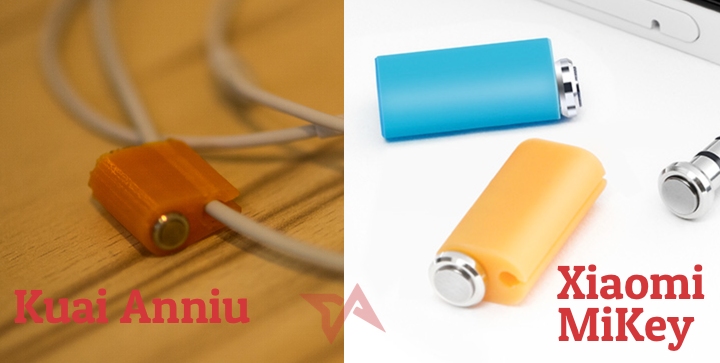
Cloning a clone But it doesn’t stop there. The Xiaomi MiKey is the spitting image of Kuai Anniu (literally ‘speed button’), a Chinese kickstarter project. This indie project raised RMB 208,579 ($34,462) late last year, but still hasn’t started sales to buyers. In fact, the Xiaomi MiKey has so totally ripped off Kuai Anniu that it has even copied the plastic carrier case that the tiny gizmo fits into – and which clips onto your earphone cable – when not in use. (Pressy is different in using a keychain attachment when it’s not being used). Here’s a comparison:

Xiaomi MiKey clones Kickstarter gadget
Less than a buck To add insult to all that injury, the Xiaomi MiKey will beat all the projects it has copied to market and will come with a tiny price-tag – just RMB 4.9, which is $0.80. In stark contrast, Pressy costs $27. Xiaomi said on its Weibo account over the weekend that the MiKey will launch on April 8. We contacted Xiaomi HQ in Beijing yesterday to ask about its design, but we’ve yet to get a response. (Update: In response to my earlier query, a Xiaomi representative says the MiKey is its own design, and it did not acquire Kuai Anniu). Hopefully Xiaomi is not transforming from a cool startup into an evil empire that steamrollers and clones others’ ideas. It’s taking Chinese web giant Tencent – the makers of WeChat – more than a decade to clean up its tarnished reputation for doing that. It’s not something that’s easy to shake off.

Source: TECHINASIA


Xiaomi rips off a Kickstarter project ............ Part I

Source: TECHINASIA
Over the weekend, Chinese phone-maker Xiaomi added to its growing repertoire of accessories with the MiKey. It’s an extra, configurable button for your Xiaomi smartphone that you can stick into the headphone jack and set to launch specific actions – like one click to launch the music app, two clicks to bring up the SMS app. It can link an action to up to 10 clicks. Xiaomi’s new gadget promises to work with popular apps like WeChat and Sina Weibo too. The big trouble with this little gizmo is that it’s a total rip-off of not just one but two crowdfunding projects. Firstly, it’s obviously based on Pressy, the hugely popular Kickstarter project unveiled last summer that still hasn’t shipped to buyers. Pressy ended up raising US$695,138 – way above its $40k goal. As you can see in this side-by-side comparison, Xiaomi’s MiKey is clearly a lot like Pressy:


Xiaomi MiKey copies Pressy

Sina Weibo sets price range for shares, aims to raise $437 million in IPO

Sina Weibo IPO
China’s Twitter-esque Sina Weibo is now one big step closer to its IPO. The social network has filed a new form with the US SEC that shows Weibo will price its shares in the US$17 to $19 range. If it debuts at the top of that range, Weibo will raise $437 million. Weibo had 143.8 million monthly active users in March. Earlier this week, Weibo – which is a spin-off from web portal company Sina (NASDAQ:SINA) – revealed that it has opted for NASDAQ rather than the NYSE. Its stock ticker will be NASDAQ:WB.

FLYING IN AA WITHOUT KNOWING NOR BEEN ADVISED BY ANY MEANS Beware!

Yesterday I came back from my vacations to Hollywood and Ft Laudardale.

  I bought a round-trip LAN  ticket online.

The surprise  came when I wanted to confirm my return flight.

On Thursday I tried to do my check-in online,once twice I couldn't do it,I desisted,I thought it was
too early.

  On Friday I tried again. I couldn't do it either.
  Although there was always a message on the frontline(given them the benefit of the doubt):
  Don't rush! Remember that you can check in your LAN flight between 48 and 2 hours before
departure.
  Yesterday morning I tried to do the check-in again, my flight departed at 16.35, it was never open online!

  Just in case a went early to the airport .
  I went to the check-in line of LAN, I had to wait maybe 40 minutes.
  When my turn arrived, I was told by the attendant that for a reason (he didn't gave no explanation), my flight return was operated by American Airlines.
  He said that there was an explanation at the entrance of the waiting line for the check-in for LAN
flights!!!!!!!!!!!! And that then I had to go to the check-in points of American Airlines.

  To make this story short, I had to rush all the way from LAN to AA.
   I waited shortly in the line, my turn arrived, the attendant said she couldn't help me, that I should do the check-in in the computers that where placed just before the check-in desks.
  She tried to help me but the computers where very slow and busy.
  At the end I was finally  assisted by a third  lady who really understood the problem. She was already used to these "surprised" passengers of American Airlines.

  Always surprised by the oldie fly-hostess of AA of today, and remembering the good Old days of this  almighty company and their young and beautiful and sometimes naughty fly-hostess.


Popular Posts