Wednesday, 18 June 2014

U.S. Signals Iraq's Maliki Should Go

       The WSJ reports,"the U.S. administration is indicating it wants Iraq's political parties to form a new government without Mr. Maliki as he tries to assemble a ruling coalition following elections this past April, U.S. officials say.
Such a new government, U.S., officials say, would include the country's Sunni and Kurdish communities and could help to stem Sunni support for the al Qaeda offshoot, the Islamic State of Iraq and al-Sham, or ISIS, that has seized control of Iraqi cities over the past two weeks. That, the officials argue, would help to unify the country and reverse its slide into sectarian division".
On Wednesday, Iraq stepped up efforts on several fronts to blunt the insurgency's progress, deploying counterterrorism units and helicopter gunships to battle them for control of the country's main oil refinery, in Beiji.
A growing number of U.S. lawmakers and Arab allies, particularly Saudi Arabia and the United Arab Emirates, are pressing the White House to pull its support for Mr. Maliki. Some of them are pushing for change in exchange for providing their help in stabilizing Iraq, say U.S. and Arab diplomats.
The chairwoman of the Senate Intelligence Committee, Sen. Dianne Feinstein (D., Calif.) told a congressional hearing Wednesday: "The Maliki government, candidly, has got to go if you want any reconciliation."
Senior administration officials have become increasingly critical of Mr. Maliki in their public statements and question whether he is committed to mending ties with Sunnis.
"There's no question that not enough has been done by the government, including the prime minister, to govern inclusively, and that that has contributed to the situation and the crisis that we have today in Iraq," White House spokesman Jay Carney said Wednesday. "The Iraqi people will have to decide the makeup of the next coalition government and who is the prime minister," he added. "Whether it's the current prime minister or another leader, we will aggressively attempt to impress upon that leader the absolute necessity of rejecting sectarian governance."
The Obama administration has for years warned Mr. Maliki's Shiite-dominant government to be more inclusive and less punitive against the minority Sunnis at the risk of further alienating them.
Mr. Maliki has largely ignored that advice over the past five years, U.S. and Arab officials say, jailing popular Sunni protest leaders, blocking even other Shiite blocs from sharing power and taking most key cabinet positions in government for himself.
This week, as pressure rose from the U.S. and other allies to work toward a representative government for Iraq, Mr. Maliki participated in a unity meeting with top Sunni, Shiite, Kurdish leaders. The result wasn't hopeful, U.S. and Arab officials say.

mobile WorldLive: while the PC is used mostly in a study, mobile usage is anytime and anywhere

LIVE FROM MOBILE ASIA EXPO 2014: Wang Gaofei, CEO of Chinese microblogging service Sina Weibo, used his keynote to highlight the radical difference he sees between PC and mobile internet users.
Those users who access Weibo and other internet services via a PC – a minority – have seen an alteration to how they spend time in an office or internet cafe but what has happened with the mobile internet impacts everything, he said.
“The PC change affects two hours of daily life but mobile and the internet of things changes all twenty-four hours,” said Gaofei, who added 70 per cent of total daily users access the service with a mobile device.
And domestically, while the PC is used mostly in a study, mobile usage is anytime and anywhere.
“The mobile internet is not an extension of the internet,” he said.
However, Weibo is anxious to carry their old-school PC users with them, even though they represent a minority. “We want them to avoid feelings of confusion when they move from one to another [PC to mobile],” said Gaofei.
“When we launch new services, they go first on mobile and if it’s good then move to PC as well,” he explained.
Since its launch four years ago, Weibo has accumulated a monthly active user base of 144 million.
Among Weibo’s future plans is greater user of location-based services, so that it can offer more targeted services to users, he said.

Modern Dance: Cloud Gate Dance Theater of Taiwan: Moon Light


                                           Another creative Choreography of Master Lin Hwai-Min

After building a Chinese web empire, Qihoo looks to new markets in developing nations

It’s not just Baidu, China’s top search engine company, that’s looking to developing nations for new market opportunities with hundreds of millions of first-time netizens. Now Qihoo (NYSE:QIHU), China’s second biggest search engine, is doing the same thing. The new battleground is software. It’s a battle taking place in countries like Brazil, Indonesia, and Thailand, where the number of web users will double from 2010 to 2015. Baidu (NASDAQ:BIDU) started this a couple of years ago when it began pushing its antivirus software in Southeast Asia – it was treading a path beaten by smaller and more adventurous Chinese companies like UCWeb, maker of the popular mobile browser app. Now Qihoo is doing the same with its own software offerings. Kevin Tellier, business development manager of Qihoo’s relatively new global team, says the company is looking to areas like Southeast Asia and Brazil with four of its Android, iOS, and Windows apps. Three of them are related to antivirus, while the other is the 360 Browser app for PCs. They’re marketed under the 360 Safe brand on an English-language homepage. 360 Browser has already surpassed Internet Explorer in China, and now Qihoo wants to try replicate that elsewhere. The 360 Browser app sells itself on security, and comes with a built-in file download scanner in addition to more conventional safeguards such as anti-phishing tools. However, since many developing nations are going straight to mobile (with cheap Android smartphones) and bypassing PCs, it’s a surprising omission that the company’s 360 Browser for Android app remains limited to the Chinese market.

Tellier says Qihoo wants to be known “first and foremost for security services” in its new markets, pitting it against names such as Avast and Norton. That could extend to Qihoo’s new hardware, which is currently limited to consumers in China. At the Mobile Asia Expo in Shanghai this week, Qihoo is showing off its little gadgets to international visitors to gauge their reactions. There’s a wi-fi dongle, an Android “smart key” that’s a clone of Pressy, and a wearable gizmo for children (pictured below) that allows parents to monitor where their kids are at.

The company has no comment on whether its web empire – which in China covers 360 Search, 360 Answers, an AOL-style web directory, and online advertising – will also venture abroad. Clearly it’s a lot harder to adapt and localize web services than it is a suite of apps. Arch-rival Baidu seems close to launching its search engine in Thailand, Brazil, and Egypt – markets where it has already been active for years with a mix of software offerings and web products such as a simple web links directory. Whatever the extent of Qihoo’s overseas ventures, the company looks set to clash with Baidu on a number of new fronts. But without any web products operating outside of China, Qihoo’s monetization options are limited with its free software. In China, its web browser and antivirus apps are part of a huge ecosystem that prints money out of ad clicks, referrals, and driving search engine traffic – a lot like Google. Outside of China, that’s not yet possible for Qihoo. “Our priority is in users,” adds Tellier. “Monetization [in new markets] is a question to be answered later.”

Source: TECHINASIA

U.S. Steelmaker Nucor now sees U.S. manufacturing OK with some natgas exports

 The United States could export a "reasonable amount" of natural gas while also creating the manufacturing jobs it needs, the chief executive of U.S. steelmaker Nucor Corp told Reuters on Wednesday.

In comments that mark a shift in tone for the U.S. steelmaker, Chief Executive John Ferriola said the government should give natural gas exports "thoughtful, careful consideration."

Nucor made its first foray into gas production in November 2012 to secure supplies for its own operations, forming a joint venture with Encana Corp , which is now on track to produce more fuel than Nucor needs. Drilling was temporarily suspended late last year due to weak gas prices.
"You don't want to export everything and you don't need to export nothing," Ferriola said on the sidelines of the Steel Success Strategies conference in New York.

"I truly believe that you can reach a point where manufacturing would generate the jobs we need in this country, and still export a reasonable amount of natural gas."

Ferriola's predecessor Dan DiMicco has been very critical of plans to export more U.S. natural gas, though he has not called for a complete export ban. Nucor and its rivals see a big opportunity in the low energy costs that have come with the U.S. shale boom that boosted domestic gas supplies.

Ferriola said that under its current drilling plan, within the next decade Nucor would have enough natural gas to supply all its steel mills, its new direct reduction facility in Louisiana, and a second direct reduction plant, with 40 to 50 billion cubic feet of annual production left to sell into the market. He said that plan will likely change.

The government expects the United States to become a net exporter of gas in 2018. The first of what is expected to be several liquefied natural gas export terminals is set to be completed in late 2015.


TSUNAMI OF RUSSIAN STEEL

Ferriola said Nucor is looking at options to address a surge in imports of hot-rolled coil from Russia, including challenging the so-called suspension agreement that has sheltered Russia from steep duties since the Cold War.

Reuters reported on Wednesday that steel industry leaders were considering challenging the trade deal amid mounting tensions over Russia's actions in Ukraine. [ID:nL2N0OZ0GI]

"It's a tsunami, it's out of control, and we will look at every legal remedy and response to that," said Ferriola on Russian imports.


RIGHT OPPORTUNITIES IN IRON ORE

Ferriola said Nucor is considering long-term iron ore supply agreements and could even buy an iron ore mine, though it is less interested in an acquisition now than three years ago, when prices were much higher.

The move to secure more raw materials comes as the company ramps up its new direct reduced iron (DRI) plant in Louisiana.

DRI is made from iron ore and is a substitute for scrap, the company's traditional raw material.

"For the right opportunity under the right circumstances, you know we've go the capital to do it," he said. "If something came along that was perfect for our needs we would consider it."

Source: Reuters

Xiaomi reveals Mi3 sale date and price in the Philippines

Xiaomi Mi3 Philippines

Xiaomi VP Hugo Barra’s visit to the Philippines last week signalled the Chinese smartphone maker’s imminent arrival in the country. Now Xiaomi has revealed that 3,000 Mi3 smartphones will be on sale in the country on June 26 at 12 noon. The Mi3 16 GB smartphones will be sold at Php 10,599 (US$241), which is lower than Barra’s earlier estimate of Php 12,000 (US$272). That’s likely due to Xiaomi lowering the cost of the Mi3 in China, where it costs RMB 1,499 (US$240) for the 16GB version. Customers can purchase the phone through Xiaomi’s local partner, Lazada Philippines. This announcement was made through the Mi Philippines Facebook page. Unlike other smartphone brands, Xiaomi is known for its flash sales, in which it sells phones in batches. It even does that in new markets outside China. Devices usually sell out in just a few minutes. In Hong Kong, the startup company sold 10,000 HongMi phones in only 36 seconds – its fastest overseas sale to date. Its slowest sell out is in Malaysia where it sold 4,000 Mi3 phones in 17 minutes.
As the Philippines is the fastest growing nation in smartphone uptake, many expect a quick sell-out for its first batch. Following the Philippines, Xiaomi is also set to expand in Indonesia, Thailand and India.

Source: TECHINASIA

POLL-U.S. natgas EIA stock build seen at 110 bcf, outpacing norm

 U.S. utilities likely put 110 billion cubic feet of natural gas into underground storage caverns last week, continuing the record pace of injection as utilities rebuild depleted heating supplies before next winter, a Reuters poll of analysts showed on Wednesday.

The previous week's addition of 107 bcf marked five consecutive weeks of injections exceeding 100-bcf, only the second such string of injections, according to the U.S. Energy Information Administration.

A 110-bcf injection for the week ended June 13 would surpass

the prior week's 107-bcf build, as well as the 92-bcf build last year and the 87-bcf five-year average. If the forecast is right, it would be the ninth week in a row that injections exceeded the five-year norm.

After a slow start in April, storage builds over the last four weeks have outdistanced the 2013 and five-year norm. Utilities have stockpiled 446 bcf of gas over the last four weeks, compared with 383 bcf in the same period in 2013 and 364 bcf for the five-year average.

Even with a 110-bcf forecast build, overall gas in storage will remain at an 11-year low for mid-June as utilities attempt to replace a record 3 trillion cubic feet of gas withdrawn from storage over the past winter to keep homes and businesses warm.

Analysts polled by Reuters said they expect utilities to add a record 2.6 tcf of gas into storage during the April-October injection season to get stocks up to what several consider a healthy 3.4 tcf before the November-March winter heating season.
That, however, would still be well below the 3.8 tcf five-year norm and would be the lowest amount of gas in storage at the start of a heating season since 2005.

This week's injection forecast would bring total gas in storage to 1.716 tcf, slightly narrowing the storage deficit to

29 percent below the 2013 level and 33 percent below the five-year average for this time of year.

Some analysts warn that even 2014's strong injection pace will not be enough to avoid price spikes next winter. Other analysts argue that record U.S. gas production will make utilities less reliant on stored gas than in previous winters.

The EIA will release the gas storage data on Thursday at 10:30 a.m. EDT (1430 GMT).

The Reuters poll had 22 participants, with injection estimates ranging from 101 bcf to 115 bcf. The median estimate and the average were both 110 bcf.

Early estimates for injections in the next storage report ranged between 75 and 97 bcf, with an average build of 89 bcf, surpassing the 94-bcf increase seen a year ago and the five-year average of 81 bcf.

Source: Reuters

Pretenders vie for Chile's copper crown but can't replicate boom

 As top copper producer Chile starts to lose market share, players are betting on fledging suppliers to help feed hunger for the red metal, but no single country is likely to replicate the South American nation's boom of the last century.

Chile produces about a third of the global supply of copper, a key raw material for construction and power that is vital for industrialisation. With consumption rising 4 percent yearly, the country's output growth is not enough to meet additional demand.

Its market share is being eroded by spiralling costs at ageing deposits, with neighbouring Peru and Africa's Democratic Republic of Congo (DRC) and Zambia gaining ground.

While those countries are poised to become large suppliers in a more fragmented market, the emergence of a single, giant challenger to Chile is unlikely in the foreseeable future due to geological, political and infrastructure constraints.

"Is there ever going to be another source of supply as good as Chile? No," Bernstein Research analyst Paul Gait said.

"Collectively Peru, the DRC and Zambia have half the geological endowment of Chile. They are great copper locations but they won't be able to do what Chile did to the copper market in the 20th century."

Chile accounted for almost 34 percent of global output of the metal in 2010 but its share fell to less than 32 percent in 2013, according to data from Cochilco, a body that advises Santiago on matters concerning copper.

Thomson Reuters GFMS forecasts Chile's contribution will decline to less than 30 percent in 2016.


CHILE ENDOWMENT

Riven along its length by a crack in the Earth's crust that makes it one of the world's most seismic zones and creates the perfect conditions for large porphyry copper deposits, Chile became the top copper supplier in the 1980s, after the closure of high-cost mines in previous No.1 the United States.

The discovery in the 1980s of deposits such as Escondida, now the world's largest copper mine, proved the country was rich in the metal that it could produce cheaply and export quickly.

However, ore grades are falling, mines are getting deeper, water availability is scarce and energy is expensive.

Even replacing existing supply is extremely costly.

To increase capacity from 2012's 1.7 million tonnes to 2 million tonnes by 2021, state-owned Codelco, the world's No.1 copper producer, needs to invest some $30 billion.

A seawater desalination plant to provide Escondida a steady water supply, necessary to process the metal, will cost global miner BHP Billiton $3.4 billion.

Some costly expansion projects have been delayed after a 30 percent drop in copper prices in the past three years due to slowing economic growth in top consumer China.

"The outlook for Chilean mining has become much more complicated in recent years. Probably not all the projections for the increases in production will come about," said Juan Carlos Guajardo, head of Chilean mining think tank CESCO.

Global markets' sanguine reaction to the insurgency in Iraq looks complacent

 Global markets' sanguine reaction to the insurgency in Iraq looks complacent. The recent intensification of fighting has nudged crude oil prices to a nine-month high while stock and bond markets have barely moved. That overlooks the stagflationary risks.

Brent crude hovered above $113 per barrel on June 18 amid reports that insurgents had targeted the Baiji oil refinery in the north, the largest in Iraq. The fear is of sustained high prices, or even a spike to the $140 per barrel levels that assailed the global economy in 2008.

The risks are there because Iraqi supply matters. With Libyan exports currently reduced to minimal levels, the International Energy Agency is expecting increased Iraqi oil output to supply 60 percent of the overall rise in OPEC output for most of the rest of the decade. Most of Iraq’s infrastructure is in the south of the country and still far from the current fighting. Last week, the IEA suggested the threat to oil output remains small for now.

Markets nonetheless have cause to be uneasy. The roughly 3 percent rise in the oil price that has occurred this month is already bad for a less-than-robust global economy, and has proved a shock for India. The rupee has fallen to a two-month low, putting pressure on the central bank to intervene. Inflation in India is already a high 6 percent. With the government providing subsidies on diesel and cooking fuel, a rising oil price worsens its budgetary position.

The global economy stands to suffer from even a small increase in the oil price if any rise is sustained. In China, every $10 increase in the crude oil price will reduce growth by 0.2 percentage points, Barclays estimates.

Then there is the global inflationary impact of pricier oil. In the United States, consumer price inflation has risen to 2.1 percent and investors are already watching for a change in the stance of the Federal Reserve. A more hawkish shift would tend to push up U.S. rates and the dollar. That would worry equity investors and weaken sentiment on emerging economies. Yet right now, markets are priced for little to go wrong.

Source: Reuters

TheGuardian: Isis insurgents attack Iraq's biggest oil refinery

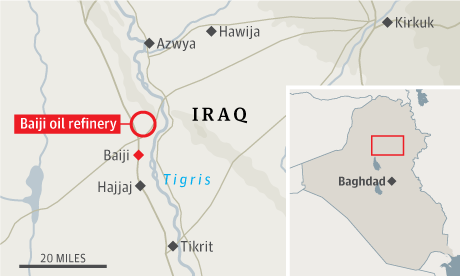
   Islamist militants have attacked Iraq's largest oil refinery in the city of Baiji, 155 miles north of Baghdad, as Iran raised the prospect of direct military intervention to protect Shia holy sites.
A top security official told the Associated Press that fighters of the Islamic State in Iraq and the Levant (Isis) had begun their attack on the refinery late on Tuesday night. The attack continued into Wednesday morning, with militants targeting it with mortar shells, starting a small fire on the periphery.
The refinery accounts for more than a quarter of the country's entire refining capacity, all of which goes toward domestic consumption – petrol, cooking oil and fuel for power stations. At the height of the insurgency from 2004 to late 2007, the Baiji refinery was under the control of Sunni militants who used to siphon off crude and petroleum products to finance their operations. Isis has used its control of oilfields in Syria to boost its coffers.
Any lengthy disruption at Baiji risks long lines at the petrol pump and electricity shortages, putting further pressure on the Shia-led government of the prime minister, Nouri al-Maliki. Iraq's beleaguered prime minister has fired several top security commanders after Iraqi troops melted away before Isis militants as they captured the Mosul in the north, Iraq's second largest city.
Jihadi rebel forces have reached Baquba, less than 40 miles north of Baghdad, while fighting continues to rage further north in the city of Tal Afar. State television late on Tuesday aired footage of army troops and armed volunteers disembarking from a transport C-130 aircraft at an airstrip near the city.
Isis and disaffected Sunnis have threatened to march to Baghdad, the capital, and the Shia holy cities of Kerbala and Najaf in the worst threat to Iraq's stability since US troops left. The three cities are home to some of the most revered Shia sites. Isis has tried to capture Samarra, north of Baghdad, home to another major Shia shrine.
iraq baiji
Hassan Rouhani, the Iranian president, warned that Iran would do whatever it took to protect the shrines.
"Dear Kerbala, Dear Najaf, Dear Kadhimiya and Dear Samarra, we warn the great powers and their lackeys and the terrorists, the great Iranian people will do everything to protect them," he said, in a speech on Wednesday in Khoramabad, near the Iraqi border.
On Tuesday Rouhani mentioned petitions signed by Iranians who said they were willing to fight in Iraq "to destroy the terrorists and protect the holy sites", which are visited by hundreds of thousands of Iranian pilgrims annually.
"Thank God there are enough volunteer Shias, Sunnis and Kurds in Iraq to fight the terrorists," he added.
Thousands of Iranians have volunteered to defend the shrines. Iran is 90% Shia, a group considered to be apostates by Isis and Sunni extremists. Rouhani said on Saturday that Iran had never dispatched any forces to Iraq and it was very unlikely it ever would, but Qassem Suleimani, commander of the Quds force of the Iranian Revolutionary Guard Corps (IRGC), was in Baghdad last week to give advice to Maliki.
Amid the fighting, the plight of foreign oil workers has become a concern. The Turkish embassy in Baghdad is investigating reports that a group of Turkish construction workers were among 60 people abducted by militants near Kirkuk. Isis seized 15 Turks who were building a hospital near the town of Dour, in Salahuddin province near Kirkuk.
The reported abduction came a week after 80 other Turkish nationals were seized by insurgents in Mosul, 49 of them from the Turkish consulate, including special forces soldiers, diplomats and children.
The Indian government has not been able to make contact with 40 Indian construction workers in Mosul, with the Times of India reporting that they have been kidnapped.
The foreign ministry spokesman, Syed Akbaruddin, said dozens of Indian workers were living in areas overrun by Isis and India was in contact with many of them, including 46 nurses. The nurses are stranded in Tikrit, which is under militant control, with many of them holed up in the hospital where they work. Nurses who spoke to the Indian media said they had been treating people injured in fierce street fighting.
The White House has indicated that it may be some days away from a decision on any US military intervention as senior Democrats expressed growing caution about the risks of being sucked back in to conflict in the country.
Amid signs that Barack Obama is treading warily over calls for air strikes, the administration spokesman, Jay Carney, said the president would "continue to consult with his national security team in the days to come", and there would also be further consultations with members of Congress, including some closed briefings later this week.

Kirkuk the elephant in the room as Kurds, Iraqis talk pipelines

 Barely a week after Iraqi Kurdistan took over the Kirkuk oil field, Iraqi oil officials seemed resigned to its loss when they joined their Kurdish counterparts at a London industry conference.

Instead of tough messages over ownership of the prized giant field, the Iraqis sparred with the Kurds over pipeline logistics, as though the change of affairs was now the status quo.

The Kurdish Minister of Natural Resources, Ashti Hawrami, announced the completion of a new pipeline link on Tuesday, which could be used to export Iraq's Kirkuk oil through its territory. [ID:nL5N0OY2PI]

In response, Iraqi officials cast doubt over the existence of the link and stuck to their line that the Kurds of the semi-autonomous region had no right to export oil independently. But their legal threats have been falling on deaf ears as refiners have already brought Kurdish oil, which has been trucked through Turkey.

"Kurdistan of Iraq is already on its national desired border and I don't think it will be easy to push back," Adnan al-Janabi, a senior Sunni politician and head of Iraq's oil and gas committee said on the first day of the conference.

The Kurds see Kirkuk as their historic capital.

"The Peshmerga is on Kurdish territory and there is no reason to get them back," Taha Zanghana, deputy minister of natural resources of Iraqi Kurdistan, told reporters on Wednesday, speaking of Kurdish forces around Kirkuk.

Kirkuk oil has been largely trapped in Iraq after its export pipeline to Turkey was sabotaged in March and the Sunni extremist onslaught makes repairs hazardous.

The Kurdistan Regional Government (KRG) still needs Baghdad.

Its small oil sales by truck and its pipeline exports from its own pipeline, which began in May, will not cover its financial needs for a while.

After the KRG completed the pipeline to Turkey by-passing the federal system, Baghdad cut the Kurds out of the budget for the last five months, forcing the northern region to take out large loans to stay afloat.

Ashti Hawrami, the Kurdish minister of natural resources, said the KRG had already borrowed $1 billion internationally against future oil sales and another $2 billion locally.


BAIJI REFINERY ATTACK

The Kurds said the new pipeline announced on Tuesday was built with the cooperation of Iraq's North Oil Company, which runs the field, and once operational it would allow oil flows to link up with the Kurdish pipeline to Turkey.

But it still needed to be tested, Zanghana said.

Kurdish officials at the conference were unable to comment on capacity or give greater detail on the connection to its pipeline to Turkey.

The pipeline could start quickly, Zanghana added, but the region was waiting for an agreement with Baghdad.

Thamir Ghadhban, the chairman of the advisory commission to the prime minister, said that the Kurdish energy minister's announcement was the first he had heard of such plans.

Early on Wednesday, Sunni Muslim militants began attacking Iraq's largest refining complex at Baiji and now control 75 percent of the complex. The plant was shut down on Tuesday.
Some output from the refinery was sent to the Kurdish region, which will now have to make up for the loss.

"We were expecting that case, and we made all the preparations to supply our local demand ... It's not the first time it has been shut down or they cut our supplies," Zanghana said.

"We are importing products and we are swapping products for diesel and fuel oil. I think it will not be easy for us, I got calls from our distribution centres...but I'm confident that we will tackle that case."

Source: Reuters

US STOCKS-Wall St on track to end at a new record after Fed comments

 U.S. stocks rose, with the S&P 500 on track to close at a new record, after the Federal Reserve hinted at a slightly faster pace of interest rate increases starting next year but suggested rates in the long-run would be lower than it had indicated previously.
After a two-day policy meeting, the Fed cut the 2014 economic growth forecast to a range of between 2.1 percent and 2.3 percent from around 2.9 percent.
The Fed also cut its monthly bond purchases to $35 billion a month, a reduction of $10 billion, as widely expected, in connection with its plans to wind down one of its main stimulus programs by the end of the year. 
"The decision confirms that a steady-as-she-goes Federal Reserve will complete its quantitative easing exit later this year, but still have to rely more on forward policy guidance due to remaining growth and jobs challenges," said Mohamed El-Erian, chief economic adviser at Allianz SE in Newport Beach, California.
"Remaining growth and jobs challenges involve achieving economic lift-off that materially reduces long-term unemployment," El-Erian added.
The Dow Jones industrial average <.DJI> rose 60.05 points or 0.36 percent, to 16,868.54, the S&P 500 <.SPX> gained 9.8 points or 0.5 percent, to 1,951.79 and the Nasdaq Composite <.IXIC> added 14.32 points or 0.33 percent, to 4,351.55.
The benchmark S&P 500 was already above its record close of 1,951.27 set on June 9. The index is now up 0.8 percent for the week as investors largely shrugged off mounting tensions in Iraq and focused on a flurry of merger and acquisition activity and better-than-anticipated manufacturing data.
Among the biggest gainers was FedEx Corp , which rose 5.9 percent to $148.52 after hitting an all-time intraday high of $148.58. The world's No. 2 package delivery company reported better-than-expected quarterly revenue. Its gains helped push the Dow Jones Transportation average up 1.3 percent. 
Amazon.com Inc <AMZN.O> shares jumped 2.9 percent to $334.93 after Chief Executive Officer Jeff Bezos unveiled a "Fire" smartphone with free, unlimited photo storage, jumping into a crowded field dominated by Apple Inc <AAPL.O> and Samsung Electronics 
Adobe Systems <ADBE.O> shares shot up 8.1 percent to $73.03. Adobe was the S&P 500's best performer a day after the maker of Photoshop and Acrobat software reported better-than-expected quarterly profit and revenue. 

Source: Reuters

WSJ: Fed Ups Projections for rates in 2015,2016.

     The WSJ reports,"In a statement released after the meeting, the Fed underlined an improving economic performance in the past few weeks and said it would wind down its monthly purchases of mortgage and Treasury bonds by another $10 billion starting in July, to $35 billion".
Economic activity rebounded since officials last met in April, the Fed said in its official policy statement.
"Labor market indicators generally showed further improvement," the Fed said on an optimistic note. "The unemployment rate, though lower, remains elevated." Officials also pointed to a recent resumption of business investment after a slowdown earlier this year as one source of an improved economic environment.
That tint of optimism follows a dismal first quarter in which the economy contracted, forcing officials to reduce their projection for economic growth this year. Officials now see the economy expanding at a 2.2% rate in 2014, substantially slower than a projected growth rate of near 3% offered last March. Still, the Fed maintained its optimism about a pickup in 2015 and 2016.
Fed Chairwoman Janet Yellen, at a news conference after the Fed meeting, said there are "many good reasons" to expect faster growth in 2015 and 2016, including an improving labor market, the Fed's easy-credit policies, reduced household-debt burdens, rising stock and home prices, and an improving global economy. She said she also expects consumer spending to pick up in part because of rising wages.
The Fed's interest rate forecasts are likely to draw substantial attention among investors.
On average, Fed officials projected the benchmark federal funds rate would hit 1.2% by the end of 2015 and 2.5% by the end of 2016, up from averages of 1.125% in 2015 and 2.4% in 2016 when the Fed last projected rates in March. Over the longer run, officials on average said the target interest rate could settle in at a lower-than-normal 3.75%, down from earlier forecasts of 4%.
Ms. Yellen warned financial market participants not to become overly confident the central bank's ultra-easy monetary policy will exist forever. It is important "for market participants to recognize that there is uncertainty about what the path of interest rates, short-term rates, will be, and that's necessary because there's uncertainty about what the path of the economy will be," she said.
The Fed "will adjust policy to what it actually sees unfolding in the economy over time, and that necessarily gives rise to a certain level of uncertainty about what the path of rates will be, and it is important for market participants to factor that into their decision-making."
She added, "There is no mechanical formula" for when the Fed will start raising rates.
The Fed's new interest rate forecasts arise against a shifting economic backdrop. Officials in their projections for the years ahead see the jobless rate falling more than previously thought.
They see the jobless rate receding to 6% or 6.1% by year-end and then to the mid-5% range in 2015 and low-5% range in 2016. Those represented downward revisions from March and suggest the Fed sees less slack in the economy than previously thought, which could help explain the slightly higher near-run interest rate projections.
At the same time, however, the Fed is a little less optimistic about the outlook for economic growth. Officials said the economy's growth potential might be as low as 2.1% in the long-run, the latest in a string of downward revisions made in recent years. That gloomier long-run growth outlook could help explain why the central bank is producing a lower long-run interest rate forecast of 3.75%.
Ms. Yellen said Fed officials had various reasons for lowering their estimates of long-run growth, but many have cited the "residual effects of the financial crisis," including lower consumer spending and reduced credit availability.
On inflation, Ms. Yellen said recent data have been "a bit on the high side," but generally provide evidence that price levels are moving back toward the Fed's 2% target.
"I think it's important to remember that, broadly speaking, inflation is evolving in line with the committee's expectations. The committee has expected a gradual return in inflation toward its 2% objective, and I think the recent evidence that we've seen—abstracting from the noise—suggests that we are moving back gradually, over time, toward our 2% objective," she said.
When asked whether the Fed would allow inflation to rise above 2% for a while, as advocated by some economists, Ms. Yellen said it "would not willingly see a prolonged period in which inflation persistently runs below our objective or above our objective."
Ms. Yellen also said Fed officials are still working out the mechanics of how they will raise short-term interest rates in the future. "We've made quite a lot of progress in our discussion, but we've not yet reached conclusions" about the exact mix of tools that will be put into play to help raise interest rates when the time comes, she said.
No officials dissented at the meeting. It was the second straight policy meeting this year for Ms. Yellen in which there was no dissent.

Mexico's rural landowners pose threat to foreign energy investors

When foreign investors begin to pour into Mexico's overhauled energy sector in the coming months, they will face a potent force well-known to miners: Mexico's ejidos, or rural landowner groups.

The product of revolutionary land reform - almost a century ago - that redistributed more than 100 million hectares from large landowners to small farming groups, the ejidos control surface rights to large swaths of Mexico.

The ejidos are often poor but they can be powerful: machete-wielding landowners shuttered government plans for a new Mexico City airport in 2002.

For years, foreign companies have owned concessions to mine metals in Mexico, leading them into delicate negotiations with the ejidos, who often block mines for months when they feel they are getting a raw deal.

But until last year, when Congress approved a reform to end state oil giant Pemex's ] 75-year monopoly, foreign firms were blocked from exploiting the oil and gas reserves of the world's 10th largest oil producer.

Now, they too will have to get along with the ejidos, forging long-term relationships that will help define the success of Mexico's efforts to boost economic growth and lure new investment to stem a decade of declining crude oil output.

"If you don't manage it well, this can be a real challenge," said Gustavo Nieves, a project manager for Mexican oil services company Grupo Diavaz, which operates on behalf of Pemex in the Chicontepec region in central Mexico and pumps up to 13,000 barrels of crude a day. "It can get really complicated."

Leftist lawmakers and agrarian groups, many of whom opposed the reform, have raised the temperature for foreign investors by accusing them of planning land grabs.

"This is the total destruction of property in this country in the service of international companies," said Labor Party Senator Manuel Bartlett.


LAND UNCERTAINTY

Unlike in Mexico, where the state owns all oil and gas in the ground, U.S. mineral rights are privately owned. Such clearly defined land rights are one of the reasons some believe the U.S. shale oil and gas revolution has been so successful, and will be hard to replicate overseas.

Oil majors like BP and Exxon Mobil have been quietly building up their presence in Mexico City, but they have not disclosed specific investment plans. Last month Chevronsaid it saw "tremendous opportunity" in Latin America's second-largest economy.

But, experts say, investors in Mexico's energy sector face troubling questions.

"Who do we deal with, what kinds of arrangement can we make, and third, can they be enforced and will they be respected?" said Jim Rice, a Houston energy lawyer at global law firm Sidley Austin.

The Mexican government is trying to bring some clarity to these questions. Under the terms of the reform, whose fine print is still being hashed out in Congress, surface rights holders will be incentivized to reach a quick and amicable agreement at a fair price or face the prospect of expropriation.

But the previous experience of miners suggests the reality is far more complicated, with costly shutdowns a fact of life.

"The land tenancy issues are the biggest piece of uncertainty you have to deal with as a foreign mining company and I would foresee energy companies having the same issue in the future," said Michael Harvey, director of corporate affairs at Canadian gold miner Goldcorp .

The company's Los Filos mine was blocked by an ejido for more than a month earlier this year, and it has faced weeks of legal uncertainty at its giant Penasquito mine.

In 2012, Canadian silver miner Excellon saw its share price fall by nearly 50 percent during a 99-day blockade at its La Platosa mine in northern Mexico.

Miners complain of outlandish demands.

In the case of Excellon, it said the ejido wanted a concession to truck silver from the mine but was unwilling to insure the cargo, a charge the ejido disputes.

Harvey recommended engaging landowners from the outset and dealing with them directly rather than through middlemen.


OIL AND TOIL

Experts say much of the initial investment resulting from the energy reform will head to areas like Chicontepec, which holds about a third of Mexico's reserves and where mid-size companies can forge relationships with Pemex or operate alone.

Emiliano Zapata, a sweltering citrus-growing village in the Chicontepec oil basin, is one of the 3,631 ejidos in the eastern state of Veracruz. It has the highest number of landowner groups in Mexico, making up 40 percent of the area of the state.

As such, it is a testing ground for whether foreign oil companies can make nice with local landowner groups.

On March 2, an eight-inch Pemex oil pipe burst into a stream that provides water to the village, which is named after a revolutionary peasant leader who fought for land redistribution.

Pemex took responsibility for the leak, but months passed until the stream was this week finally declared clean. During that time, residents relied on tanked-in water supplies, and they said up to eight days would pass without a delivery.

Exasperated by the lack of water and a perception they were saddled with all the costs of oil extraction, but saw none of the benefits, members of the 2,000-strong ejido blocked the main road into the oil-producing zone.

"The government's slogan is that the oil belongs to us Mexicans," said laborer Josue Sanchez. "But us Mexicans, who live the reality, haven't seen half a peso of that wealth."

Faced with the prospect of more investors arriving, locals in an area where half the population lives on food handouts, say they are left with few options to make themselves heard.

"We're looking at the prospect of blockades, because nobody wants to take responsibility for these problems," said Gumercindo Gonzalez, the head of the ejido.

A Pemex spokesperson said the company took care of the leak in Emiliano Zapata, but added that a lot of ejido complaints lacked substance, and that the groups were usually looking for financial gain.

According to Gustavo Hernandez, the head of Pemex exploration and production, Mexico's extractive industries generally enjoy a fruitful relationship with the ejidos.

"The ejidos collaborate closely with the mining industry, with the oil industry, with Pemex, and with the energy companies working there extracting gas," he said.

But the experience of energy firms already operating in Mexico provides a different perspective.

"For foreign companies it's a real nightmare," said the security manager of an international oil services firm operating in the state of Tabasco who declined to be identified because he wasn't authorized to speak to the media.

He spoke of widespread oil theft and impromptu blockades.

Source: Reuters

Russia's Lukoil in talks with Hess over Ghana project -sources

Lukoil is in talks with U.S. oil firm Hess Corp to buy a stake in its offshore project in Ghana, two sources close to the talks said, as part of its strategy to look beyond a closed Russian market.

Lukoil, a private company that is struggling to get a foothold in new major domestic fields largely taken by state firms, has the most foreign interests of any Russian energy company.

"Lukoil is interested in the Deepwater Tano/Cape Three Points project operated by Hess," one of the sources said.

The project, located about 44 miles (70 km) offshore Ghana, is 90 percent owned by Hess, and the rest belongs to Ghana National Petroleum Company. Hess started pre-development studies on the block after finishing drilling its seventh well last year.

The other source said Lukoil was considering buying a significant stake but not a majority stake.

Lukoil declined to comment. Hess did not immediately respond to a request for a comment.


SOURCE:  Reuters

EIA Petroleum Report


The U.S. current account deficit increased 2.6% in Q4 2013

The U.S. current-account deficit—a net measure of transactions between the United States and the rest
of the world in goods, services, primary income (investment income and compensation), and secondary
income (current transfers)—increased to $111.2 billion (preliminary) in the first quarter of 2014 from
$87.3 billion (revised) in the fourth quarter of 2013. The deficit increased to 2.6 percent of current-dollar
gross domestic product (GDP) from 2.0 percent in the fourth quarter. The increase in the current-account
deficit largely reflected an increase in the deficit on goods and a decrease in the surplus on primary
income. In addition, the deficit on secondary income increased and the surplus on services decreased.

Brent Pares Gains as North Iraq Fighting Spreads

Brent pared gains as Islamist militants fought Iraq’s government for control of a northern refinery, while the main southern oilfields in OPEC’s second-biggest producer were spared. West Texas Intermediate rose amid forecasts that U.S. oil stockpiles fell.
Futures gained as much as 40 cents in London. The Baiji refinery in northern Iraq was damaged as Islamist militants fought with the army for control of the country’s largest crude-processing plant. U.S.crude inventories probably slid by 750,000 barrels last week, a Bloomberg News survey showed before an Energy Information Administration report today.
“The situation in Iraq is so volatile now that things can move it quite quickly,” Nic Brown, head of commodities research at Natixis SA in London, said by phone. “While the country’s main oil fields are in the south, Baghdad is not, and, if there are any attacks there, that could hurt the Iraqi government.”
Brent for August settlement rose as much as 0.4 percent to $113.85 a barrel on the London-based ICE Futures Europe exchange, before falling to $113.67 at 1:42 p.m. The contract rose 51 cents to $113.45 yesterday, the highest close since Sept. 9. The volume of all futures traded was about 2.8 percent above the 100-day average for the time of day. Prices have increased 2.6 percent this year.
WTI for July delivery was 33 cents higher at $106.69 a barrel in electronic trading on the New YorkMercantile Exchange. Brent was trading at a premium of $7.50 a barrel to WTI on ICE.
Exports of Basrah Light, southern Iraq’s main crude, may reach about 2.8 million barrels a day next month, according to a preliminary loading plan obtained by Bloomberg News on June 16. That would be near February’s record level of shipments, which was the last month Iraq shipped Kirkuk grade crude via a pipeline to the Mediterranean. The fighting hasn’t spread to the south, which the EIA estimates is home to three-quarters of Iraqi output.
Source: Bloomberg

Main Iraq Oil Refinery in Flames After Rebel Attack

         The WSJ reports,"parts of Iraq's main oil refinery were in flames Wednesday as government forces fought to repel militants who gained partial control of the oil facility, Iraqi security officials said".
"Sunni militant fighters behind a week-old offensive that has claimed several major cities and towns in northern Iraq attacked the refinery in the northern city of Baiji overnight and seized part of the installation, an oil ministry official in the country's north said.
The official said employees fled the refinery as it came under attack, the latest in a weeklong siege of the oil hub.
The fighting over the main source of Iraq's refined fuel for its domestic market doesn't affect production or exports from the country's oil fields and facilities in the south, where militants haven't reached.
But the fall of the Baiji refinery to rebel control would intensify the turmoil inside Iraq, as well as open to militants another major potential source of income.
The price of crude oil hasn't reacted specifically to the Baiji news, said Cuneyt Kazokoglu, an analyst at FACTS Global Energy in London, but if the refinery is closed Iraq's gasoline and diesel imports will likely increase.
In midmorning trading, oil was at $113.50 a barrel and hovering close to 9-month highs touched June 14, just after the crisis in Iraq crisis broke.
Reuters reported mortar strikes and machine-gun fire at the refinery Wednesday morning as government forces and militants battled for control. Officials said some fuel storage centers inside the installation were on fire.
Militants including hundreds of fighters from the Islamic State of Iraq and al-Sham, or ISIS, are battling to hold captured cities and seize more territory in their offensive against the Shiite Muslim-dominated government of Iraqi Prime Minister Nour al-Maliki.
Iraq's Sunni minority accuses Mr. Maliki's government of systematic discrimination against Sunnis and other sects and political blocs in Iraq. Some Sunni veterans of Saddam Hussein's armed forces and Sunni tribal fighters also are participating in the offensive.
Iraq said government security forces were bolstering their numbers around the north Wednesday in a bid to recapture territory.
In Diyala province, directly to the east of Baghdad, an Iraqi government airstrike targeting a meeting of ISIS fighters killed 15 of them overnight, according to Abdul-Amier al Zaidi, the commander of a government command center.
Security forces were preparing a government offensive to reclaim the area of the attack, Udhaim, from ISIS fighters, Mr. Zaidi said.
The Iraqi military was reinforcing its forces in the Diyala provincial capital, Baquba, after fighting near the city Tuesday.
Authorities also reported fighting Wednesday at the northwestern city of Tal Afar, after militants seized much of that town over the weekend, sending tens of thousands of residents fleeing. Iraqi television on Tuesday showed government reinforcements rolling to that battle".

Popular Posts