Monday, 16 December 2013

Sinocism: Events on China last week

"Policymakers were busy with two important conferences in the last week. The Central Economic Work Conference (CEWK) concluded Friday and the Central Urbanization Work Conference ended Saturday'.
"The CEWK made no mention of a 2014 GDP target but did lay out six tasks for 2014:
“guaranteeing food safety, reducing industrial overcapacity, containing local government debt, enhancing coordination of regional development, improving people’s livelihoods and promoting further opening up”
The focus on local debt is another obvious sign of leadership concerns about the issue, as is the delay in releasing the results of the Q3 2013 local debt audit. Perhaps we will have to wait for the March NPC meeting and Premier Li’s work report for the 2014 GDP target?
The urbanization conference appears to have concluded without approval of the long awaited urbanization plan but with top-level agreement on the direction of urbanization. Expect less focus on “build it and they will come” local government infrastructure binges and more on limited hukou reform and what the leadership calls “human-centered urbanization”. Local officials and their cronies may not like it but Beijing has been signaling this for a while, with official media also running several stories on “ghost cities” and urbanization white elephants over the last few months. Implementation will of course be messy but when is anything not here?
The Third Plenum ended a month ago and there has been no official release of the composition of the Central Party Leading Group on Comprehensively Deepening of Reform or the National Security Commission. It is unclear if this is a sign something is amiss, the membership lists were never intended to be made public, or is it too soon to tell.
The US-China relationship is not ending 2012 on a positive footing. The White House was apparently given five minutes advance notice of the new air defensive identification zone, exactly the kind of surprise Obama supposedly asked Xi Jinping to avoid in the relationship. And on December 5 a PLA Navy ship attached to the Liaoning aircraft carrier group forced a US Navy vessel to take evasive maneuvers in the South China Sea.
This week we should learn whether or not China will begin effectively expelling reporters from The New York Times and Bloomberg by not renewing their visas, a move that is sure to provoke a reaction in DC. Vice President Biden raised this issue with President Xi Jinping, so if the visas are not renewed expect it to be viewed as a direct rebuke of the VP and his attempts at diplomacy. I expect some to be renewed and some to not, and for Bloomberg to come out better than the New York Times. Otherwise why would any foreign media organization believe Bloomberg-style appeasement is the right approach given the reputational risk?
2013 will be the Year of the Horse, so let’s hope a horse year is better than a snake year for relations between eagles and pandas. Then again, hope is never a responsible strategy…
Rumors about the imminent arrest of former Politburo Standing Committee member Zhou Yongkang continue to swirl. Two Sundays ago the rumor was he was under house arrest and that an official announcement would be made Monday. That obviously didn’t happen, and while where there is smoke there is likely fire so far there has not been a conclusive report on is status. I have no idea what is going on but I can not find any Beijing friend who does not think the rumors are true.
A move against a PBSC member would be both unprecedented and risky, though if Xi pulls it off then he would appear to have control over both the military and security services, making him probably the most powerful leader since Mao. But given the rumors and now the expectations, if he is not taken down then all the tiger talk in the anti-corruption campaign will be seen as just that and Xi’s prestige may take a hit.
Xi issued his “Eight Guidelines” to rein in extravagance just over a year ago and the campaign has been harsher and better enforced than many expected. Businesses and investors still hoping for any near-term rebound in luxury or high-end food and beverage spending will likely be very disappointed by the newly released guidelines to rein in official spending.
Source: The Sinocism China Newsletter

Contradictions in China's Foreign Policy (Will Continue)

You may have missed the funeral, but China’s new leadership has quietly buried the admonition of former leader Deng Xiaoping that as China rises in wealth and power it should maintain a low profile (known as taoguang yanghui). In its place, the new leadership is advancing a more proactive diplomacy in surrounding regions. President Xi Jinping is displaying self-confidence that seems to match the mood of the times in China, one of renewed nationalism and self-assertion. In most neighboring capitals this development will be viewed positively but warily; in Manila and Tokyo, less positively.
The issue is that China wants the benefits of a charm offensive with its neighbors, but it also wants to jealously guard its far-flung territorial claims. It cannot do both.
Beijing held a major conference on peripheral diplomacy on October 24 and 25. Xi made what was described as an “important speech,” followed by remarks by Premier Li Keqiang and Beijing’s top party and government foreign policy officials. This was shortly before China announced its intention to create a State Security Commission (also variously translated as National Security Council or National Security Commission) at the third plenum of the 18th Party Congress. Taken together, these actions portend a concerted activism that will deploy China’s newly acquired wealth and influence to “maintain a stable peripheral environment.”
Xi’s speech catalogued the economic aid, trade, scientific and technological, financial, security, and public relations diplomacy tools for China’s regional strategy. The official press releases did not mention sensitive issues such as territorial disputes or the soon-to-be-imposed air defense identification zone (ADIZ) over the East China Sea. According to people familiar with the details of the meeting, however, these issues were very much on the agenda.
Source: Sinocism

Russia in Talks With Ukraine Over Possible Loan

According to a report from the Wall Street Journal,"Russia said Monday it is in talks with Ukraine about a possible loan to help bail out its crisis-stricken neighbor, which is facing possible economic collapse amid large-scale protests over its rejection of a trade deal with the European Union''.
Ukraine is facing its biggest crisis in a decade after President Viktor Yanukovych walked away from the long-planned deal with the European Union last month, saying the terms of the deal and heavy trade pressure from Russia not to sign would have been devastating for the Ukrainian economy .
A loan and cheaper gas from Russia would be a lifeline for Ukraine's recession-hit economy but would risk further infuriating protesters who have been camped out for weeks on Kiev's main square demanding closer ties with Europe and an end to economic and political dependence on Russia.
Russian and Ukrainian officials are entering loan talks ahead of a meeting between Mr. Yanukovych and Russian President Vladimir Putin in Moscow on Tuesday to discuss bilateral trade and economic cooperation.
"Negotiations are under way," a spokesman for Russia's finance ministry told The Wall Street Journal. A spokeswoman for Ukraine's finance ministry had no immediate comment.
The Kremlin said it expected a number of deals to be signed during Tuesday's meeting.

Malaysia Population 2013

Source:worldpopulationreview

Malaysia Population 2013


Malaysia is a federal state that has a monarchy system of governance. It is comprised of 13 large states and 3 different federal territories. Its area is about 329,847 square kilometers. The Malaysian land is divided into two parts, namely Malaysian Borneo and Peninsular Malaysia, between which the South China Sea flows.
Malaysia borders Brunei,Thailand, and Indonesia. Its sea borders Singapore,Vietnam and the Philippines. Kuala Lumpur is the capital of Malaysia.

Malaysia Population 2013

The current population of Malaysia in total is 29,791,949. Of this number, 50.7% (or 15,106,780) is the male population, and the remaining 49.3% (which is 14,685,169) is female population.
During the 1960s Malaysian population was recorded to be 8.16 million, which gradually increased to 10.91 million in 1970. In 1980 the Malaysian population increased to 13.83 million, after which a drastic rise took place and the population reached 20.21 million in 1994. Finally, the population rate was 28.86 million in the year 2011.
The population of Malaysia was 28,334,135 according to the 2010 census. This made Malaysia the 42nd most populated country in the world. Malaysia consists of people of different cultures and religions. Only 50.4 percent of the population is Malay, and the rest is Bumiputera, Muslim, etc., including majorities and minorities.
Malaysian nationality is only given to a child whose parents are both Malaysian. Dual nationality in Malaysia is not allowed.
The infant mortality rate in 2009 was 6 deaths per 1000, and life expectancy at birth in 2009 was 75 years in Malaysia. Five percent of the government social sector development budget is spent on health care to develop Malaysia into a medical tourism destination. Peninsular Malaysia has an urban population of 70%. This area consists of 28 million Malaysians, and the population is mostly concentrated here. Kuala Lampur is the capital and is also the center of financial and commercial activities. A city named Putrajaya was constructed in Malaysia to normalize the growing population in Kuala Lumpur and is now the seat of government.
Malaysia is estimated to have over 3 million migrant workers because of a rise in labor-intensive industries. It is estimated by the Sabah-based NGOs that out of those 3 million migrant workers, 2 million are illegal migrants.

Population History

YearPopulationChange
19506,110,000N/A%
19608,161,00033.57%
197010,909,00033.67%
198013,834,00026.81%
199018,211,00031.64%
200023,421,00028.61%
201028,276,00020.73%
 

Population Projections

YearPopulationChange
202033,196,00017.40%
203037,872,00014.09%
204041,770,00010.29%
205045,204,0008.22%
206048,224,0006.68%
207050,383,0004.48%
208051,872,0002.96%
209053,195,0002.55%
210054,375,0002.22%
 

How Many People Live in Malaysia Right Now?

Based on the most recent estimates, the current population is projected as:
29,768,915

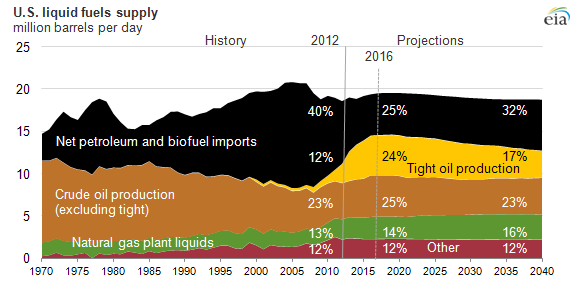
U.S. Energy Information Administration: Increased tight oil production, vehicle efficiency reduce petroleum and liquid imports

The U.S. Energy Information Administration's Annual Energy Outlook 2014 Reference case shows that recent growth in domestic crude oil and natural gas production is expected to continue for many years. In 2016, crude oil production is expected to be close to the historical high of 9.6 million barrels per day, a record set in 1970. The AEO2014 Reference case was released at 9:30 a.m. EST today. It contains baseline projections for U.S. energy production, consumption, and imports through 2040.
While domestic crude oil production is projected to level off and then slowly decline after 2020, natural gas production grows steadily, with a 56% increase between 2012 and 2040, when production reaches 37.6 trillion cubic feet. The full AEO2014 report, to be released next spring, will also consider alternative resource and technology scenarios, some showing significantly higher long-term oil production than in the Reference case.
graph of U.S. liquid fuels supply, as explained in the article text
Some other key findings of the AEO2014 Reference case include:
Low natural gas prices boost natural gas-intensive industries. Industrial shipments are expected to grow at 3.0% per year over the first 10 years of the projection and then slow to 1.6% annual growth through 2040. Bulk chemicals and metals-based durables account for much of the increased growth in industrial shipments. Industrial shipments of bulk chemicals, which benefit from an increased supply of natural gas liquids, grow by 3.4% per year from 2012 to 2025. The competitive advantage in bulk chemicals diminishes in the long term. Industrial natural gas consumption is projected to grow by 22% between 2012 and 2025.
Natural gas overtakes coal as the largest fuel for U.S. electricity generation. Projected low prices for natural gas make it a very attractive fuel for new generating capacity. In some areas, natural gas-fired generation replaces power formerly supplied by coal and nuclear plants. In 2040, natural gas accounts for 35% of total electricity generation, while coal accounts for 32%. Generation from renewable fuels, unlike coal and nuclear power, is higher in the AEO2014 Reference case than in AEO2013. Electric power generation from renewables is bolstered by legislation enacted at the beginning of 2013 extending tax credits for generation from wind and other renewable technologies.
Higher natural gas production supports increased exports of pipeline and liquefied natural gas (LNG). In addition to increases in domestic consumption in the industrial and electric power sectors, U.S. exports of natural gas also increase in the AEO2014 Reference case. U.S. exports of LNG increase to 3.5 trillion cubic feet (Tcf) before 2030 and remain at that level through 2040. Pipeline exports of natural gas to Mexico grow by 6% per year, from 0.6 Tcf in 2012 to 3.1 Tcf in 2040. Pipeline exports to Canada grow by 1.2% per year, from 1.0 Tcf in 2012 to 1.4 Tcf in 2040. Over the same period, pipeline imports from Canada fall by 30%, from 3.0 Tcf in 2012 to 2.1 Tcf in 2040, as more demand is met by domestic production.
Car and light truck fuel use declines sharply. AEO2014 includes a new, detailed demographic profile of driving behavior by age and gender as well as new, lower population growth rates based on updated Census Bureau projections. As a result, annual increases in vehicle miles traveled (VMT) in light-duty vehicles (LDV) average 0.9% from 2012 to 2040, compared to 1.2% per year projected over the same period in AEO2013. The rising vehicle fuel economy of LDVs more than offsets the modest growth in VMT, resulting in a 25% decline in LDV energy consumption between 2012 and 2040 in the AEO2014 Reference case.
The full AEO2014 will be released this spring with side cases that examine the effect of alternative resource and demand assumptions as well as changes to some existing policies on the energy sector.

China shoppers ring luxury tills from London to New York

"Fang Ying's December wish list of Louis Vuitton handbags and Chanel perfume is not only for Christmas. Fang, 33, a secretary working in Shanghai, writes one every month for friends and family travelling abroad".
"Fang is not alone. Over two-thirds of luxury spending by mainland Chinese was made overseas in 2013, an increase from 2012, according to theChina Luxury Market Study from consultancy firm Bain & Company released on Monday.
Chinese shoppers often wait for trips abroad, plan shopping sprees to Hong Kong or get friends or specialist "daigou" agencies to bring back luxury items from overseas because they are often cheaper due to China's high import taxes.
 China is the number one luxury spender worldwide, making up 29 percent of total global luxury spend this year, according to the Bain report. So Chinese consumers - wherever they may be - are a key battleground for firms from LVMH Moet Hennessy Louis Vuitton SA  and Gucci owner Kering Holland NV  to trenchcoat maker Burberry Group PLC , cosmetics giant L'Oreal SA  and Cartier watchmaker Compagnie Financiere Richemont SA .
"The store fronts are in Shanghai and Wuhan, but the cash registers are in Los Angeles, New York and London," said Sage Brennan, CEO of China Luxury Advisors, which helps brands in the Americas and Europe attract Chinese shoppers.
Chinese luxury spending slowed at home in the wake of a crackdown on corruption and shows of wealth, prompting warnings of a sales slowdown from liquor maker Pernod Ricard SA  and Volkswagen-owned  Bentley Motors and Lamborghini.
Luxury brand store openings dropped significantly in 2013, according to Bain, which estimated China's luxury market will grow two percent this year versus seven percent a year earlier.

Source: Reuters

U.S. Industrial production jumps in November to record high

Industrial production in November saw the biggest one-month percentage gain in a year to reach a record high, though the monthly advance was led by utilities output after an unusually cold month. The Federal Reserve said Monday that industrial production climbed 1.1% in November, the biggest percentage rise since Nov. 2012, as utilities output jumped 3.9%. Also, October production was revised up to a 0.1% gain from a previously reported 0.1% drop. Economists polled by MarketWatch had expected a 0.6% gain for November. The level of 101.3 for industrial production is on an index that was 100 in 2007. Capacity utilization rose to 79% from an upwardly revised 78.2% in October. 

Source: marketwatch

UK housebuilders counter Ed Miliband's land-hoarding claim

Britain's housebuilders have launched a scathing counter attack against Ed Miliband's claim that they are hoarding land for profit.
The industry said plots are built on as soon as planning permission is secured, and argued that the 557% increase in profits among the nation's four biggest housebuilders this year comes from a very low base following the financial crisis.
Pete Redfern, chief executive of Taylor Wimpey, said: "The industry is only just returning to the point where it is meeting its cost of capital following the most prolonged downturn in housing history.
"The comparison used for profitability is against a point where many in the industry were loss making, so a percentage improvement is rather meaningless."
Britain's chronic housing shortage is expected topushuppricesbyasmuchas 8% next year according to the property website Righmove , unless a flood of new properties are built.
The biggest four developers by turnover – Barratt, Berkeley, Persimmon and Taylor Wimpey – have a collective land holding of almost 300,000 plots.
Redfern strongly rejected the Labour leader's accusation that housebuilders are hoarding land.
"We continue to start all sites as soon as possible once an implementable planning permission is received. Taylor Wimpey specifically and the industry as a whole have only a tiny percentage of sites that have a planning permission, where construction has not been started."
A spokesman for the Home Builders' Federation (HBF), the industry's trade body, said: "Developers don't land bank, all the evidence is there. As soon as developers get a planning permission they want to start on site. Developers are not land hoarders."
One major housebuilder said companies in the sector would be perceived as hugely risky and lose investment if they did not have sufficiently long land bank holdings of typically more than four years.
The HBF said the industry would work with Michael Lyons, the chair of Labour's new independent commission on housing, to improve understanding of the issues.

Source: theguardian

FTSE bounces back from two-month low, technicals support

The top share index bounced back from two-month lows on Monday, led by power provider Aggreko after it gave encouraging profit guidance, and as the market found some technical support after recent sell-offs.

A survey showing euro zone businesses ended the year on a high as new orders surged also helped the blue-chip FTSE 100 to extend gains. The index was up 32.94 points, or 0.5 percent, at 6,472.90 points by 1131 GMT, after having fallen as far as 6,422.23, its lowest since early October.
The FTSE 100 index recouped some losses after falling in the past four sessions and ending last week in negative territory, its sixth consecutive week of losses and the biggest weekly decline since late June. However, it is still up nearly 10 percent so far this year.
Source: Reuters

Euro zone October trade surplus up on higher exports, lower imports

The euro zone's external trade surplus almost doubled year-on-year in October, data showed on Monday, thanks to a modest rise in exports and a fall in imports which point to rising euro zone competitiveness but still weak domestic demand.

The trade surplus for the 17 countries sharing the euro, unadjusted for seasonal swings, was 17.2 billion euros (£14.48 billion) in October, compared with 9.6 billion euro surplus in the same period last year.
The trade surplus of the 9.5 trillion euro economy more than doubled in the first ten months of the year to 122.8 billion euros compared with 57.4 billion euros in the same period of 2012, data from the EU's statistics office showed.
Non-seasonally adjusted, exports from the euro zone rose by 1 percent on the year in October after a 3 percent increase in September, while imports fell by 3 percent, following a 1 percent rise in September.
In a sign the southern periphery was regaining competitiveness, crucial for balancing the fragile economic rebound in the single currency area,Portugal saw exports rising 4 percent in the first nine months and exports from Greece and Spain were up 5 percent.
The United Kingdom, flirting with the idea of leaving the European Union after a planned 'in-or-out' referendum in 2017, remains the bloc's biggest trade partner both in terms of exports and imports.
Seasonally adjusted exports from Germany, Europe's largest economy, fell 0.9 percent in October, which was counterbalanced by a 1.0 percenmanyt decline in imports.
The euro zone recovery almost stalled in the third quarter after a return to growth in the second quarter.
Source: Reuters

EU says suspends work with Ukraine on trade agreement

The European Union said on Sunday it was suspending further work with Ukraine on an ambitious trade and cooperation agreement because the government in Kiev had failed to give a clear commitment to signing the deal.
EU enlargement chief Stefan Fuele said on Twitter that the words and deeds of Ukrainian President Viktor Yanukovich and his government on the proposed trade pact with the EU were "further and further apart. Their arguments have no grounds in reality."

Fuele said he had told Ukraine's first deputy prime minister Serhiy Arbuzov in Brussels last Thursday that further discussion on the trade agreement was conditional on a clear commitment by Kiev to sign it, but he had received no response.
As a result, work on the agreement was "on hold", he said.
Source: Reuters

Euro zone business recovery ends year on a high

Euro zone businesses ended the year on a high as new orders surged, but the chasm between a resurgent Germany and wilting France has widened this month, surveys showed on Monday.

Markit's Flash Eurozone Composite Purchasing Managers' Index (PMI), which gauges business activity , rose to 52.1 in December from 51.7 last month.
It was the second-highest reading since mid-2011 and beat the median forecast in a Reuters poll for 51.9. The index has been above the 50 mark that denotes growth for all the second half.
However, survey compiler Markit warned that while the increase in growth was reassuring, the country-by-country breakdown of the data revealed a lopsided recovery, with France floundering and Germany steaming ahead.
"But we should not get too carried away either - the still-low level of the overall index is a firm reminder that this recovery is still very fragile and sluggish."
The French composite PMI fell to a seven-month low of 47.0 and signalled a steady contraction in activity, while the same measure in Germany showed a solid expansion to 55.2.
Markit said the data suggested the euro zone economy, which escaped from its longest-ever recession earlier this year, would grow around 0.2 percent this quarter, in line with a Reuters poll published last week.
New orders rose for the fifth month, suggesting the recovery should continue into 2014.
Markit's Eurozone Manufacturing PMI rose to 52.7 in December from November's 51.6. That was its best showing in 31 months and smashed median expectations for 51.9. It was higher than all forecasts in a Reuters poll of 35 economists.
A gauge measuring manufacturing output soared to 54.8 from 53.1, a level not seen in more than 2-1/2 years.
As new orders for manufactured goods grew, factories were able to build up a backlog of work at the fastest pace since April 2011.
"This is very much a manufacturing-led recovery. It's reflective of companies, especially in Germany, being more competitive and taking advantage of the upturn in global trade," said Markit's Williamson.
The PMI for the services sector, which makes up the bulk of the euro zone's economy, dipped to 51.0 from 51.2, confounding expectations for a rise to 51.5.
Services firms were forced to cut prices again last month, as they have done for the last two years, to drum up business.
Source: Reuters

Nikkei dips to 3-1/2-week low, mkt jittery before Fed meet.

Japan's Nikkei share average fell 1.6 percent to a 3-1/2-week closing low on Monday, hit by selling in futures and index-heavyweight stocks as investors braced for possible tapering in monetary stimulus by the US Federal Reserve this week. The Nikkei shed 250.20 points to end at 15,152.91, the lowest closing level since November 20. The Topix shed 1.3 percent to 1,222.95, with all of its 33 sub-sectors in negative territory. Investors unloaded their positions in futures and index-heavyweight stocks such as SoftBank Corp , which tumbled 3.2 percent and was the most traded stock by turnover. Currency-sensitive stocks also lost ground as the dollar stepped back from a five-year high against the yen. Toyota Motor Corp shed 1.9 percent and Honda Motor Co fell 2.8 percent.

Source: Reuters

After China Mobile sugar rush, Apple will fight for customers

Apple Inc's long-awaited iPhone agreement with China Mobile Ltd may deliver little more than a fleeting revenue jolt for the U.S. giant.

A deal with the world's largest mobile carrier, expected as early as this week, nets Apple 759 million potential new customers that could generate $3 billion (1.8 billion pounds) in 2014 revenue, or nearly one-quarter of Apple's projected revenue growth in its current fiscal year.
But after the initial haul, Apple will find itself in a familiar, expensive battle with its main smartphone rival, South Korea's Samsung Electronics Co Ltd, to win over customers, one wallet at a time.
And China Mobile will likely have to wait at least a year for its payout as it spends billions of dollars to build a 4G network so customers can make full use of their iPhones.
"The easiest way to grow iPhone sales was always distribution. This was the pot at the end of the rainbow and now that we're there, it's going to be an old-fashioned slog it out over customers," said Ben Thompson, a Taipei-based writer on the technology industry at stratechery.com.
China is Apple's second-largest market after the United States. Net sales in China for the fiscal year ended September 2013 rose 13 percent to $25.4 billion, accounting for about 15 percent of Apple's $170.9 billion in total net sales.
But its performance has been mixed. Where once there were lines around the block for the newest iPhone, now Apple faces intense competition from Samsung plus a host of local players such as Xiaomi making cheaper smartphones.
China Mobile, which says it already has 45 million iPhone users, could gain 17 million new activations and the deal should generate at least $3 billion in revenue for Apple in 2014, according to Forrester Research.
Analysts expect Apple's revenue to increase by $13.2 billion in its fiscal year ending.
Source: Reuters

Sunday, 15 December 2013

Indonesia Population 2013

Indonesia Population 2013


December, 6th 2013
It may surprise some people to learn that Indonesia is in fact the fourth largest country on earth (behind just China,India, and the U.S.). Far from being small, Indonesia is in fact a vast archipelago that comprises over 17,000 Islands, which go to form a land mass equating to 1,919,440 square kilometres (735,355 square miles). This means that Indonesia is the 19th largest country in terms of land mass and it has a high population density, too.
The last official census recording the population of Indonesia took place in 2010 and it showed that there were 237,424,363 people living on its 17,508 Islands. This equated to a population density of 123.76 people per square kilometer (323.05 per square mile). Around 58% of Indonesia’s population live on the Island of Java and the statistics involved here make it the most populous island in the whole world.
In recent years, the country has embarked on a program of family planning awareness but that has done little to slow down a considerable population growth which is expected to reach around 254 million by 2020 and a staggering 288 million by 2050. The population of Indonesia in 2013 is already estimated at 250,585,668 with no signs of slowing, and this represents a very sizable increase from the official 2010 figures.

Indonesia Demographics

Within Indonesia, the final figure of 237 million citizens in 2010 comprised of a diverse range of ethnic groups. The breakdown of ethnic groups in Indonesia is as follows:
  • Javanese: 41.71%
  • Sundanese: 15.41%
  • Matay: 3.45%
  • Madurese: 3.37%
  • Batak: 3.02%
  • Minankabau: 2.72%
  • Betawi: 2.51%
  • Bantenese: 2.05%
  • Banjarese: 1.74%
  • Balinese: 1.51%
  • Makassarese: 0.99%
  • Crebonede: 0.94%
In addition to this diverse population, Indonesia is also the world's most populous Muslim-majority country, as just over 86% of Indonesians declared Muslim on the 2000 census. 8.7% are Christian, 3% are Hindu, 1.8% are Buddhist or other.
As the 4th most populous country on earth, Indonesia's 2013 population is estimated at 250,585,668.
Source:  worldpopulationreview

Crazy. Indonesia’s TokoBagus now has 1 billion monthly pageviews

Indonesia’s classifieds leader TokoBagus has been tight-lipped about sharing its key stats, but today the company had a change of heart and revealed devastating numbers for all other Indonesian marketplaces: the site passed one billion pageviews per month in July, and says that the company is on course to beating its initial forecast in terms of growth. COO Alif Priyono says:
 
We are also happy to see that our users are very engaged, with more than 25 pages per visit on average. Moreover, we here at Tokobagus.com are excited to learn that these results have put us among the top five largest online classifieds in emerging markets globally.
Priyono adds that the team expects TokoBagus to be among the top five largest classifieds sites in the world “once the Indonesian online market grows to its full potential in the future.” The team explains that cars, motorcycles, and properties have become strong categories on the site with millions of visitors every month. Every day there are 50,000 new listings posted on TokoBagus.
TokoBagus plans to strengthen its consumer-to-consumer (C2C) focus next year by “putting everyday second-hand items at the center of its strategy.” This can be seen through the company’s TV commercials, which encourage users to sell items cluttering their households. The team – which recently refreshed its logo and introduced new tagline – will continue its strong push into Indonesian market with TV commercials, online marketing, and offline activities.
In terms of features, TokoBagus plans to introduce more support for sellers like prioritizing their listings on the site. Moreover, the team will heavily focus on improving its mobile user experience. In February TokoBagus introduced a revamped Android version of its app. 
2013 has been an interesting year for TokoBagus; it’s the first full year since new CEO Michal Klar took charge,replacingco-founders Remco Lupker and Arnold Egg. Back in April, Klar told us that TokoBagus records well over 10 million Indonesian visitors each month, with a total of 1.8 million ads active on the site.
TokoBagus’ direct competition in Indonesia is Berniaga and online forum Kaskus. The latter recently saw a major transition as new CEO Sukan Makmuri took charge this month. The forum claims to have 600 million pageviews from 40 million users visiting the site every month.
Source: TECHINASIA

China Dec. flash HSBC PMI fell to 50.4 in November

The first piece of economic data for November shows manufacturing activity eased in the month. The flash HSBC purchasing manager’s index fell to 50.4 from October’s 50.9, mainly due to shrinking new export orders. 
Still, it is the fifth month the figure has remained above 50 -- which marks expansion. HSBC economist Qu Hongbin said the moderated PMI was due to weakness in new export orders and slower restocking. He added the muted inflationary pressures should give the government room to keep policies accommodative. China has made it clear that it would accept slower growth while it pushes ahead with economic reforms.
Source: CCTV

Shenzhen to switch to service industry

Economic reform is high on the agenda for China in the coming year. Shenzhen, just north of Hong Kong, is creating a new special economic zone catering to businesses in the service industry. More flexible policies will be applied, especially in finance.
Shenzhen was China’s first special economic zone. Now it is becoming a pilot for the service industry, with the creation of the Qianhai Shenzhen-Hongkong Modern Service Industry Cooperation Zone. Qianhai-based firms will be given more flexible policies to explore financial reform.
“Qianhai is one of the first areas to allow cross-border loans in Chinese yuan. Qualified enterprises can issue Chinese yuan bonds to Hong Kong investors, or establish mother funds of private equity in Hong Kong. It also supports overseas private equity funds to invest in Qianhai. Cross-border bonds have already exceeded 10 billion yuan.” Wang Jinxia, spokesman for Qianhai Shenzhen-Hong Kong Cooperation Zone, said.
The 15-square-kilometer zone is designed to be a huge business district for financial services, logistics, information services and technology services.
Reporter: “Qianhai is built on reclaimed land. The infrastructure construction will be completed by 2015. The government says it’s going to be a center of producer-service industry in the Asia-Pacific region.”
As China’s manufacturing industry flattens out, enterprises are looking for ways to capitalize on services. Qianhai is becoming a popular place for entrepreneurs and more than 2,600 companies have now come here.
“Chinese enterprises must upgrade their business models. We will change from a manufacturing-led economy to a service-led economy. China Merchants Group is now focusing on the service industry; including finance, transportation, and commercial development.” Yang Tianping, general manager of China Merchants Shekou Industrial Zone, said.
The value added of the service industry in Shenzhen accounts for 58% of its GDP, 13% higher than the national average. The local government says it is confident the figure will exceed 60% in 2014, with the help of Qianhai cooperation zone.
Source: CCTV

Beijing residents support, criticize subway fare hike

A possible fare hike to ride Beijing's subways is generating a lot of comments from the city's commuters. People note that the move may reduce the number of people riding the subway during rush hour, but pushing more people to take a bus will only make the city's already packed ground transit even more crowded.
"I agree with the plan. Less people will take subways in rush hours."
"I agree with the idea. So many passengers take the subway these days. It has passed its maximum capacity. "
"I’m against the plan. Subways are just one form of public transportation. If subway fares increase, what about bus fares?"
"I think it’s very dangerous to take subways during rush hours, because there are so many people. I think if the government decides to raise subway fare, one yuan is enough, that’s a fifty percent increase."
Source: CCTV

Traffic in Guizhou province affected by icy weather

Extreme weather is also affecting southwest China's Guizhou province. Freezing rain hit many parts of the region on Sunday, leading to icy situations on the roads, affecting ground traffic in many parts.
The rain coupled with the cold also suspended traffic in the mountain areas in the province where one of the most dangerous roads nationwide is located. Local governments have issued traffic warnings to drivers to avoid possible risks as well.


The National Meteorological Center forecasts that snow and rain will continue to sweep Guizhou and adjacent Yunnan province over the following week..A cold front is expected to sweep through most parts of Southern China. Many regions will see their lowest temperatures since the winter began.

Plan to adjust China's "hukou" restrictions outlined

China aspires to achieve quality, human-centric and sustainable urbanization, say government leaders following an urbanization work conference held by the central government. It was the highest-level meeting on urbanization to date.
President Xi Jinping, Premier Li Keqiang attended the conference. Leaders say urbanization is key to China’s drive to modernize.
According to the statement issued after the conference, urbanization should enable migrant workers from the countryside to gain status as urbanites in an orderly manner. China’s hukou system has long been seen as a barrier to urbanization as it restricts migrants from accessing many social services in cities where they may have worked and lived for years.
The document promises to eventually remove or ease hukou restrictions based on the city’s size. Restrictions will eventually be removed in towns and smaller cities. They will gradually be eased in medium-sized cities and certain conditions will be set to allow migrants to integrate in big cities. Strict control over population growth in mega cities will be maintained. More than half of China’s population now live in urban areas. In 1978 more than 82 percent of the people lived in the countryside.
Source: CCTV

Wesfarmers to sell insurance underwriting unit to IAG

Australia's Wesfarmers Ltd  has agreed to sell its insurance underwriting businesses to InsuranceAustralia Group Ltd  for A$1.85 billion (1.01 billion pounds), the two companies said on Monday.

Wesfarmers, a coal-to-retail conglomerate, said in a statement that the sale was consistent with its focus on disciplined portfolio management.
The sale includes commercial lines of Wesfarmers' insurance underwriting operations, the Lumley and WFI brands, and a growing personal lines business sold through the Coles Insurance affinity partnership, the company said. The Coles part would continue with Coles Supermarkets with a remaining 10-year term.
The sale does not include Wesfarmers' insurance broking operations and its premium funding businesses, the company added.
Source: Reuters

Britons turn less gloomy about finances in 2014 - survey

British households are less worried about the outlook for their finances next year as a recovering economy raises the prospect of more pay, a survey showed on Monday.
Expectations for household finances over the year ahead remained gloomy, but the degree of negative sentiment was its lowest in nearly four years, according to the survey by financial information firm Markit.

Living standards have turned into a major political issue in Britain where consumer price inflation has outpaced wage growth.
The overall Markit Household Finance Index, which measures households' overall perceptions of financial wellbeing, rose slightly to 39.7 in December after a plunge in November to its lowest level in seven months.
"December's survey suggests that a rising proportion of UK households are hopeful that the squeeze on their finances will begin to subside during 2014," said Tim Moore, senior economist at Markit.
"However, while job insecurities have receded this year, the latest survey highlights that income and saving trends remain very subdued, especially at the lower end of the pay spectrum."
Source: Reuters

Popular Posts